Why doesn't ChatGPT mention my company? The most common causes and what helps

In short
Strong Google rankings and invisibility in AI answers are not a contradiction, they are the normal case. ChatGPT doesn't search for most questions at all, and when it does, it picks sources by different rules than a results page. This page works through the causes in the order you should check them, and shows where the problem stops being a technical one. From that point on, everything depends on whether the answers to your buying questions have been written at all. That is the work scaile takes on: researched, fact-checked and approved by your team.

Simon WilhelmCo-founder
Simon is co-founder of scaile and works with enterprise teams on visibility in AI search, from the first audit to defensible Share of Voice numbers.
Key takeaways
Only about 18 percent of ChatGPT conversations trigger a web search. For the rest, what's stored in the model about you decides, and that only changes with the next training run.
Ranking doesn't carry over. In Google's AI answers, only 38 percent of cited pages now come from the top 10 of the query asked, and 31 percent sit beyond position 100.
The most common technical finding in practice is mundane: the AI crawlers are allowed in robots.txt but blocked by the CDN.
When the smaller competitor gets recommended, it's usually because people are writing about them in the sources the system pulls from anyway. Evidence density is proven to help smaller providers the most.
Visibility goes to whoever has actually answered their customers' questions. scaile writes those answers, checks every claim, and puts them in front of your team for approval, within 14 days of onboarding.
If ChatGPT doesn’t mention your company, it’s almost never a penalty and almost always one of four causes: the AI crawlers can’t reach your site, no usable answer to the question asked exists on your website, nobody outside your own domain is talking about you, or the question doesn’t trigger a search at all and gets answered from the model’s own knowledge, where you don’t appear.
Your Google rankings say little about this. That’s not a flaw in your SEO, it’s a property of the system.
The first cause is a day of technical work. The other three are content, and they are the ones that decide the outcome: every question your buyers ask before they decide needs a complete, sourced answer on your own site, and something has to keep producing them. That is what scaile runs as managed infrastructure, with a named AI Search Strategist, research from your own knowledge base, every fact checked and your team approving before anything publishes, live in 14 days.
Cause 1: The crawlers can’t get through
Check first whether OpenAI can even fetch your pages. What matters are OAI-SearchBot for search, GPTBot for training, and ChatGPT-User for fetches made on a user’s behalf. All three are documented by OpenAI and can be controlled individually.
The mistake we see most often isn’t in robots.txt. There, the bots are allowed, while the CDN or firewall blocks them by IP range or bot signature. The result looks like a content problem and is actually an infrastructure problem. Check your server logs for actual hits from these bots, not just the configuration file.
For Google, a second, equally hard condition applies: the page has to be indexed and eligible for a snippet. Anyone using nosnippet or max-snippet excludes themselves from AI Overviews without noticing.
Cause 2: The answer doesn’t exist
The second reason is more uncomfortable, because it can’t be fixed with a setting. AI systems cite passages that answer a specific question completely. If your website only has a benefits-led product page for the question you want to be named for, there’s nothing to cite.
The test is simple: take the ten questions your customers ask right before a purchase decision, and look on your own website for a page that answers exactly that question, with evidence, in complete sentences. For most companies, one or two out of ten survive that test.
Once an answer exists, evidence density measurably helps. In controlled tests, citations, sources and statistics brought up to around 40 percent more visibility in generative answers, with the biggest effect on pages that had ranked weaker beforehand.
Cause 3: Nobody is talking about you elsewhere
For brand-related questions, only around 23 percent of citations come from the brand’s own website. Nearly half come from earned sources, meaning trade articles, comparison lists, forums and directories.
That explains the case that frustrates most marketing leads the most: the smaller competitor gets recommended even though they visibly have less substance. They appear in the lists the system pulls from. If you’re missing from the comparison articles that matter in your category, you’re missing from the sources the answer gets built from, no matter how good your own website is.
What most people try first won’t help here: the correlation between classic backlink metrics and mentions in AI answers is close to zero in the available studies, and big PR names barely register a measurable effect either. It isn’t about authority in the old sense, it’s about appearing in the specific sources retrieved for your question.
Cause 4: The question doesn’t trigger a search at all
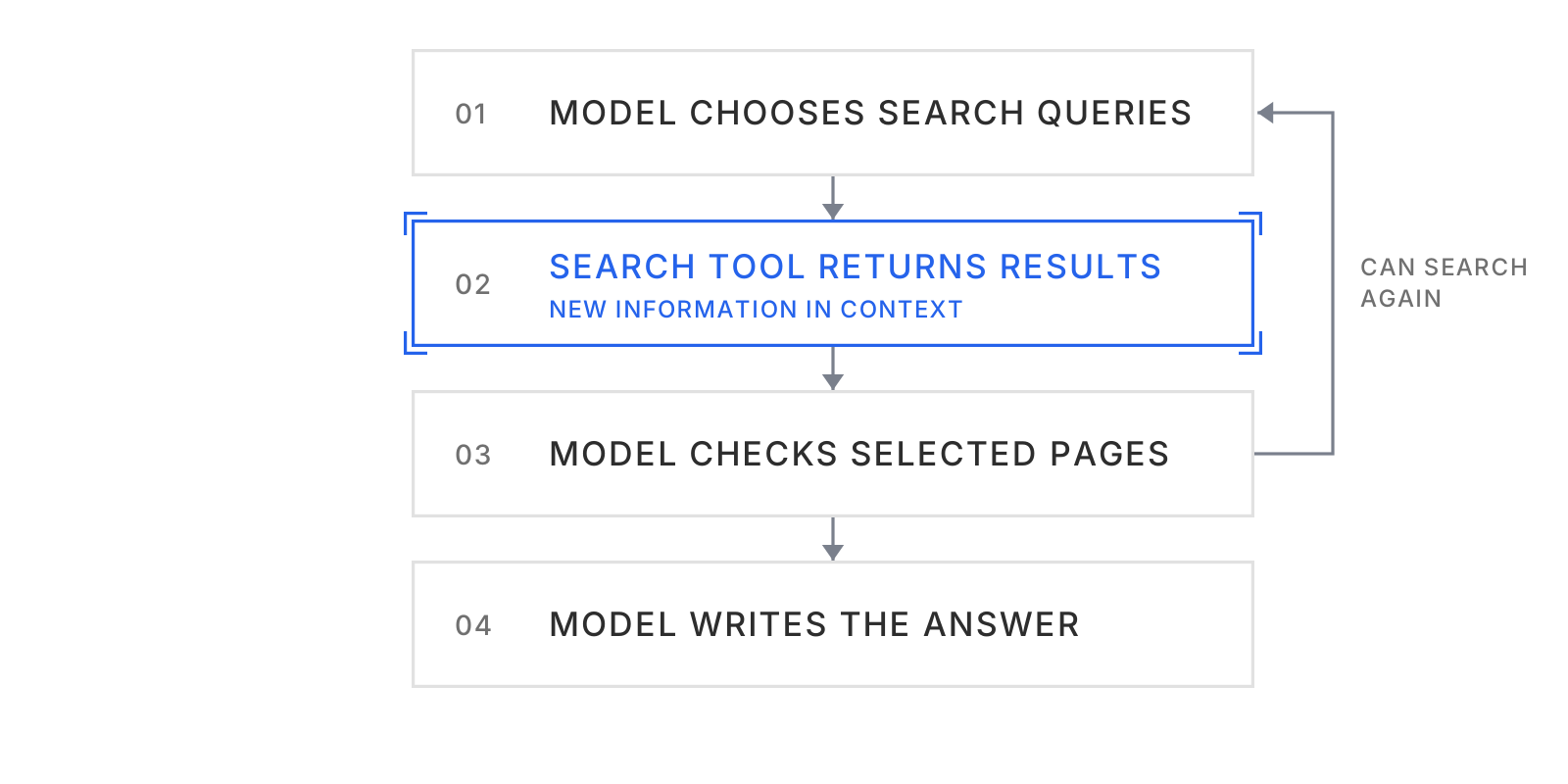
Only about 18 percent of all ChatGPT conversations trigger a web search at all, measured across more than 730,000 conversations. Everything else, the model answers out of itself.
That has an uncomfortable consequence: for these answers, what matters isn’t what’s on your website today, it’s what was said about you online at the time of training. In the short term you can’t influence that. In the medium term you can, because today’s content and mentions are the next model generation’s training data. Whoever waits to react until the gap becomes visible loses an entire cycle.
A second point worth noting: ChatGPT no longer relies mainly on Bing. Overlap with Bing fell from 26 to 8 percent, while overlap with Google rose to 33 percent. Anyone who ties their visibility to one search engine is measuring the wrong thing.
Why strong Google rankings don’t protect you
Both systems require indexing, and after that the paths diverge. Google builds its AI Overviews through a process that breaks a question into sub-questions and retrieves sources for each one. That’s why only 38 percent of cited pages now come from the top 10 of the query asked, while 31 percent sit beyond position 100.
For the German market, click losses are real on top of that. An analysis of 100 million German keywords found AI Overviews present on around 20 percent of searches, a drop in click-through rate on position one from 27 to 11 percent, and an estimated 265 million lost organic clicks per month. So visibility isn’t just disappearing in ChatGPT, it’s disappearing in the search results where you rank well too.
What actually helps
Fix the technical causes first, that’s a day’s work. After that the real task begins, and it’s made of content: a complete, sourced, current answer on your own website for every purchase-deciding question, plus presence in the sources pulled for those questions.
A measurement tool shows you the gap cleanly, it can’t close it. That’s where scaile comes in. The engine surfaces the questions at the commercial end of your funnel, researches from your knowledge base and current sources, checks every fact, and puts every article in front of your team for approval. It learns from every edit, and we explicitly recommend adding your own knowledge. Existing pieces get updated at the same URL, which serves the freshness AI systems use to pick their sources.
The free AI Visibility Check shows where you stand today. For the levers themselves with evidence, see the overview of the mechanics.
FAQ
Why does ChatGPT recommend my competitor instead of us?
Usually because they appear in the sources the system retrieves for that question, such as comparison lists and trade articles. For brand-related questions, only around 23 percent of citations come from the brand’s own website.
We rank on page one on Google, why doesn’t that help?
Because AI answers are assembled from sub-questions. Only 38 percent of cited pages sit in the top 10 of the question asked, and 31 percent sit beyond position 100.
Can I check whether ChatGPT is even allowed to fetch my site?
Yes. Check robots.txt for OAI-SearchBot, GPTBot and ChatGPT-User, then check your server logs for actual hits. The CDN often blocks these bots even when robots.txt allows them.
Has my company been penalized by ChatGPT?
Very unlikely. There’s no penalty system in the sense classic search has one. Missing mentions are almost always missing reachability, missing answers, or missing mentions elsewhere.
How long does it take before something changes?
For a tightly scoped set of questions, first movement shows up within weeks. For answers that come from the model without a search, it takes until the next model generation.
Does llms.txt help against invisibility?
No. In a study of 137,000 websites, 97 percent of these files were never fetched, and Google says it doesn’t use them.
We have fixed the technical causes. Who writes the answers?
That is the half that decides whether you get named, and it is a production problem: every buying question needs a complete, sourced, current answer on your own site, month after month. scaile runs it as managed infrastructure, with a named AI Search Strategist, research from your knowledge base, fact-checking on every claim and your team approving before publication, live in 14 days. Building Radar doubled its qualified inbound leads in 90 days on it.
Sources
- Google Search Central: AI features and your website. Indexing and snippet eligibility as requirements, query fan-out.
- OpenAI: crawler overview. OAI-SearchBot, GPTBot and ChatGPT-User.
- Ahrefs on rankings and AI citations. 38 percent of cited pages from the top 10, 31 percent beyond position 100.
- GEO: Generative Engine Optimization, Aggarwal et al., KDD 2024. Effect of evidence density, biggest effect on weaker-ranked pages.
- Omniscient Digital on where AI citations come from. 23 percent owned content for brand-related questions.
- SISTRIX on AI Overviews in Germany, February 2026, 100 million German keywords. Prevalence and click losses.
- Ahrefs on llms.txt adoption. 97 percent never fetched.
- Profound, analysis of more than 730,000 ChatGPT conversations. Share of queries triggering search and the shift from Bing to Google. Published via tryprofound.com.