The agent’s path, step by step
Every page it opened, what it read there, what it said it was doing, and the exact step where it stalled. On this page live, and in the report as a numbered list with URLs.
Free shop check
The scaile Agentic Commerce Readiness Check sends a real shopping agent to any shop and draws its path live, from robots.txt to checkout, with a deterministic score on three levels under it. It is free and needs no account.
A real agent, read-only: it opens pages, reads prices, stock, delivery and returns, and says what it is doing at every step.
The agent’s path
The three that weigh most are under “Fix these first”. Every change, with the page it was seen on, is in the report.
Page as read
/ 100
Partially ready starts at 70, Ready at 90.
01
Understood and recommended
Clear product facts, evidence, and markup that matches the page.
02
Reliably comparable
Exact variants, current prices, stock, delivery costs, returns and seller identity.
03
Able to act
Checkout, account and order surfaces an agent could use.
Nothing to fix on the pages we read
Every check passed on this page
| Check | State | What this page states |
|---|
Each check counts for as much as it matters: critical 15 points, high 8, medium 3, low 1. A failed check loses its points, a partly failed one loses half, and a check we could not verify counts for neither side. The level score is the points you kept out of the points that ran.
Building your report for …
Reading fifty product pages and your feed, rendering the PDF and sending it. This takes a couple of minutes.
Your report is on its way
Book a call with Simon to walk through what the agent found.
SimonCo-Founder and CEO
Trusted by 40+ Enterprises












Every check names the document it applies. The score is deterministic: the same shop gets the same score.
Agentic commerce means an AI assistant does the shopping. A customer asks ChatGPT, Gemini or Google for a product; the assistant reads shops, compares offers and, where a shop allows it, buys. ChatGPT shopping and Google’s shopping surfaces build those answers from two things: the product pages themselves and the merchant’s product feed.
For a product to appear there, both have to state the same facts in a form a machine can read: name, brand, identifier, price with currency, stock, delivery cost, return terms and seller. The feed specification rejects a row whose required values are omitted, empty or unrecognised, and a fact that is only visible to a human reaches neither the feed nor the crawler.
This check reads your product pages, your policies and your feed against the published rules those assistants apply, and prints what each page states, what the rule expects and what to change. The documents are listed below.
The field names, formats and rules the feed check applies: required fields, money as "79.99 EUR", the availability list, GTIN check digits, one row per variant, return fields.
The same specification as used for advertising, and the is_ads_eligible flag.
How ChatGPT selects and shows products, and where merchant data comes from.
The checkout integration the Level 3 probes look for: manifests, checkout sessions, seller policies.
The markup the Level 1 and 2 checks read: name, brand, GTIN, price, priceCurrency, availability, AggregateRating.
How delivery costs and return terms are declared per offer.
OAI-SearchBot and GPTBot, the two user agents the access check tests in robots.txt.
The agent’s full path, a score you can recompute, and the fix for every finding.
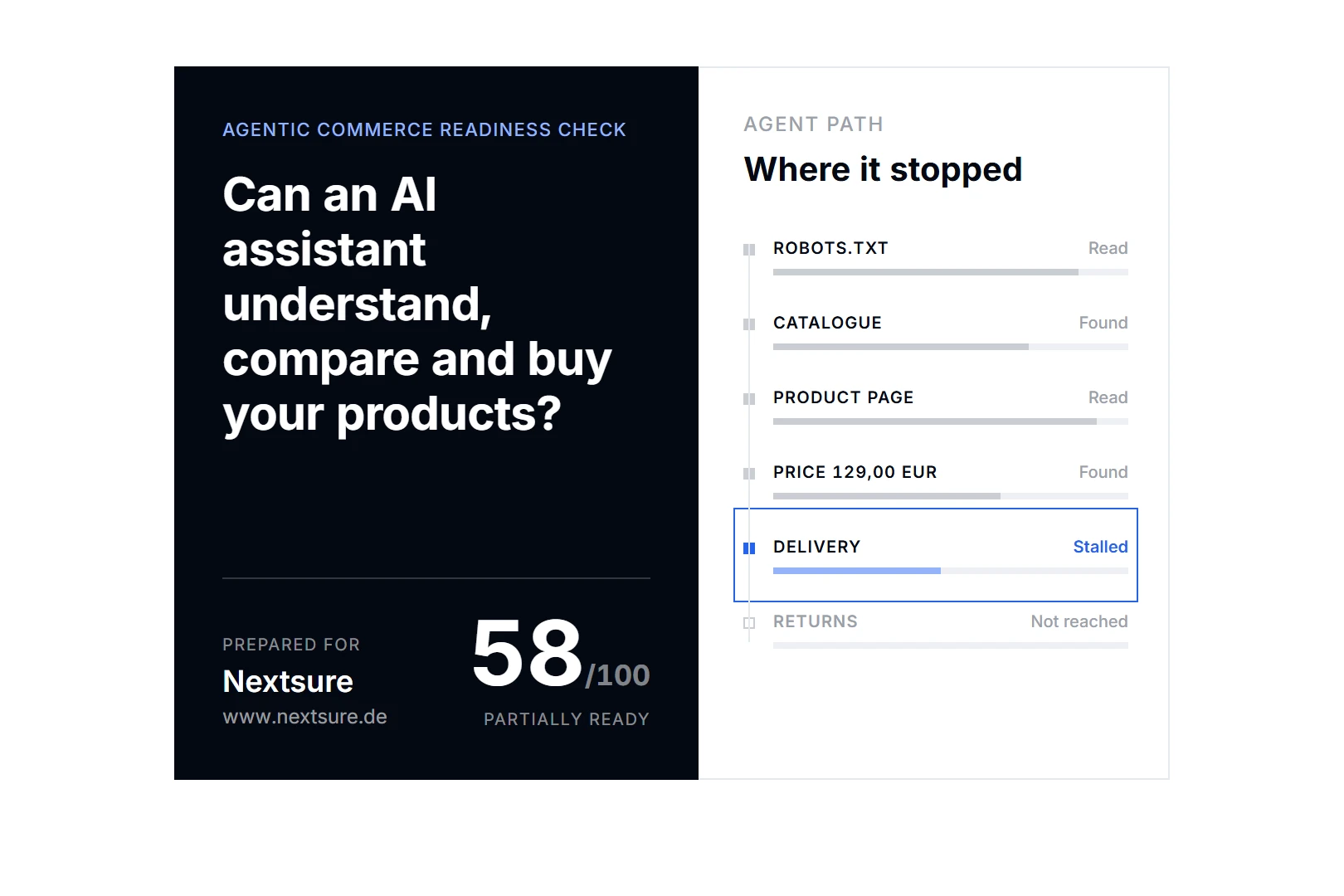
Every page it opened, what it read there, what it said it was doing, and the exact step where it stalled. On this page live, and in the report as a numbered list with URLs.
Understood and recommended, reliably comparable, able to act. Nineteen deterministic checks over fifty product pages and your feed, weighted and printed so you can recompute them.
Worst first, each with the pages it was seen on and the change that clears it: markup, prices, stock, variants, delivery, returns, seller identity, feed fields.

It starts at your homepage, reads what you sell, and is told to buy one product: find it, its price and stock, delivery cost, return terms, the seller, and a way to pay.
Each step draws on the page as it happens: robots.txt, catalogue, product page, policies, checkout. It says what it is doing before every step and where it gets stuck.
Nineteen deterministic checks run over the product pages, grounded in the OpenAI product feed specification and schema.org. The same shop gets the same score every time.
The only step that needs an email. The PDF arrives a couple of minutes later with fifty product pages, your feed validated field by field, the agent’s whole path, and every finding with its fix.
The agent is read-only, and the checks measure only the pages we opened.
What AI shopping assistants need from a shop, and why a product feed alone is not enough.
Agentic commerce is shopping where an AI assistant does part of the work for the customer: finding products that fit a need, comparing offers, and, on platforms that support it, completing the purchase. Instead of browsing like a person, the assistant reads structured data, product feeds and policy pages, and it acts through integrations a shop has to expose. Getting ready for it means making your products easy for AI to understand, evaluate and purchase, with accurate data and customer control at every step.
Level one is being understood and recommended: clear product facts, use cases, evidence and reviews, consistent across your site, feed and retailers. Level two is being reliably comparable: exact variants, current prices, stock, delivery costs, returns and seller identity, in machine-readable form, so an assistant can tell whether the offer meets the customer’s requirements. Level three is enabling the assistant to act: cart, checkout, payment and order status integrations with customer authorisation and clear responsibility for cancellations and returns. This check scores the first two and detects the third.
A feed tells an assistant what you sell, at what price, and whether it is in stock. It does not let the assistant buy. Purchasing needs a checkout integration the platform supports, a way for the customer to authorise the payment, and an agreed owner for what happens after: cancellations, returns, support. Feeds are level two work, and checkout is a separate level three project.
It is a language model with five read-only tools: read robots.txt, list product URLs, open a page, search the sitemap and the pages it has read, and check for a feed. Told to buy one product, it explains each step before taking it, and it never submits a form, adds to a cart or leaves your domain. What you watch is the path it took and the step where it could not get further.
No. The score comes from deterministic checks over your product pages: structured data present and consistent with the visible page, prices with a currency, stock declared per variant, delivery and returns declared or linked, the seller named, the feed valid. The same shop gets the same score every time. The agent’s run adds one finding per level where it stalled, with the page it stalled on.
The OpenAI product feed specification for field names, formats and rules such as money as "79.99 EUR", availability from a fixed list, valid GTIN check digits and one row per variant; schema.org Product, Offer, AggregateRating, OfferShippingDetails and MerchantReturnPolicy for on-page markup; and robots.txt directives for OAI-SearchBot and GPTBot for access.
Method last reviewed Reviewed by Simon Wilhelm, Co-Founder and CEO of scaile.
The others run on their own too. No registration, no credit card, no call required.

An instant visibility score across 103 technical, structured-data, AI-crawler and E-E-A-T checks.
See your site the way AI crawlers see it: your structure drawn as a map, with the pages they cannot reach.
See who ChatGPT, Gemini and Perplexity name when your buyers ask. Ten real buying questions, three assistants, the full leaderboard.
Need more detail? Book a Call
No. The check is free and needs no signup. An email is needed only for the PDF report.
No. It is read-only and never adds to a cart, submits a form or leaves your domain.
The agent runs for up to ninety seconds and you watch it the whole time. The report reads fifty product pages and arrives a couple of minutes after you ask for it.
Usually because a fact was not readable: no stock status in the markup, delivery costs only in a cookie-walled overlay, a product page that answers crawlers with a challenge. The step where it stalled names the page, and the checks under the path say what was missing.
Yes. The check works on any public shop and obeys that shop’s robots.txt exactly as it obeys yours.
No. Password-protected and staging environments cannot be read.
No. The Health Check scores whether your pages are built to be cited. This one asks whether an assistant could understand, compare and buy your products, and shows you an agent trying.