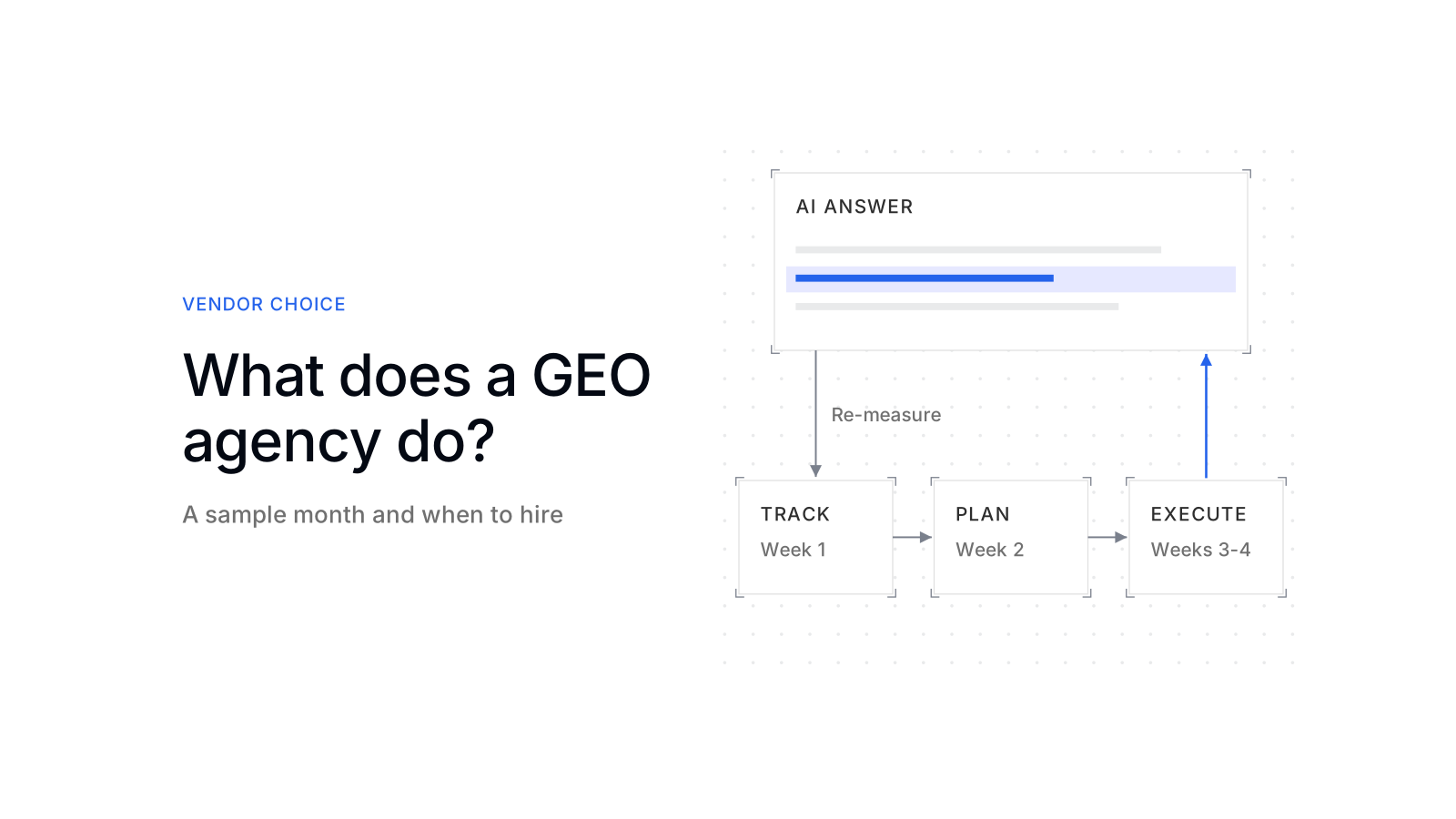
Technical GEO audit services: what a good audit delivers (2026)
In short
A technical GEO audit tells you whether ChatGPT, Perplexity, Gemini and Google AI Overviews can reach, read and attribute your website, and what to change so they can. Tools, SEO agencies and GEO specialists all sell one, and they differ most in who makes the fixes afterwards. scaile audits your site for AI search, makes the changes with your team and sets up the measurement that shows whether they worked.

Dora is a founding engineer at scaile. She studied computer science, psychology and neuroscience at TUM, which is the perfect fit for GEO: she has a deep understanding of technology and of the human side, and knows how to write and produce content that leads humans to buy and AI to show you in its answers.
Key takeaways
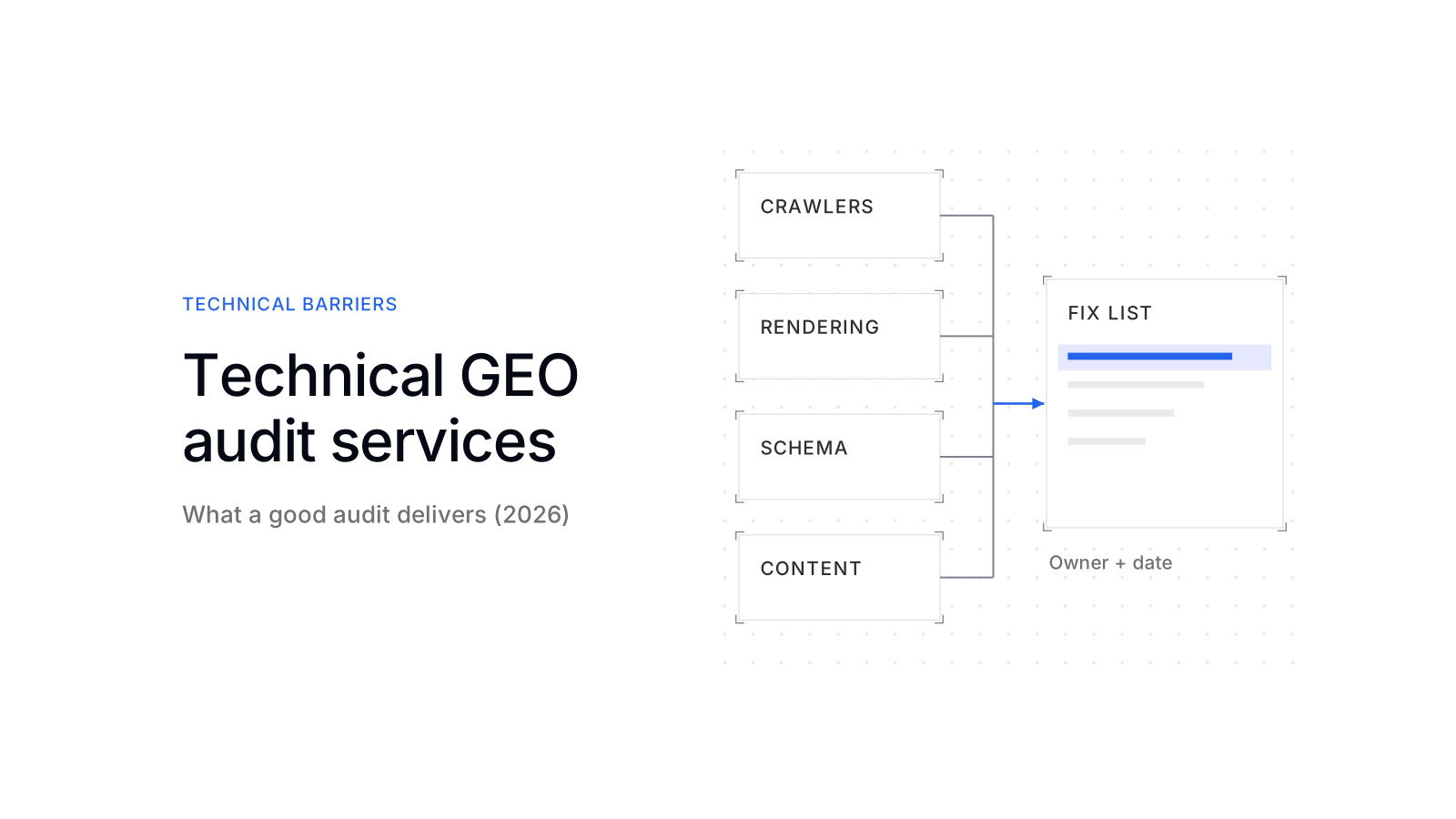
A credible technical GEO audit covers crawler access per bot, rendering, indexing, structured data, entity signals, content citability and measurement.
Blocking a training crawler and blocking a search crawler are different decisions. An audit that reports "AI bots: allowed or blocked" misses the difference.
Software tools find issues at scale. They do not decide which fix matters first or make the change.
Ask every provider who implements the fixes and how you will see the effect. A findings list alone changes nothing in AI answers.
scaile audits, implements with your team and measures, and can carry on with tracking, strategy or the full job afterwards.
What is a technical GEO audit?
A technical generative engine optimization (GEO) audit checks whether the systems behind AI answers can fetch your pages, read them and attribute them to your company. It ends in a ranked list of changes. It is narrower than a full GEO programme: it does not decide which buyer questions to win or write new content. It removes the technical reasons an AI system cannot use what is already on your site.
The cause of AI invisibility is often mundane. A line in robots.txt blocks the crawler that feeds ChatGPT search. A product page renders its text only in JavaScript. Schema on the page says something different from the visible text. A classic SEO audit, which scores you for ranking in a list of links, catches none of this. All of it decides whether an answer engine can quote you.
A technical audit is also the most contained part of GEO. Most of its findings are one-time fixes owned by whoever runs the website.
What should a technical GEO audit check?
A technical GEO audit should check seven areas, in this order, because each one only matters once the one before it passes.
Robots.txt, CDN and firewall rules, tested for each AI crawler separately. OpenAI states that sites opted out of OAI-SearchBot “will not be shown in ChatGPT search answers”, while GPTBot only collects content that may be used for model training. [1] PerplexityBot surfaces sites in Perplexity search and is not used for training foundation models. [2] Google-Extended controls Gemini training and grounding, not Google Search. [3] Detail per crawler: which AI crawlers can read your site.
Whether the content exists in the raw HTML or only after JavaScript runs. Google recommends server-side or pre-rendering because “not all bots can run JavaScript”. [4]
To appear as a supporting link in AI Overviews or AI Mode, a page must be indexed and eligible for a snippet in Google Search, with no additional technical requirements. [5] Noindex tags, nosnippet rules and canonical errors stop it here.
Whether schema exists and validates. Google’s best practices for AI features include making sure structured data matches the visible text on the page. [5]
Whether the company, its products and its authors are named consistently, with dates and bylines an engine can attribute.
Whether the pages that should answer buyer questions state the answer in text, near the top, in a form that can be quoted on its own.
Whether Search Console, GA4 and server logs can show AI referrals and AI crawler visits, so the effect of each fix is visible.
Two items often appear in audit offers and deserve less weight. llms.txt is a proposal to add a markdown file that gives language models LLM-friendly content. [6] It is worth a mention, never more important than crawler access. Page speed matters for users, but it is rarely the reason an answer engine skips a page.
What does a good GEO audit report look like?
A good GEO audit report reads like a work order: each finding names the page, the evidence, the fix, the owner and the priority. A score on its own is not a report. Here is the table of contents a buyer can hold an offer against:
- 1Scope and method
Which pages were crawled, as which user agents, and what the audit could not see (logins, consent walls, staging)
You checkThe crawl covered your money pages, not only the homepage - 2Crawler access
One row per AI crawler: allowed in robots.txt, actually reachable through the CDN, last seen in the logs
You checkSearch and training crawlers are listed separately - 3Rendering and indexing
Raw HTML against rendered page for each template, plus noindex, nosnippet and canonical findings
You checkFindings are per template, so one fix covers many pages - 4Structured data and entities
Schema found, schema missing, mismatches with visible text, author and organisation markup
You checkEach mismatch quotes both the markup and the page - 5Content citability
Which buyer questions the site answers in quotable text, and which it does not
You checkThe questions come from your buyers, not a generic list - 6Prioritised fix list
Every change with page, owner, effort and expected effect, ordered by what unblocks the most
You checkSomeone is named for each fix, and a date - 7Measurement setup
How Search Console, GA4 and logs will show the effect over the next weeks
You checkA baseline exists before the first fix ships
Who offers technical GEO audit services?
Three kinds of providers sell technical GEO audits: software tools, SEO agencies that added AI checks, and GEO specialists. They overlap on the checks and differ on what happens after the report.
Software tools run automated checks across many pages. Semrush’s AI Search Site Audit, for example, checks a site for technical issues that might prevent AI bots from crawling its content. [7] GEO tool roundups list such technical foundation audits as a standard tool feature. [8] SEO agencies extend their existing audit with an AI crawler and schema section. GEO specialists start from how the answer engines retrieve and cite, and usually implement what they find.
| Software tool | SEO agency | GEO specialist | scaile | |
|---|---|---|---|---|
| What it checks | Automated technical checks, often hundreds of pages | Classic SEO audit plus an AI section | Crawler access, rendering, schema, entities, citability | Crawler access, indexing, structured data, content structure, authorship |
| Who decides priorities | You | The agency | The specialist | A human strategist with your team |
| Who implements | You | Often you, sometimes the agency | Varies by provider | scaile, with your team |
| Measurement after the fixes | Re-run the tool | Usually SEO reporting | Varies by provider | Search Console, GA4, AI traffic and AI crawler visits |
| What you get | A dashboard and issue list | A report and a call | A report, often with implementation | Changes live on your site and the setup to measure them |
The third row separates them. If the answer is “you”, budget developer and SEO time for the list: that is where the cost of a cheap audit sits.
Which questions should you ask a GEO audit provider?
Ask five questions before you sign, and expect concrete answers to each.
- Which AI crawlers do you test, and do you test them through our CDN? A robots.txt check alone misses the firewall rule that blocks a bot the file allows.
- Do you compare raw and rendered HTML per template? If not, JavaScript problems stay invisible.
- What does the report look like? Ask for an anonymised sample. If it is a score with generic advice, the work order is yours to write.
- Who implements the fixes, and in which system? Name the CMS, the developer and the timeline.
- How will we see the effect? The answer should name the data sources (Search Console, GA4, crawler logs) and a baseline taken before the first change. Measurement has limits: AI referrals are only partly visible in analytics, and a good provider says so.
Broader agency selection, beyond the audit, is covered in the best GEO agencies in 2026, scored.
Red flags in a GEO audit offer
The clearest red flags are promises nobody can keep and checks nobody needs.
Guarantees a position or a citation in ChatGPT, sells special “AI Overview markup”, or reports AI bots as one yes or no
Tests each crawler separately, shows raw against rendered HTML, names an owner for every fix and sets a baseline before the first change
A guarantee is the first one to rule out. AI answers are generated fresh for each question, so there is no fixed position to promise. “AI Overview markup” is the second: Google states there are no additional technical requirements to appear in AI Overviews or AI Mode beyond being indexed and eligible for a snippet. [5] A third: an audit that ranks llms.txt above crawler access, or a report so long that nothing in it has an owner.
Be wary, too, of an audit that stops at the homepage. Free scanners, including scaile’s own, read the homepage, robots.txt and sitemap and say what they cannot see. That is a starting point, not an audit of your product and article templates.
The technical audit is the part of GEO with the clearest return. Once the crawlers can read your pages, everything you publish has a chance to be cited. Pick the provider by who makes the changes and how you will see the effect, not by the length of the report. Book a technical GEO audit of your site with scaile: Website GEO Audit & Setup, with a human strategist and your team.
FAQ
What should a technical GEO audit of a website check, and who offers one?
It should check AI crawler access per bot, rendering, indexing and snippet eligibility, structured data, entity and authorship signals, content citability and measurement. Software tools, SEO agencies and GEO specialists offer it; they differ in who implements the fixes.
What is an SEO audit and what does it include?
A classic SEO audit checks how well a site can rank in search results: crawlability, indexing, speed, titles, internal links and backlinks. A technical GEO audit shares the crawl and index foundation and adds what answer engines need: access for each AI crawler, rendered text, structured data that matches the page and content that can be quoted.
How much does a website GEO audit cost?
Prices depend on site size, the number of templates and whether implementation is included. An automated tool costs a monthly subscription; an audit with implementation is quoted per project. Compare offers on what is delivered and who makes the changes, not on the headline price. scaile discusses pricing on a call.
How long does a technical GEO audit take?
The checks are the short part. The time goes into the fixes: a robots.txt or CDN rule can change in an hour, while a rendering fix across templates is a development task. OpenAI notes that a robots.txt change can take about 24 hours to reach ChatGPT search.
Is a free AI visibility check enough?
A free check is enough to find blocking problems on the homepage, robots.txt and sitemap. It cannot judge your product and article templates or whether your pages answer your buyers’ questions. Use it to decide whether a full audit is needed.
Sources
- Overview of OpenAI Crawlers
- Perplexity Crawlers - Perplexity
- Google’s common crawlers | Google Crawling Infrastructure | Crawling infrastructure | Google for Developers
- Understand JavaScript SEO Basics | Google Search Central | Documentation | Google for Developers
- AI Features and Your Website | Google Search Central | Documentation | Google for Developers
- The /llms.txt file, v2 – llms-txt
- AI Visibility Toolkit: Boost Brand Visibility in AI Search
- Top 6 GEO Tools for Monitoring Your Brand on AI Platforms - Genrank