How to appear in Google AI Overviews
In short
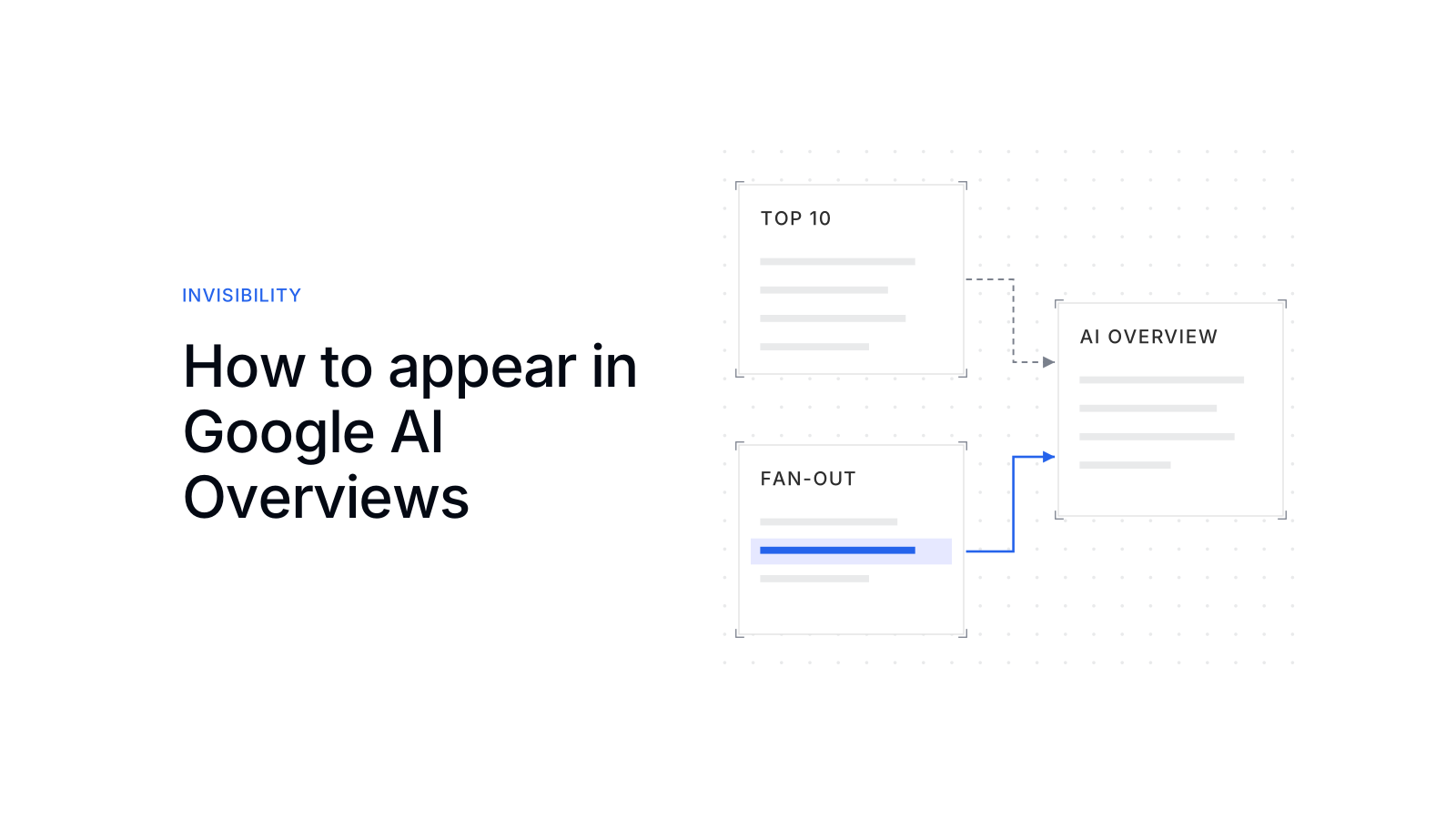
Google can cite any indexed page that is eligible to show with a snippet. The citation does not automatically go to position 1, but to the page that answers one of the sub-questions Google searches in the background. scaile therefore writes articles so that every sub-question gets its own answer that can be quoted on its own, and measures which pages Google actually cites.

Dora is a founding engineer at scaile. She studied computer science, psychology and neuroscience at TUM, which is the perfect fit for GEO: she has a deep understanding of technology and of the human side, and knows how to write and produce content that leads humans to buy and AI to show you in its answers.
Key takeaways
Google sets one entry rule for AI Overviews: the page is indexed and eligible to show with a snippet. No special schema, no AI text file.
The citation goes to whoever answers the sub-questions Google searches in the background, not automatically to position 1. In scaile's measurement of 183 buyer questions on Google US, 242 of 554 cited pages sat outside the top 10.
That is how scaile writes articles for AI Overviews: every sub-question gets its own heading, the answer sits in the first sentence below it, with the number or condition in the same paragraph. Google can then take the passage without the rest of the page.
Every article brings evidence other pages lack: own data, cases and sources. Where a question is practical, a short video adds a second page Google can cite.
Search Console counts AI Overview traffic inside the Web search type, so scaile tracks for every question which pages the answer cites.
How do you appear in Google AI Overviews?
You appear in Google AI Overviews when one of your pages is indexed, can show with a snippet, and answers a search Google runs while it builds the answer. Google’s documentation names the first two as the only technical requirements. [1] The third is where SEO teams win or lose. Google says AI Overviews may issue “multiple related searches across subtopics and data sources” to develop a response, a technique it calls query fan-out. [1] Your page competes for those related searches, not only for the question the person typed.
So a ranking report tells only half the story. A page outside the top 10 can still be cited if it answers one sub-question better than anything on page one.
The practical consequence for an SEO team: plan for the sub-questions behind each buyer question, not only for the typed query. Give each one a passage on your site that can be quoted on its own.
What does Google require to show a page in AI Overviews?
Google requires an indexed page that is eligible to show in Search with a snippet. Beyond that, “there are no additional technical requirements.” [1] The same page lists what you do not need:
Indexing, snippet eligibility and the normal Search technical requirements: crawling allowed in robots.txt and by your CDN, important content in text form, and structured data that matches the visible text. [1]
New machine-readable files, AI text files or special markup. “There’s also no special schema.org structured data that you need to add.” [1]
Two of Google’s points bear directly on AI Overviews. The first is snippet control. Google says more restrictive preview settings “will limit how your content is featured in our AI experiences.” [2] Google’s robots documentation says max-snippet also limits how much of a page may be used as a direct input for AI Overviews and AI Mode. [3] A value set years ago for design reasons now caps what an AI Overview can quote. The second is the content itself. Google asks for “unique, non-commodity content that visitors from Search and your own readers will find helpful and satisfying.” [2] A page that repeats what ten others say gives the answer nothing to cite it for.
If you use schema, keep it accurate rather than adding more of it; the schema validation checklist covers how to check it.
Do you need a top 10 ranking to be cited in an AI Overview?
No, but it remains the best single place to be. The share of cited pages that also rank in the top 10 for the same query fell sharply between Ahrefs’ two studies. In between, in January 2026, Google moved AI Overviews to Gemini 3. [4] Three measurements show the range:
| Measurement | Sample | Cited pages in the top 10 for the same query |
|---|---|---|
| Ahrefs, 2025 | 1.9M citations from 1M AI Overviews [5] | 76.10% [5] |
| Ahrefs, 2 March 2026 | 863K keyword SERPs, 4M AI Overview URLs [4] | 37.9% [4] |
| scaile, 6 November 2026, Google US | 183 buyer questions, 554 cited pages | 56% (312 of 554) |
| scaile, 6 November 2026, Google Germany | 62 buyer questions in German, 145 cited pages | 63% (91 of 145) |
Ahrefs reads its own drop as Google “selecting far fewer pages straight from the original SERP” and relying more on the fan-out searches. [4] Ahrefs sells an AI visibility tool, so treat its numbers as one vendor’s data set, measured on keywords.
scaile’s measurement used a different input: the non-branded questions scaile tracks for its own website. They are full sentences a buyer would type, run in English on Google US and in German on Google Germany, on desktop. An AI Overview appeared on 176 of 183 US questions and 59 of 62 German ones. In the US, 62 of 176 AI Overviews cited the page ranked first. Yet 34 of them cited no page from the top 10 at all.

The limits are real: one day, one run per question, one topic area, and pages matched by their titles because Google wraps most result links in redirects. A title Google rewrote counts as a miss, so 56% is a floor. Full questions also sit closer to what fan-out searches look like than short keywords do, which may explain why the share lands between Ahrefs’ two figures.
Where the other AI Overview citations come from
The other citations come from pages that rank for a related search rather than the typed one, and from platforms the top 10 rarely shows. Google describes the first route itself: fan-out searches run “across subtopics and data sources.” [1] A question like “how do I measure AI visibility” can fan out into searches on tracking tools, Search Console reports and attribution. The cited pages come from those result lists.

The second route is video and discussion. In scaile’s US data, 68 of the 410 citations with a readable domain went to YouTube, 29 to Reddit and 29 to LinkedIn. Ahrefs found YouTube URLs made up 5.6% of all AI Overview citations in its 2026 data set. [4] For a B2B team, a video that answers a buyer question is part of AI Overview work, not a separate social task. So is an expert post that names your method.
The levers that apply to every AI answer engine, from crawler access to evidence density, are covered in how to get cited in AI answers. The steps below are the ones specific to Google.
How do you write pages that AI Overviews cite?
You write pages that answer the sub-questions of a buyer question in passages Google can lift without the rest of the page. Five steps turn that into a routine:
- 1Map the question
Take one buyer question and list the sub-questions an answer needs: the definition, the options, the cost, the risks, the next step. Search each one and note who ranks.
Your partDecide which questions are worth winning - 2Answer each sub-question in one passage
Put the answer in the first sentence under a heading that asks the sub-question, with the number or condition in the same paragraph.
Your partSupply the facts only your company knows - 3Add evidence the others lack
Statistics, sources and quotations are among the methods tested in the research paper that named generative engine optimization (GEO). It reports visibility gains of up to 40% in generative engine responses, varying by domain. [6] That study did not measure AI Overviews, so test it on your own questions.
Your partShare your own data and cases - 4Cover the formats Google cites
Where a question is visual or practical, a short video that answers it gives Google a second page to cite.
Your partFilm the answer with your expert - 5Check the snippet settings
Remove
nosnippetand tightmax-snippetvalues from pages you want quoted.Your partApprove the template change
Step 2 is the one SEO teams skip most. A page written for a head term often answers its sub-questions halfway down a long paragraph. Move each answer to the top of its section, where it can be lifted on its own.
How do you check whether you already appear in AI Overviews?
You check by tracking a fixed set of buyer questions over time and recording which pages each AI Overview cites, because Search Console does not separate them. Google states that traffic from AI features is counted in the Performance report “within the ‘Web’ search type.” [1] Clicks and impressions from an AI Overview land in the same totals as blue-link traffic.
A single manual search is not a measurement either. Google says AI Overviews “may use different models and techniques, so the set of responses and links they show will vary.” [1] Track the same questions on a schedule, in the market and language you sell in. Count how often your pages are cited, and which pages win when yours are not. Which questions belong in that set is covered in which prompts to track.
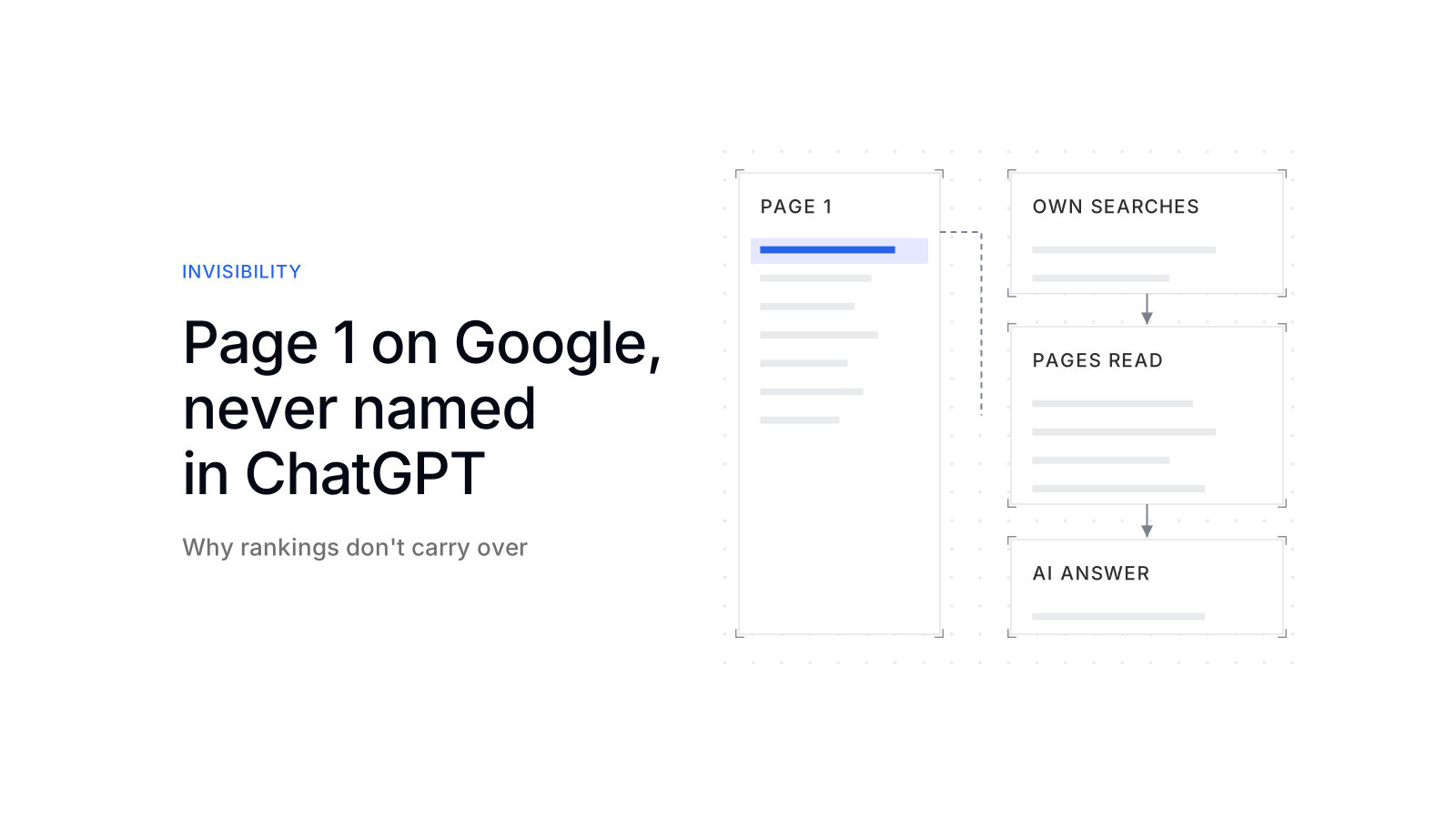
Google AI Overviews also behave differently from ChatGPT, which runs its own searches and barely reads Google’s results. Why page 1 on Google does not carry into ChatGPT explains the gap. Track the engines separately and compare them per question.
Appearing in Google AI Overviews comes down to three things you control. You need a page Google can index and quote, a passage for each sub-question, and a measurement of which pages are cited. If your SEO team wants to keep execution in-house, with a strategist who maps the fan-out questions and tracks AI Overviews, talk to scaile about Strategy with you.
FAQ
Can you keep your content out of AI Overviews?
Yes. Google’s nosnippet rule applies to AI Overviews and AI Mode and also stops the content from being used as a direct input for them. noindex removes the page from Search entirely.
Does AI Mode follow the same rules as AI Overviews?
Google applies the same requirement to both: an indexed page that can show with a snippet. Both may use query fan-out, so the same sub-question passages serve both.
Do AI Overviews show for every search?
No. Google shows them only when it considers them additive and says they often don’t trigger. Full buyer questions trigger them far more often: in scaile’s measurement, 96% of the US questions showed one.
Sources
- AI Features and Your Website | Google Search Central | Documentation | Google for Developers
- Top ways to ensure your content performs well in Google’s AI experiences on Search | Google Search Central Blo
- Robots Meta Tags Specifications | Google Search Central | Documentation | Google for Developers
- Update: 38% of AI Overview Citations Pull From The Top 10
- 76% of AI Overview Citations Pull From the Top 10
- 2311.09735 GEO: Generative Engine Optimization