We rank on page 1 of Google, but ChatGPT never mentions us. Why?
In short
ChatGPT does not read Google's page 1. It runs its own searches: in 80 answers scaile measured, 3.5% of cited pages ranked on page 1 for them. scaile's Managed GEO covers SEO and AI search in one plan.

Dora is a founding engineer at scaile. She studied computer science, psychology and neuroscience at TUM, which is the perfect fit for GEO: she has a deep understanding of technology and of the human side, and knows how to write and produce content that leads humans to buy and AI to show you in its answers.
Key takeaways
ChatGPT writes its own searches and reads its own results. Only 1.6% of those results were also on Google's page 1 for the same search.
A ranking does not become a mention: 61 of 76 ChatGPT answers cited no page from Google's page 1 for the searches ChatGPT ran.
Google's AI Overviews behave differently. There, 76% of cited pages rank in Google's top 10, so your SEO keeps paying off.
Measure ChatGPT per buyer question: which searches it runs, which pages it cites, and whether your brand is on them.
Why doesn’t ranking on page 1 of Google get us mentioned in ChatGPT?
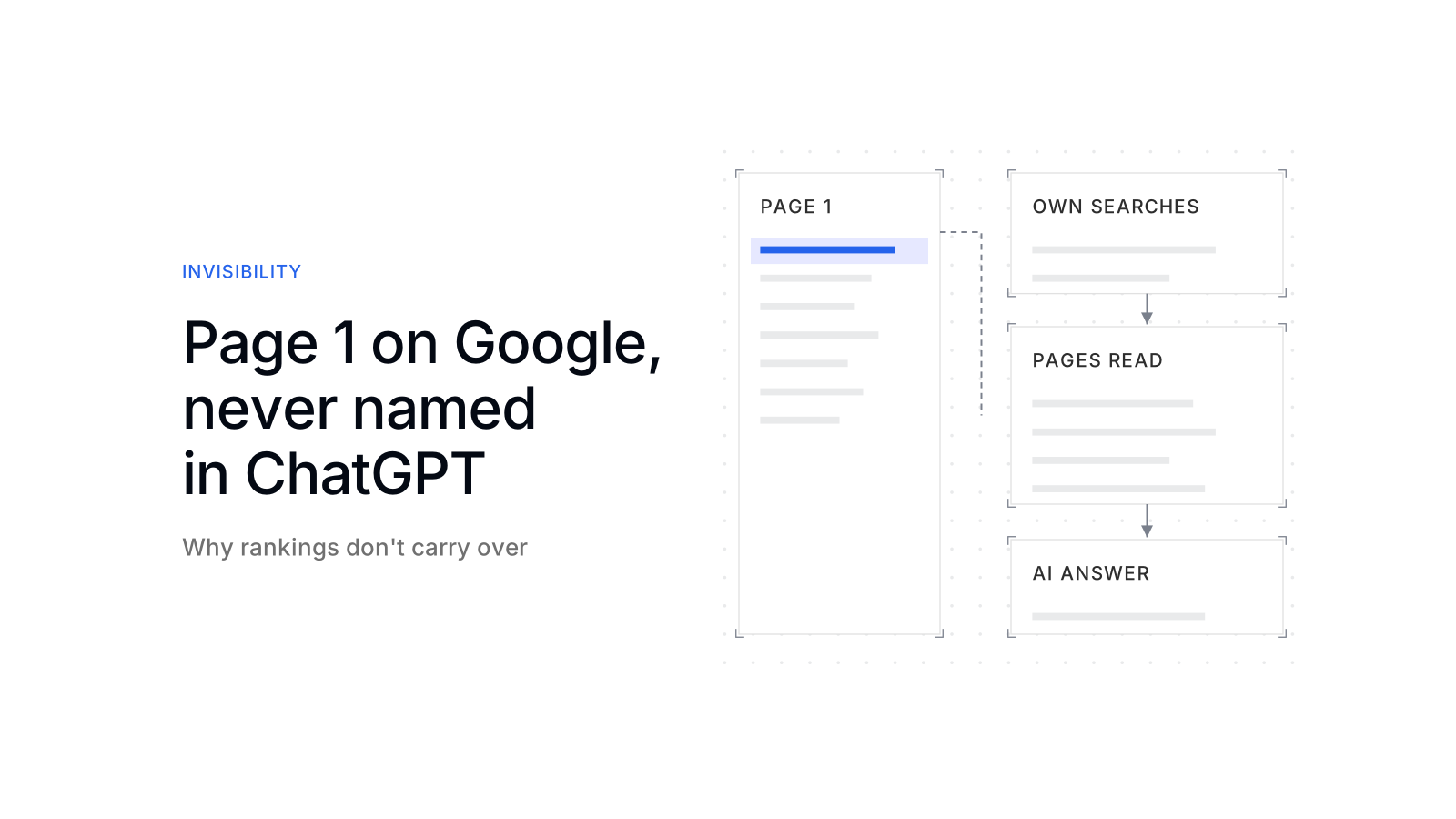
Because ChatGPT does not look at Google’s results page. When it searches, it rewrites your buyer’s question into its own queries, runs them through its own search, reads a handful of pages and names the brands those pages name. Your ranking is a position on Google’s list. ChatGPT’s answer is built from a different list.
Ahrefs puts the first step plainly: AI assistants may never search for the prompt the user typed; the prompt only triggers other searches. [1] The last step decides the mention. In one study of ChatGPT’s software recommendations, at least 92.7% of the brands it recommended were named in the content it cited. [2] So the useful question for an SEO team is not “do we rank?” but “are we on the pages ChatGPT reads for this question?”

If ChatGPT never names you for any question, check the general causes first, from blocked crawlers to missing answers, in why ChatGPT doesn’t mention your company. This article is about the narrower case: the rankings are there, the mentions are not.
How often does ChatGPT cite pages from Google’s page 1?
Rarely. scaile took 80 ChatGPT answers, drawn at random from the non-branded questions it tracks for its own website, measured on 2 November 2026 with location Germany and language English. For every question, and for every search ChatGPT ran to answer it, scaile then pulled Google’s top 10 for Germany in English and compared the pages URL by URL. Some of ChatGPT’s longest searches return no Google results at all; four answers had no Google page 1 to compare and are left out.
- 3.5% of the pages ChatGPT cited (18 of 517) ranked on Google’s page 1 for any of the searches ChatGPT itself ran.
- 0.7% of the cited pages (3 of 446) ranked on page 1 for the question as the buyer typed it.
- 1.4% of Google’s page-1 results for ChatGPT’s own searches (18 of 1,311) were cited.
- 61 of 76 answers cited no page at all from those Google page 1s.

One example from the sample: asked how much generative engine optimization (GEO) costs, ChatGPT searched for “generative engine optimization GEO agency pricing cost monthly retainer 2026” and one more query. It cited four agency pages. None of them ranked on Google’s first page for either search.
The numbers fit an independent, larger study. Ahrefs asked ChatGPT, Gemini and Copilot 15,000 long-tail questions and found that on average only 12% of the links they cited appeared in Google’s top 10 for the same prompt. [1] scaile’s sample is smaller and narrower: one set of questions about GEO and marketing, one run per question, one market, and Google checked three days after ChatGPT answered. Read the percentages as the size of the gap, not as a constant.
What is the difference between ranking on Google and being named by ChatGPT?
The two systems answer the same buyer question with different inputs, and four of them matter for an SEO team:
Google ranks you for what a person types. ChatGPT writes its own searches: 184 of them for the 80 answers in scaile’s sample, with a median length of 12 words, like the one in the example above.
ChatGPT’s search returns its own list. Only 22 of the 1,346 results it returned (1.6%) were also on Google’s page 1 for the same search string.
Google ranks one page per result. ChatGPT cited 541 pages across the 80 answers, about seven per answer.
A ranking is a position your page holds. A mention is your name inside the answer, and it can come from someone else’s page as easily as from yours.
Some of the groundwork carries over. Sites opted out of OpenAI’s search crawler are not shown in ChatGPT search answers. [3] A clear page that answers one question well helps in both systems. What does not carry over is the position itself. Where the two disciplines overlap and where they split is laid out in GEO vs SEO.
Does ChatGPT’s knowledge cutoff explain why our brand is missing?
Only for answers ChatGPT gives without searching. A model’s trained knowledge ends where its training data ends. OpenAI’s GPTBot crawls content that may be used in training its generative AI foundation models. [3] When ChatGPT searches, the pages it retrieves are placed into the model’s context for that answer, which OpenAI calls in-context memory. [4] Those answers can draw on pages published after the cutoff.
A quick way to tell the two cases apart: an answer that shows sources searched the web, and for that answer the cutoff is not your problem. Every one of the 80 answers in scaile’s sample cited sources. What happens between the question and the cited sources, step by step, is described in how OpenAI ChatGPT search works.
Do Google AI Overviews, Perplexity and Gemini work the same way?
No. How much your Google ranking counts depends on the engine, and Google’s own AI answers sit at the other end of the scale from ChatGPT:
| Engine | Cited pages that rank in Google’s top 10 | What it means for your rankings |
|---|---|---|
| Google AI Overviews | 76.10%, in 1.9 million citations [5] | Rankings count a lot: a page must be indexed and eligible for a snippet [6] |
| Perplexity | 28.6%, in 15,000 prompts [1] | Rankings help; Perplexity runs its own index |
| ChatGPT, Gemini, Copilot | around 8%, in the same 15,000 prompts | Rankings help little; most citations do not rank for the query |
Google also uses query fan-out in AI Overviews and AI Mode, issuing several related searches across subtopics for one answer. [6] The difference is that those searches run in Google Search, where your rankings live. For a Head of SEO that means two scorecards: rankings and AI Overviews move together, ChatGPT needs its own measurement.
Where an SEO team starts: the pages ChatGPT reads for your questions
Start from the questions where you already rank, and find out what ChatGPT reads instead of your page:
- 1Turn page-1 keywords into buyer questions
Take the keywords closest to a purchase and write each as the question a buyer would ask ChatGPT, without your brand name.
Your partSearch Console queries and the questions sales hears - 2Record what ChatGPT cites
Ask each question several times in a fresh session and write down every cited page, and whether your brand is named on it.
Your partThe same wording every time - 3Compare the cited pages with your page
Check what the cited pages answer that your ranking page does not: a price range, a comparison, a number, a named use case.
Your partDecide which gaps your page can close truthfully - 4Change your page and get onto theirs
Add the missing answer to your page, and work on being named on the third-party pages ChatGPT keeps citing.
Your partFacts, data and approvals - 5Measure again, question by question
Answers vary from run to run, [7] so compare shares over many runs, not one screenshot.
Your partReview the report
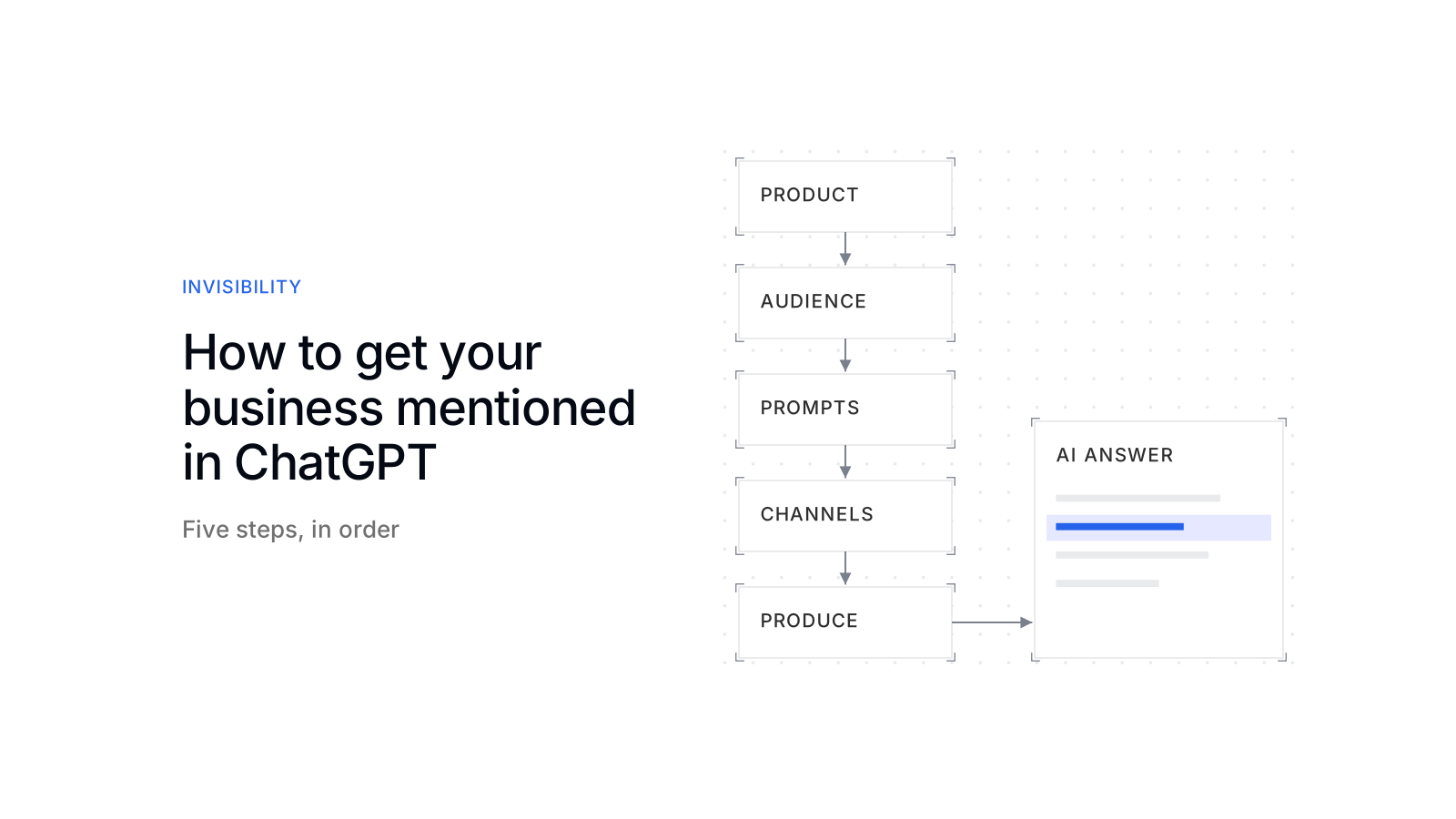
The places ChatGPT looks beyond your own site are covered in how to get your business mentioned in ChatGPT. When a competitor takes your place, read why ChatGPT recommends your competitor. For a first look at your own questions, scaile’s free AI Visibility Check shows who ChatGPT, Gemini and Perplexity name.
Page 1 on Google is a real asset, and ChatGPT barely looks at it. It answers from its own searches and its own results, and in scaile’s sample 3.5% of the pages it cited came from Google’s page 1 for those searches. Keep the SEO, and measure ChatGPT per buyer question until you know which pages it reads instead of yours. To see those searches and cited pages for your own questions, talk to scaile about Track. scaile finds the buyer questions with you and tracks the answers and their sources in its own platform. scaile optimizes for each AI system differently, because ChatGPT, Gemini, Perplexity and Google AI Overviews do not search and cite the same way. And when the models change, scaile stays on top of it.
FAQ
If ChatGPT ignores our rankings, should we cut the SEO budget?
No. Rankings still carry Google’s own results and its AI Overviews. GEO adds a second measurement for the assistants that read other pages; it does not replace SEO.
Does blocking GPTBot keep us out of ChatGPT search?
No. GPTBot collects training data. ChatGPT search uses a different crawler, OAI-SearchBot. Check both in robots.txt and at your CDN, as the guide to AI crawler access explains.
Sources
- Only 12% of AI Cited URLs Rank in Google’s Top 10 for the Original Prompt
- How much can you influence which brands ChatGPT recommends?
- Overview of OpenAI Crawlers
- Optimizing LLM Accuracy | OpenAI API
- 76% of AI Overview Citations Pull From the Top 10
- AI Features and Your Website | Google Search Central | Documentation | Google for Developers
- NEW Research: AIs are highly inconsistent when recommending brands or products; marketers should take care whe