What a major Google update would mean for GEO
In short
On October 1, Google rewrote two documentation pages: AI content should be fact-checked by hand, and fake author profiles count as deception. Google hasn't announced an update, but experts expect one against scaled AI content and GEO tricks. Here is what changed, what the rater guidelines actually say, and what it would mean for GEO.

Key takeaways
On October 1, Google rewrote two documentation pages. AI content should be fact-checked by hand, and fake author profiles count as deception.
AI itself is not the problem. Google's rater guidelines give the lowest rating to pages without effort, originality or added value, however they were made.
Google hasn't announced an update. Experts like Lily Ray expect one against scaled AI content and GEO tricks. Content with own data and real authors looks like the safer bet either way.
What Google changed on October 1
On October 1, Google changed two pages of its Search documentation. The first is its guide on using generative AI content.
It now says: “It is critical to manually factcheck and review all AI-generated content for accuracy and trustworthiness before publishing.” This also applies to titles, meta descriptions, structured data and image alt text. Google also recommends telling readers how a piece of content was created.
According to Google’s changelog, the guide now includes “information from the Search Quality Raters guidelines”. These guidelines (current version: September 11, 2025) tell Google’s human raters how to judge page quality. Their ratings don’t change rankings directly. Google uses them to check whether its algorithms work as intended.
So what do the guidelines say about AI? They don’t call AI content deceptive in itself. What they call deceptive is lying about who made it.
Section 4.5.3 lists examples of deceptive information about a website. One of them is fake creator profiles: “For example, AI generated content with made up “author” profiles (AI generated images or deceptive creator descriptions) in order to make it appear that the content is written by people.” In the same list, false claims of expertise count as deceptive too, for example an author profile that falsely claims to be a medical professional.
The second page Google changed on October 1, Creating helpful content, now says the same: fabricated creator profiles are “a form of deception” and a “signal of a low-quality page.”
What the rater guidelines say about AI content
- The lowest rating applies only if all or almost all of the main content is copied, paraphrased, embedded, auto- or AI-generated, or reposted, and it shows little to no effort, little to no originality and little to no added value (section 4.6.6).
- AI alone doesn’t decide: “the use of Generative AI tools alone does not determine the level of effort or Page Quality rating.”
- Pages made at scale with no original content or added value get the lowest rating “no matter how they are created” (section 4.6.5, scaled content abuse).
What this looks like in practice
The guidelines show real pages that raters should give the lowest rating. Four of them involve AI. The first two mislead readers about who is behind them, the last two show almost no effort:
- A parenting site that isn’t one. An article on switching babies to whole milk. The terms of use reveal AI-written articles meant for “AI enthusiasts”, not parents (p. 46).
- A rabbit blog writing about tumors. A site run by “rabbit lovers and breeders” publishes templated health Q&As, here on ovarian tumors. Deceptive and paraphrased (p. 55).
- An unedited AI answer. A cancer article starts with “As a language model, I don’t have real-time data…” and breaks off mid-sentence (p. 55).
- A chicken FAQ. Repetitive questions like “Is 40 degrees too cold for chickens?”, with answers that don’t fit together. No sign of a human editor (p. 58).
The rabbit blog and the chicken FAQ follow the same pattern. According to the guidelines, Q&A articles like these are a common way to produce scaled content: collect questions from sources such as Google’s “People also ask” and answer them with unoriginal, paraphrased text, often using generative AI. The FAQ format is not the problem. FAQs without original answers are.
Is a major update coming?
The documentation changes are not the only signal. At Search Central Live in Barcelona, Gary Illyes, analyst at Google, warned that scaled content is becoming more of a problem than link spam. That’s according to a recap by John Campbell, reported by Search Engine Roundtable. Google has also run four spam updates in 2026, compared to one in all of 2025, and the gaps keep shrinking: 92, 55, then 37 days. The latest started September 24 (Status Dashboard).
SEO consultant Lily Ray reads this as the run-up to a major update: “a matter of when, not if.” She gives no date. Her main argument is a pattern. Google has often changed its documentation shortly before big updates. Rater guideline changes came 12 days before the Medic update in 2018, and a spam policy clarification came six days before the May 2026 core update. She expects the update to target scaled AI content without human review, invented author personas, templated pages, and GEO tactics such as self-promotional “best of” listicles, paid mentions and automated Reddit posts.
Her own data suggests Google’s AI already reacts to one of these tactics. Across 100 “best B2B software” queries, brands that ranked themselves #1 in their own listicle were left out of the AI Overview’s actual recommendation 83% of the time in September, up from 69% in June. This is one analysis, not proof. But it shows that being cited and being recommended are not the same.
Our take: the direction is clear. Content that adds something new should win. Content that uses AI to rewrite what already exists should lose.
How this would influence GEO
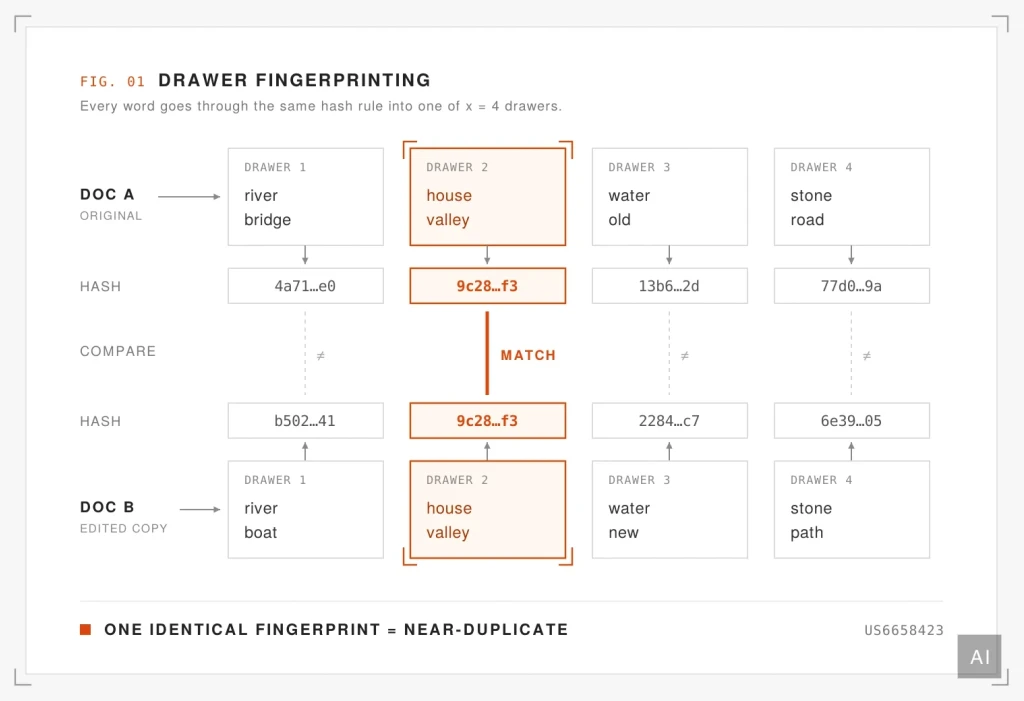
How does Google spot copied content? A Google patent from 2001 shows the basic idea. A hash function sorts the words of a page into a few “drawers”, and each drawer gets a fingerprint. If two pages share one fingerprint, they count as near-duplicates. Change a few words, and most drawers still match.

Google filed follow-up patents until 2008. None is active today, and how Google detects duplicates now isn’t public. Google says it increasingly uses AI to catch spam.
So rewording won’t help. The patent itself describes finding synonyms through the words around them, and the rater guidelines call “synonymizing” a form of scaled content abuse. Paraphrased content counts as copied, whether a person or an AI rewrote it.
What this means for GEO:
- Copies lose. Pages that only repeat what others already say, in new words, are likely to lose visibility in Google and in AI answers.
- Own substance wins. Own data, own tests, real cases and real authors give AI systems a reason to pick your page.
- Self-promotion backfires. In Lily Ray’s data, a brand’s own “best of” list mostly helped its competitors: in 70% of cases, the AI Overview recommended others from the list and left the publisher out.
Stepping up the game
Google hasn’t announced an update, and it may not come in the form people expect. But if you look at the direction of the recent changes, a few steps are worth considering now. And none of them hurts if no update comes ;)
- Review AI texts by hand. Google’s guide now calls fact-checking “critical”, including titles, meta descriptions, structured data and alt text.
- Use real authors. Real names and real credentials. If no single person wrote a piece, an honest team byline may be better than an invented persona.
- Consider saying how content was made. Google recommends this where readers would expect it. It doesn’t require it.
- Look at what you published at scale. Templated or AI pages that add nothing new could be improved, merged or removed.
- Build FAQs from real questions. Questions people actually ask, answered with something only you can add: own data, a test, a real case.
- Rethink self-ranking. Lily Ray expects “best of” lists with the publisher at #1 and paid mentions to be among the targets. Her data suggests they already help competitors more than the publisher.
What we don’t know yet: Google has not announced an update, and its timing and targets are open. Whether Google still uses the 2001 patent is not public. Lily Ray’s listicle numbers come from one analysis of 100 B2B software queries.