Branded or unbranded prompts: which to track and how to group them
In short
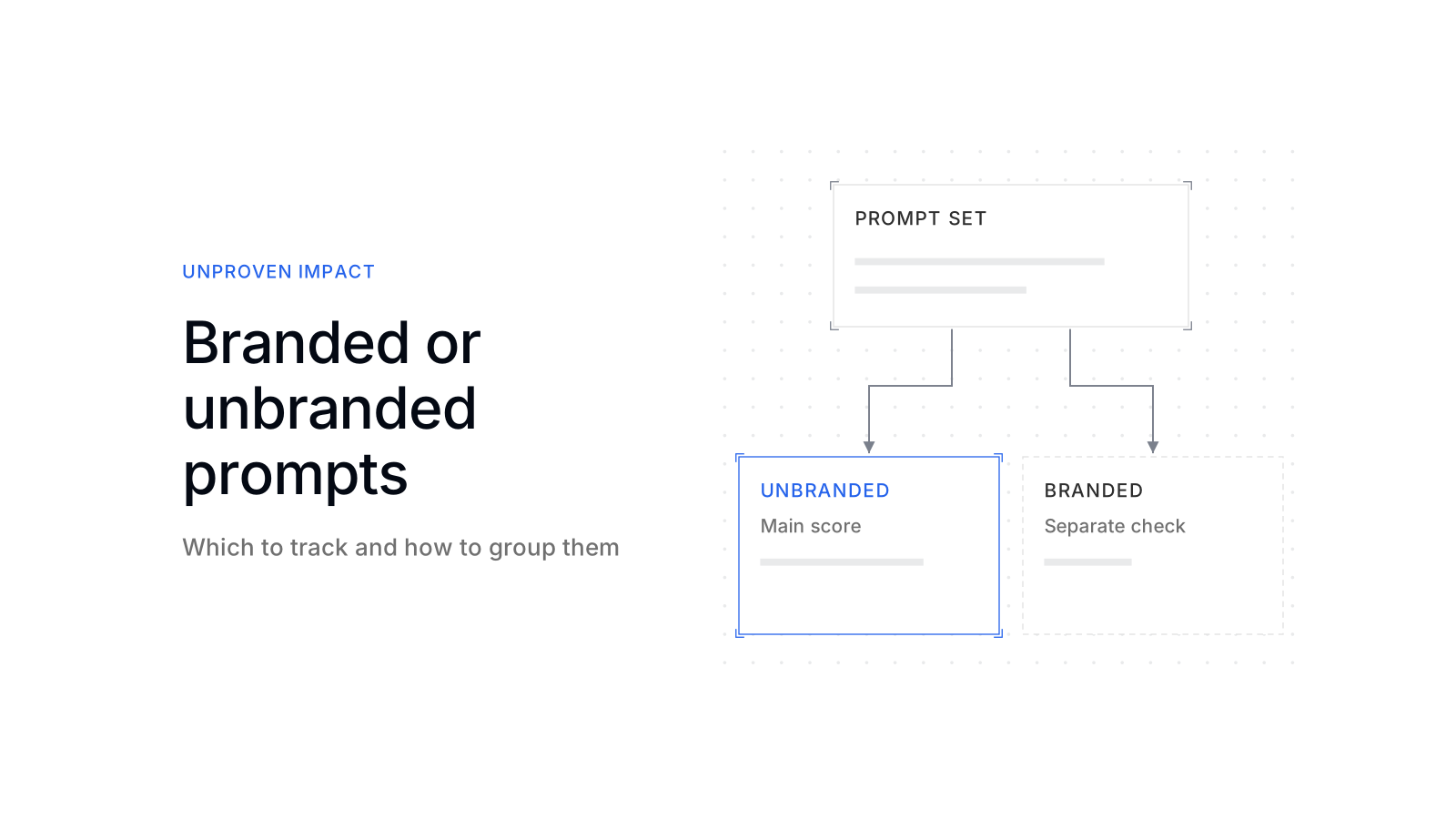
Track both, but score them apart: unbranded prompts show whether AI finds you, branded prompts what it says about you. Then group them by topic, category and audience. scaile does Managed GEO and builds that set from your buyers' questions.

Dora is a founding engineer at scaile. She studied computer science, psychology and neuroscience at TUM, which is the perfect fit for GEO: she has a deep understanding of technology and of the human side, and knows how to write and produce content that leads humans to buy and AI to show you in its answers.
Key takeaways
Unbranded prompts are the main score. They show whether AI names you when a buyer does not know you yet.
Branded prompts check what AI says about you. They almost always name you, so they say little about being found.
In scaile's own data, four branded prompts lifted a pooled score from 0.1% to 1.5%. Keep the two scores apart.
Category prompts show whether you make the shortlist, topic prompts whether you are the source, audience prompts which buyer you reach.
Build one prompt set and tag each prompt three ways, instead of three separate sets.
Should you track branded or unbranded prompts?
Track both, in two separate scores. Unbranded prompts are the main score: they ask the questions a buyer types before knowing your name. Branded prompts are a separate check on what AI says once your name is in the question. Mixed into one number, the branded ones hide the result you track for.
Google draws the same line in search. A branded query includes your brand name, its variations or misspellings, and brand-related products or services. [1] In AI search the definition carries over: “Is [your brand] any good?” is branded, “Which agency helps a law firm show up in ChatGPT?” is not.
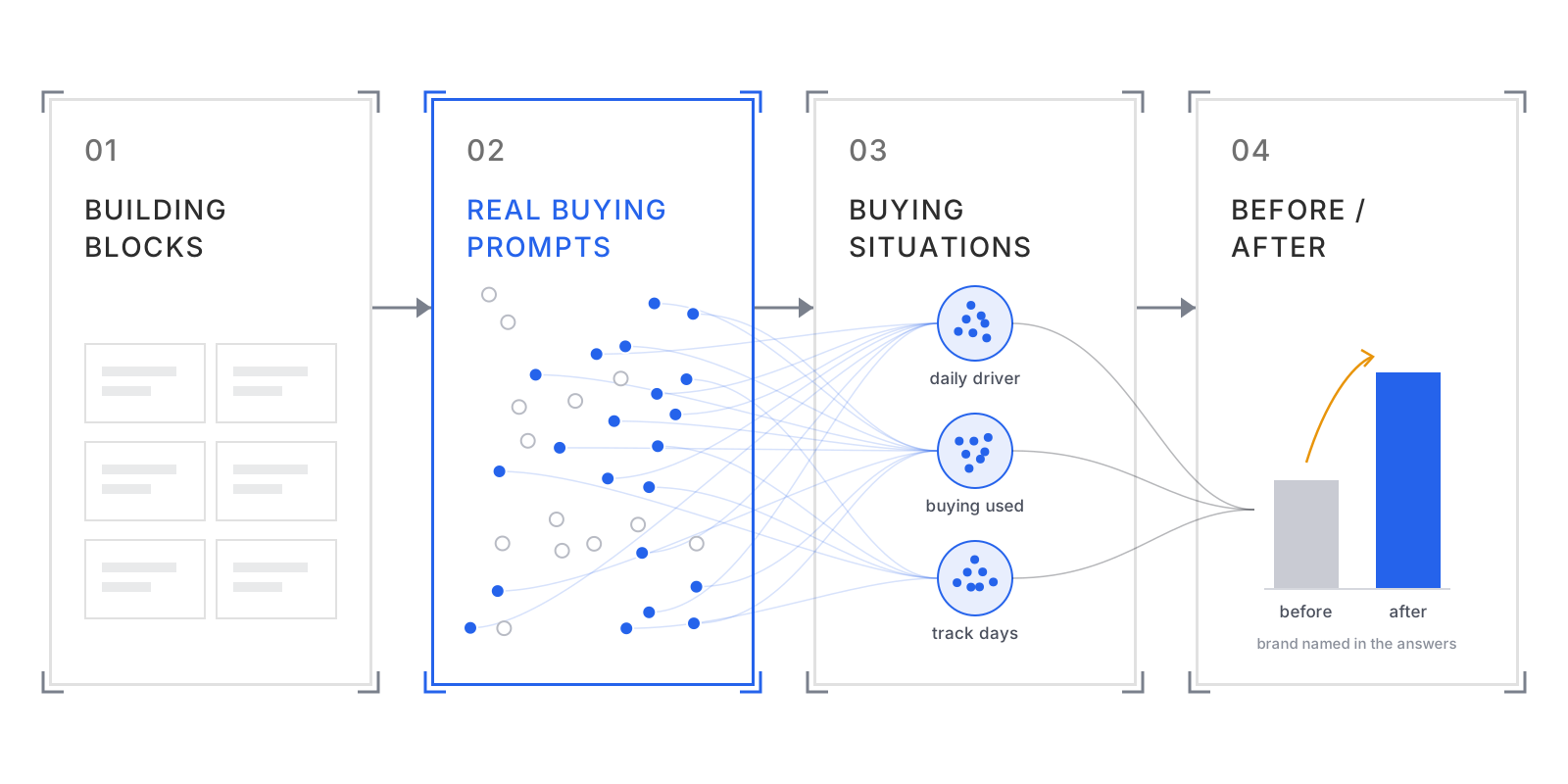
Buyers ask it in sales calls in almost these words: “How do we decide which prompts to track: with or without the brand name, by topic, category or audience?” That is two decisions: which prompts count towards the score, and how to group them so the number tells you what to do next. How to find the prompts, how many you need and how to weight them is covered in scaile’s playbook for deciding which prompts to track.
What branded prompts tell you, and what they cannot
Branded prompts tell you how AI describes you: whether the facts are right, which of your pages it cites and in what tone. They cannot tell you whether a buyer finds you, because a buyer who types your name has already found you.
scaile measured this on its own 275 tracked prompts: 3,300 answers from ChatGPT, Gemini, Perplexity and Google AI Mode on 2, 5 and 9 November 2026, location Germany. The four prompts that name scaile returned scaile in 48 of 48 answers, and cited scaile.tech in 47 of them. The 269 unbranded prompts named scaile in 3 of 3,228 answers. A branded prompt answers the question “what does AI say about us”, and almost never “does AI recommend us”.
That is still worth tracking. An answer to “What does [your brand] do?” that gets your offer wrong or cites a review site instead of your own page is a problem no unbranded score shows. Search has the same split: branded queries usually lead to higher-ranking pages and higher click-through rates, while non-branded queries show how new users find you. [1]
A third kind fits neither group: the prompt that names a competitor. “What are the best alternatives to [competitor]?” is branded, but for someone else. In scaile’s data, the two prompts of this kind named scaile in 0 of 24 answers.
What AI says about you: accuracy, tone, cited pages. Read it as a check, not as a share.
Whether AI offers you as the alternative when a buyer starts from a competitor. Report it on its own.
Whether AI names you when the buyer does not know you yet. This is the main score.
Why one mixed score misleads
One mixed score misleads because branded prompts name you almost every time. Each one you add lifts the score, so it measures the share of branded prompts in your set, not your visibility.
In scaile’s data, pooled over all 275 prompts, scaile was named in 51 of 3,300 answers, or 1.5%. Without the four branded prompts, the rate is 0.1%. Four prompts out of 275 make the score 15 times higher. The pooled number says scaile is visible in AI search. It is visible when someone already asks for it by name.

The same works over time: add three branded prompts next quarter and the score rises, remove them and it falls, with no change in your content.
The fix is the one Google built into Search Console: its branded queries filter splits the data into two views, branded and non-branded. [1] Do the same with prompts. Keep branded and competitor-named prompts in their own reports, and compute the main score on unbranded prompts only. What a good number looks like on that score is explained in what a good AI visibility score is.
These numbers come from one brand, with only four branded prompts, over eight days and one location. They show the mechanism, not a benchmark for your brand.
Topic, category or audience: what each grouping shows
Each grouping answers a different question. Category prompts show whether you make the shortlist, topic prompts whether your pages are the source, audience prompts which buyer you reach. The same unbranded prompts can serve all three views.
In scaile’s data, the unbranded prompts that ask for a tool named at least one brand in 88% of answers, those asking for alternatives in 92% and comparisons in 85%. Prompts about a problem rarely name any brand: 1% of answers in the compliance risk topic, 1% for traffic loss, 4% across the invisibility topic. There the answer is advice, not a list of vendors, so nobody wins a mention.

“Which tool, which agency, which alternative?”
ShowsWhether you are on the shortlistReadMentions, and your position in the list“How do I fix the problem my buyer has?”
ShowsWhether your pages are the source the answer usesReadCitations of your pages“Which provider for a law firm, a clinic, an agency?”
ShowsWhich buyer group AI connects you withReadMentions and citations per groupSo the metric follows the grouping. On topic prompts, read citations: in the same data, scaile.tech was cited in 16.7% of answers to cost prompts, but in 0.6% across the invisibility topic. The gap shows where scaile’s pages are the source, although scaile was almost never named on either.
Audience groups split differently again. Prompts written for agency owners named a brand in 26% of answers, prompts for medical practices and health brands in 2%, prompts for law firms, tax advisers and small businesses in 3%. This view shows which buyer group AI already connects with providers, and which it answers with general advice.
The engines group the same way. Bing Webmaster Tools now groups the queries behind your citations into Topics, broader thematic clusters, [2] and classifies them by intent, such as Commercial, Navigational, Research and Local. [2]
Reading groups instead of single prompts also makes the number stable. SparkToro collected 142 prompts that people wrote for the same purchase, and barely two of them looked alike. [3] Across the 994 answers, the leading brands still appeared 55 to 77% of the time. [3] The AI tools had captured the intent behind the different wordings. [3] One prompt is one wording. A group of prompts is an intent, and the intent is what you can move.
How to set up the mix and read it
Set up one fixed prompt set, keep branded prompts out of the main score, give every unbranded prompt three tags, and read each view with the metric that fits it.
- 1Split by brand
Put prompts with your name and prompts with a competitor’s name in their own reports.
ResultA main score that only counts unbranded prompts - 2Tag three ways
Give every unbranded prompt a topic, a category and an audience. One prompt, three tags, no second set.
ResultThree views of the same answers - 3Match the metric
Read category groups by mentions and position, topic groups by citations of your pages, audience groups by both.
ResultA number per group that means something - 4Read groups, not prompts
Report the rate per group over repeated runs, never a single answer.
ResultChanges you can tell apart from chance - 5Keep the set fixed
Add or remove prompts only between reporting periods, and say when you did.
ResultMeasurements you can compare over time
Which view leads depends on who asks. A board asking whether AI recommends the company needs the category view. A content team deciding what to write next needs the topic view. Sales needs the audience view.
Most of the set should be unbranded, because that is where buyers find providers. The number of unbranded prompts you need per group, and how to weight groups by demand, is covered in the playbook.
To see where your brand stands first, scaile’s free AI Visibility Check tests the questions your customers ask just before buying in real ChatGPT, Gemini and Perplexity sessions.
Track branded and unbranded prompts, but never in one number: the unbranded score shows whether AI finds you, the branded check whether it describes you correctly. Read the unbranded prompts by category, topic and audience, with mentions for the shortlist and citations for the source. scaile builds that prompt set from what your customers ask and reads it with your team every week. To have it built for your brand, talk to scaile about Strategy with you.
FAQ
How many branded prompts should we track?
A few per brand and per main product: what you do, whether you are any good, how you compare. They answer almost the same way every time, so more of them adds little.
Do prompts that name a competitor count as branded?
Not for your score. They are branded for the competitor. Report them on their own, as the check whether AI offers you as the alternative.
Should German and English prompts be in the same score?
Treat each language and market as its own group, like an audience. Answers, sources and named providers can differ by language, and a pooled number hides where you are strong.
Can one prompt belong to several groups?
Yes, and it should. A question like “Which agency helps a clinic show up in ChatGPT?” is a category prompt, belongs to a topic and is written for one audience. Tags let you read it in all three views.