Is generative engine optimization worth it? The ROI evidence
In short
Yes, if your buyers ask AI before they buy and you measure the result. Research found visibility gains of up to 40%, varying by domain. scaile does Managed GEO and reports AI visibility, search and GA4 together.

Dora is a founding engineer at scaile. She studied computer science, psychology and neuroscience at TUM, which is the perfect fit for GEO: she has a deep understanding of technology and of the human side, and knows how to write and produce content that leads humans to buy and AI to show you in its answers.
Key takeaways
GEO works in three steps: first AI assistants name your brand, then more people visit your site, then more leads and revenue follow. A win at one step proves nothing about the next.
Measure where you stand before you start. Then check step by step whether anything moves.
The criticism is partly fair: AI summaries cost clicks, AI answers change all the time, much of GEO is classic SEO, and vendors only show their best case studies.
Nobody can guarantee rankings, mentions or revenue. A serious provider shows you how they measure and how they calculate.
Is generative engine optimization worth it?
Generative engine optimization (GEO) is worth it when your buyers ask ChatGPT, Gemini, Perplexity or Google’s AI features before they choose a supplier. It also needs a result you measure on a fixed set of buyer questions. As a bet on a promised ranking, it is not worth it. The return comes in layers: first your brand is named and cited in AI answers, then visits arrive, then enquiries and revenue. The evidence is strongest for the first layer and thinnest for the last.
A higher visibility number shows the work is reaching the answers. It is not yet a return. The return is what happens further down the chain, compared with what you spent.
What controlled research says about GEO’s effect
The controlled research says GEO methods can raise a page’s visibility in AI answers, and that the size of the effect depends on the topic. The study that named the field is “GEO: Generative Engine Optimization” by Pranjal Aggarwal and colleagues, accepted to KDD 2024. It built a benchmark of user queries across many domains, GEO-bench, and reports that its methods can boost visibility by up to 40% in generative engine responses. [1] It also reports that the efficacy of these strategies varies across domains. [1]
“Up to 40%” is the best case in a test setup, not an average to plan with. The study measures visibility inside a generated answer, not visits, leads or revenue. And because the effect differs by domain, a result in travel says little about industrial B2B.
What the research does settle is the mechanism: how a page is written and structured changes whether a generative engine uses it. Whether that pays off for your company is a question only client data comes close to answering.
What client before-and-after data shows
Client before-and-after data shows GEO moving all three layers of return, but each result proves only its own layer. The table sorts five published scaile results by layer.
| Client | What moved | Layer | Basis |
|---|---|---|---|
| Beurer | AI answers using beurer.com: 17% to 42%, the most of any website | Share of AI answers | Same 14 buying questions, May and September 2026 |
| Beurer | 6.8 times the visits from AI assistants | Visits | GA4, Aug 2026 vs Aug 2025 |
| Braun & Kollegen | Google clicks from 218 to 1,101 a month | Visits | Search Console, Aug 2025 vs Aug 2026 |
| Building Radar | Qualified inbound pipeline doubled within 90 days | Pipeline | The company’s pipeline, no added marketing headcount |
| Hey Honey | 150K EUR additional recurring revenue | Revenue | During the project duration |
At Beurer, the questions stayed the same from May to September, so the rise does not come from measuring different ones. The page itself says part of the visit growth is people using AI assistants more. At Braun & Kollegen, most pages behind the clicks are the firm’s own guides; one new scaile guide was cited 265 times by Copilot in its first seven weeks. BILD Reisen, with three times the AI mentions in 11 weeks, reports a refresh without a holdout as an operation, not as a result.
The pipeline and revenue results, at Building Radar and Hey Honey, are the ones a CFO asks about first. All five are results on one account each, not a forecast for yours. More are on the case studies page.
How to do the ROI math for GEO
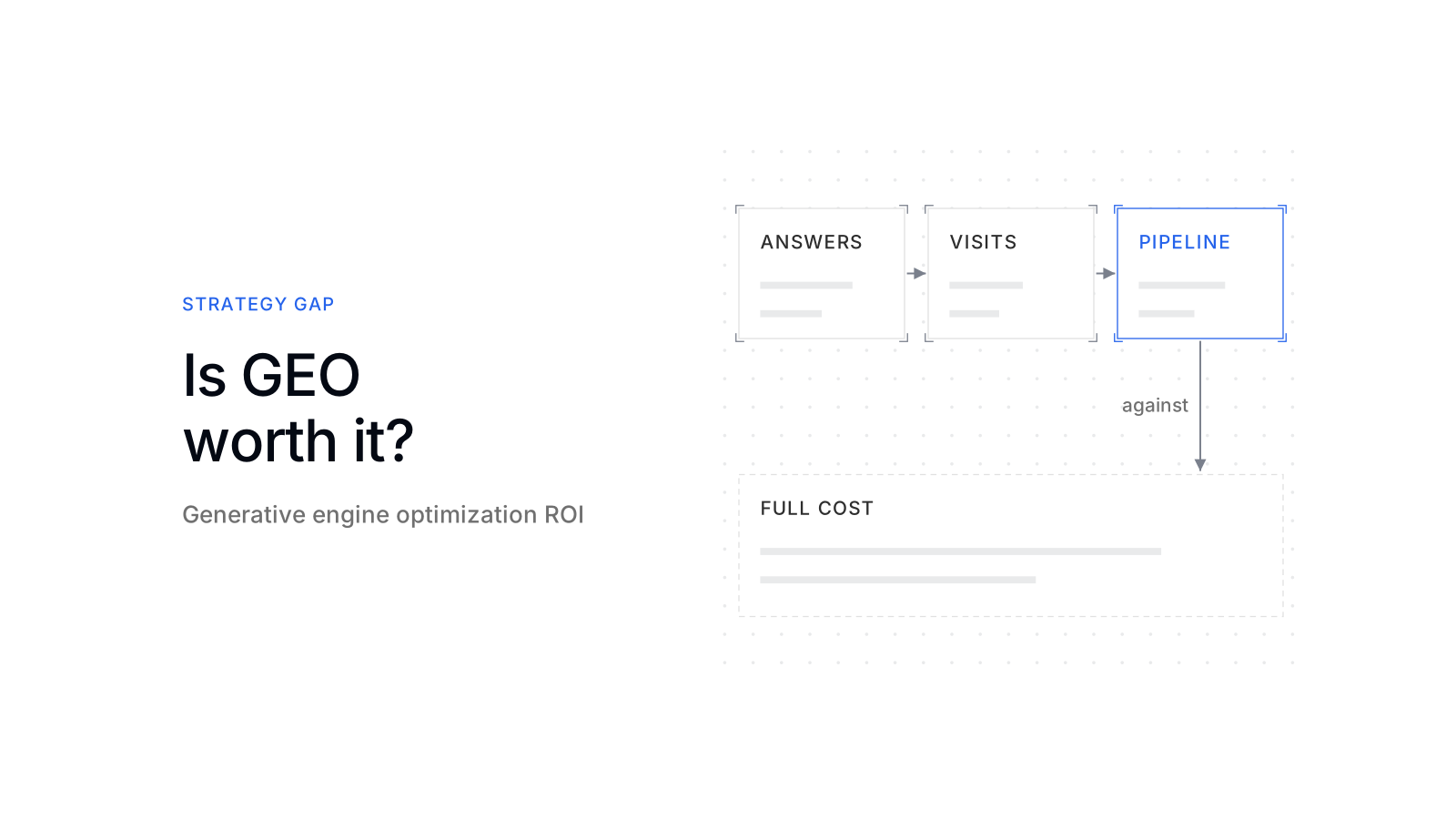
The ROI math for GEO follows the chain: answer share, the visits it brings, the pipeline those visits create, set against the full cost. Each step has its own source, and the lower steps are harder to attribute.

- 1Baseline
Fix the buyer questions and the engines, and run them several times before any change.
Your partAgree which questions and which products count - 2Answer share
Read how often your brand is named or cited on those questions, as a percentage across many runs.
Your partCheck that the questions still match what buyers ask - 3Visits
Read sessions from AI assistants in GA4. Google reports traffic from AI Overviews and AI Mode in Search Console’s Performance report, within the Web search type. [2]
Your partGive access to Search Console and GA4 - 4Pipeline
Tie enquiries and deals to those visits in your CRM, and ask new leads where they first heard of you.
Your partAdd the source question to your forms and sales calls - 5Cost
Set the result against the full cost: fees, tools and your team’s time for review and approvals.
Your partCount the hours your team spends
For the cost side, see what a monthly GEO fee covers, what agencies, tools and in-house teams charge and how GEO is priced. Leaving out your own team’s time flatters any return.
The time frame matters as much. The layers move on different clocks, so a business case read after six weeks counts the setup and almost none of the return. When each layer moves is covered in how long GEO takes to show results.
Google says clicks from result pages with AI Overviews are higher quality, meaning people are more likely to spend more time on the site. [2] Google publishes no numbers for it, so treat it as a direction, not a figure for your model.
What the skeptics get right
The skeptics get four things right: AI summaries reduce clicks, AI answers vary from run to run, much of GEO is SEO, and published results are chosen by the vendor.

Pew Research Center analysed the browsing data of 900 U.S. adults in March 2025. [3] People who saw an AI summary clicked a traditional result in 8% of visits, against 15% without one, and clicked a link inside the summary in 1%. [3] Part of the value of being named stays in the answer and never shows as a visit.
In a SparkToro study, 600 volunteers ran 12 prompts through three AI tools 2,961 times. [4] The tools gave the same list of brands twice in fewer than 1 in 100 runs. SparkToro concludes that a rank position in AI means nothing. Visibility as a percentage across many prompts, run many times, is a reasonable metric. [4]
Google says there are no additional requirements and no special optimizations needed to appear in AI Overviews or AI Mode. [2] For Google’s AI features, good SEO is most of the work. Other engines choose their sources differently, so page one on Google does not guarantee a mention in ChatGPT.
Every case study, scaile’s included, is selected by the company that publishes it. Ask for the basis instead: the same questions before and after, data from the client’s own accounts, and a holdout where there is one.
None of this says GEO does not pay. It says the return is partly uncounted, has to be measured as a share over many runs, and overlaps with SEO. scaile treats SEO and GEO as one job for that reason, from topics and pages to the optimization for each AI engine. Why a strong Google ranking is not enough on its own is shown in why page 1 on Google does not get you into ChatGPT.
When GEO is worth it now, and when it can wait
GEO is worth it now when buyers in your category ask AI tools before they contact a supplier and you can measure what follows. It can wait when your buyers do not use AI for the decision or when you cannot yet measure the result.
Your buyers research a considered purchase in AI answers and a competitor is named where you are not. A won customer justifies months of work, and Search Console, GA4 and your CRM can be connected.
Your buyers decide without AI, your category has few buyer questions, or you have no baseline and no way to tie visits to enquiries yet. Fix the measurement first.
Company size matters less than these conditions. A small business can hand the whole job to one partner; an enterprise team can keep writing and approvals and buy strategy and measurement.
scaile’s free AI Visibility Check identifies the questions your customers ask just before buying and tests them in real ChatGPT, Gemini and Perplexity sessions. If you want to test a first scope before a larger budget, what a GEO pilot should include covers it.
What scaile delivers
scaile delivers both things a business case needs: the work that gets your brand into AI answers, and the measurement that shows what it earns. SEO and GEO run as one job.
scaile finds your customers’ buying questions with you, based on data, and tracks them in its own platform, app.scaile.to.
You getYour baseline and your share of AI answers across many runsA dedicated AI search strategist builds the strategy, and scaile handles research, writing, publishing, refreshing and reporting.
You getOne report with AI visibility, Search Console and GA4, and a weekly meeting on results and next stepsYour teamReviews and approvesscaile takes over the whole function, from strategy to reporting.
You getThe work and the measurement, without extra hours from your teamYour teamProvides context and approvalsWhat this moved for clients is in the table above and on the case studies page.
Generative engine optimization is worth it when your buyers ask AI before they buy and you measure it as a chain: answer share, visits, pipeline and full cost. The research shows the mechanism works, the client data shows it can reach revenue, and the skeptics show where the counting stops. scaile builds that measurement into the work, with a strategist who reads it with your team every week. If you want a business case your CFO can check, talk to scaile about Strategy with you.
FAQ
What ROI does GEO deliver on average?
There is no honest average. Published results come from single accounts measured on different bases, so an average across them would mean little.
Can GEO revenue be attributed exactly?
No. Part of the effect stays inside AI answers without a click, and Google reports AI Overviews traffic within the normal Web search type. Attribution gets close with a fixed question set, GA4 and a source question in your CRM, never to the last euro.
Which number should go into a board report?
Share of AI answers on a fixed set of buyer questions, visits from AI assistants, and enquiries from those visits, each against the same baseline. Leave out rank positions in AI answers.
How long until GEO pays back?
There is no fixed payback period. Answer share can move within weeks of publishing, while visits, pipeline and revenue follow over months and on your own sales cycle.
Sources
- 2311.09735 GEO: Generative Engine Optimization
- AI Features and Your Website | Google Search Central | Documentation | Google for Developers
- Do people click on links in Google AI summaries? | Pew Research Center
- NEW Research: AIs are highly inconsistent when recommending brands or products; marketers should take care whe