GEO contracts: minimum term, notice and what follows the audit
In short
A GEO contract should set out when you review results and decide whether to continue. At scaile, the AI Search Lab for enterprise and large mid-market companies, the term and exit points depend on the engagement. Research, execution and measurement belong together.

Dora is a founding engineer at scaile. She studied computer science, psychology and neuroscience at TUM, which is the perfect fit for GEO: she has a deep understanding of technology and of the human side, and knows how to write and produce content that leads humans to buy and AI to show you in its answers.
Key takeaways
Before signing, clarify what follows the audit, when the contract ends and which deadlines apply to an early exit or notice.
An audit can be bought on its own. If it turns into a longer contract automatically, the proposal should say so in plain words.
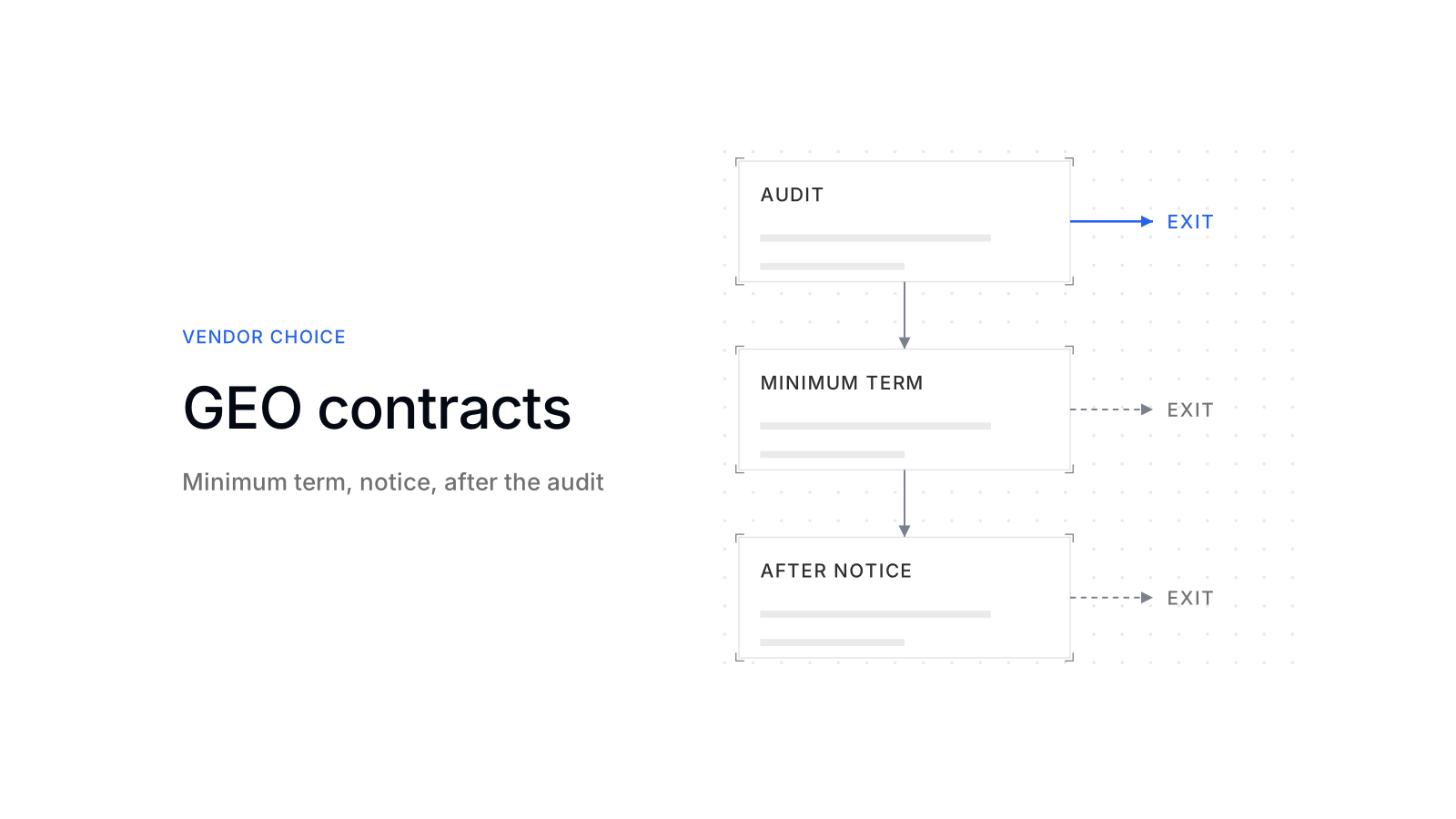
Separate the contract term from the earliest exit: scaile Focus runs for six months with an exit after month three; Program runs for twelve months with an exit after month five. Notice and conditions belong in the proposal.
Keep your website, Search Console and analytics in your own name. Then ending the contract costs you nothing you built.
Nobody can guarantee rankings or mentions in ChatGPT. A good contract promises the work, the process and honest reports instead.
What is the minimum term of a GEO contract, and are you bound after the audit?
Generative engine optimization (GEO) aims to help buyers find your brand in AI answers such as ChatGPT or Google’s AI Overviews, understand it correctly and consider it when buying. An ongoing GEO contract can run for several months, with an agreed exit before its regular end. The proposal should explicitly say whether the analysis phase commits you to further work.
Buyers ask it in sales calls in almost these words: “How long is the minimum term, and are we bound to a follow-up contract after the analysis phase?”
Check every GEO proposal for the decision after the audit, exit options during the engagement and the handover at the end. At each point, you should know what you can decide and what you keep.

Why GEO agreements have a minimum term at all
GEO agreements have a minimum term because the effect of the work takes months to measure. Google says some changes take effect within hours, others take several months, and you should usually wait a few weeks before you judge whether your work helped. [1]
The first weeks also go into setup. Someone has to find the questions your buyers ask, measure where you stand today and fix what blocks AI crawlers. The pages that should move the numbers come after that.
Enterprise and large mid-market companies also need to coordinate with subject-matter experts. Which claims have evidence? Who checks them, and who approves publication? For complex products and regulated industries, these responsibilities belong in the plan from the start. Otherwise, contract time passes before a measure goes live.
Schedule reviews before the exit deadlines. At each review, distinguish work delivered, results that can already be measured and questions still open. An early exit option does not mean the full effect must be visible by that date.
The term ends before the first reliable reading. You either renew on trust or stop without knowing.
The term ends after the agreed review date. You renew or leave on numbers.
A very long term has the opposite problem: it binds you well past the point where you could decide. Why GEO is billed as an ongoing service in the first place is covered in how GEO is priced.
What happens after the audit phase
After the audit, one of three things happens: you stop, you run a pilot, or ongoing work begins. Which one applies should be your decision, made on the audit’s findings.
At scaile, the workshop or 30-day Opportunity Assessment supports that decision. It provides a baseline, an analysis of how AI presents your business, an assessment of search demand in your market and a prioritised plan with three scenarios. These help you discuss suitable measures and budget. The proposal should make the decision to commission subsequent execution explicit.
You keep the report and its findings and act on them yourself or with your team.
One product in one market, measured against a baseline. What it needs is in what a GEO pilot should include.
The agreed engagement starts. Your team and the provider establish responsibilities, approvals, execution and review dates.
Before you sign, check four things about the step from the audit to the next phase:
- Separate or bundled: Is the audit an agreement of its own, or the first phase of a longer one? Both exist; you need to know which.
- Automatic continuation: Does the agreement continue on its own unless you object by a set date? Then that date belongs in your calendar on day one.
- Decision date: On which date are the audit results presented, and who decides on your side?
- Findings you keep: The list of buyer questions, the baseline and the recommendations, in a format you can open without the provider’s software.
The term and exit clauses to check before you sign
The clauses that decide how you can leave are the term, the notice period, the renewal and what happens when work is not delivered. Check these six points in every proposal:
How long the contract runs, when it starts and whether you can leave before its regular end. An exit after month three also needs a deadline for giving notice.
How far ahead of the term’s end you must give notice, and in which form.
Whether the agreement then runs month by month, renews for another full term or ends.
Whether you can reduce markets, products or content volume during the term.
What happens if agreed work is not delivered, and by when it must be fixed.
What the provider commits to. Rankings are not something anyone can promise.
On promises, Google is blunt: no one can guarantee a #1 ranking, and you should beware of SEOs who claim they can. [2] It also suggests asking any provider what results they expect, in what timeframe, and how they measure success. [2]
A contract that cannot promise rankings should specify scope, process and reporting in detail. At scaile, that includes the baseline, prioritised measures, responsibilities for execution and approval, and agreed measurement. Reporting should also show measures with no observable effect and outcomes that cannot yet be assessed reliably.
Check the basis for recommendations, too: which models evaluate your brand mentions? Where does the research come from? Can crawler logs show whether AI systems retrieved published content? A retrieval alone is not proof of a recommendation or an inquiry. Those outcomes should be reported separately.
Under German law, a service contract without an agreed notice period falls back on the civil code. For one paid by the month, the civil code allows notice by the 15th for the end of that month. [3]
Whether your agreement falls under that rule is a question for your lawyer. A clause that states the period is the better route.
The wider contract points (what is not included, who owns the copy) are in how contracts for outsourced marketing are structured. The questions that expose a weak provider are in how to choose a GEO agency.
How to leave a GEO agency without losing your work
You leave a GEO agency without losing anything when every account is in your name and the agency only has access. Then ending the contract means removing users, not rebuilding:
- Search Console: Owners add and remove other users, and every property needs at least one verified owner. [4] A verified owner can only be removed by taking their token off your site, [4] so make sure you verified the property yourself.
- Google Analytics: Only an Administrator at account level can delete users. [5] That role belongs to someone on your side.
- Website and CMS: Pages the agency published in your CMS stay where they are. The agency gets a login, not the site.
- Content and knowledge: Published copy, briefs and brand guidelines should be yours by contract, also after the end.
- Tracking history: The buyer questions and their history over time. Export them before the agreement ends.

At scaile, tracking history is kept from your project start for the whole engagement. Exports come as CSV, JSON, Excel or Google Sheets.
What you build with scaile during the engagement
scaile combines research, strategy and ongoing execution. The goal is for potential buyers to find your business, understand your offer correctly and include you in their shortlist. Alongside AI mentions, evaluation therefore considers qualified inquiries, the development of your sales pipeline and where the next budget should go.
The work draws on three data layers: proprietary models evaluating brand and competitor mentions, search demand in your market and crawler logs through publisher partnerships. These help scaile prioritise content, formats and publication outlets for investigation. The agreed scope should specify which coverage applies to your product and market.
Your company facts, substantiated claims and approval rules set the framework for execution. Visibility Engineers combine that knowledge with research findings, publish agreed work and assess its effect. Even for complex products, the responsibilities for factual review, publication and measurement remain clear.
The three engagements build on each other:
One product in one market. Research, prioritisation and execution begin within a clearly defined scope.
TermSix months, with an exit after month three. Notice and conditions are set in the proposal.One brand in up to two markets. Attribution of inquiries in the CRM becomes part of the engagement, so progress can be followed into sales.
TermTwelve months, with an exit after month five. Notice and conditions are set in the proposal.Across brands and markets, with a dedicated research environment and researcher. This includes advice on allocating budget across content, publishers and other measures.
TermScope, review dates and exit points are set in the individual proposal.A GEO contract is understandable when each decision point is clear: after the analysis, before an agreed early exit, at the regular end and during handover.
Align reviews with those decisions, keep every account in your name and get research, execution and measurement in writing. To discuss these terms for your business, talk to scaile about the right engagement.
FAQ
Can we end a GEO contract early if results don’t come?
Only if the contract gives you that right. Because no provider can guarantee rankings or AI mentions, results are a weak basis for an exit clause. What you can hold a provider to is the agreed scope, process and reporting, so write those down precisely.
Is there a way to see where we stand before any contract?
Yes. scaile’s free AI Visibility Check tests whether ChatGPT names your brand for your buyers’ questions, and the free AI Search Health Check runs 103 checks on your website. Neither needs an agreement.
Sources
- SEO Starter Guide: The Basics | Google Search Central | Documentation | Google for Developers
- Do You Need an SEO? Tips for Hiring an SEO | Google Search Central | Documentation | Google for Developers
- § 621 BGB - Einzelnorm
- Managing owners, users, and permissions - Search Console Help
- Add, edit, and delete Analytics users and user groups - Analytics Help