How is GEO priced? Retainer, per article or performance
In short
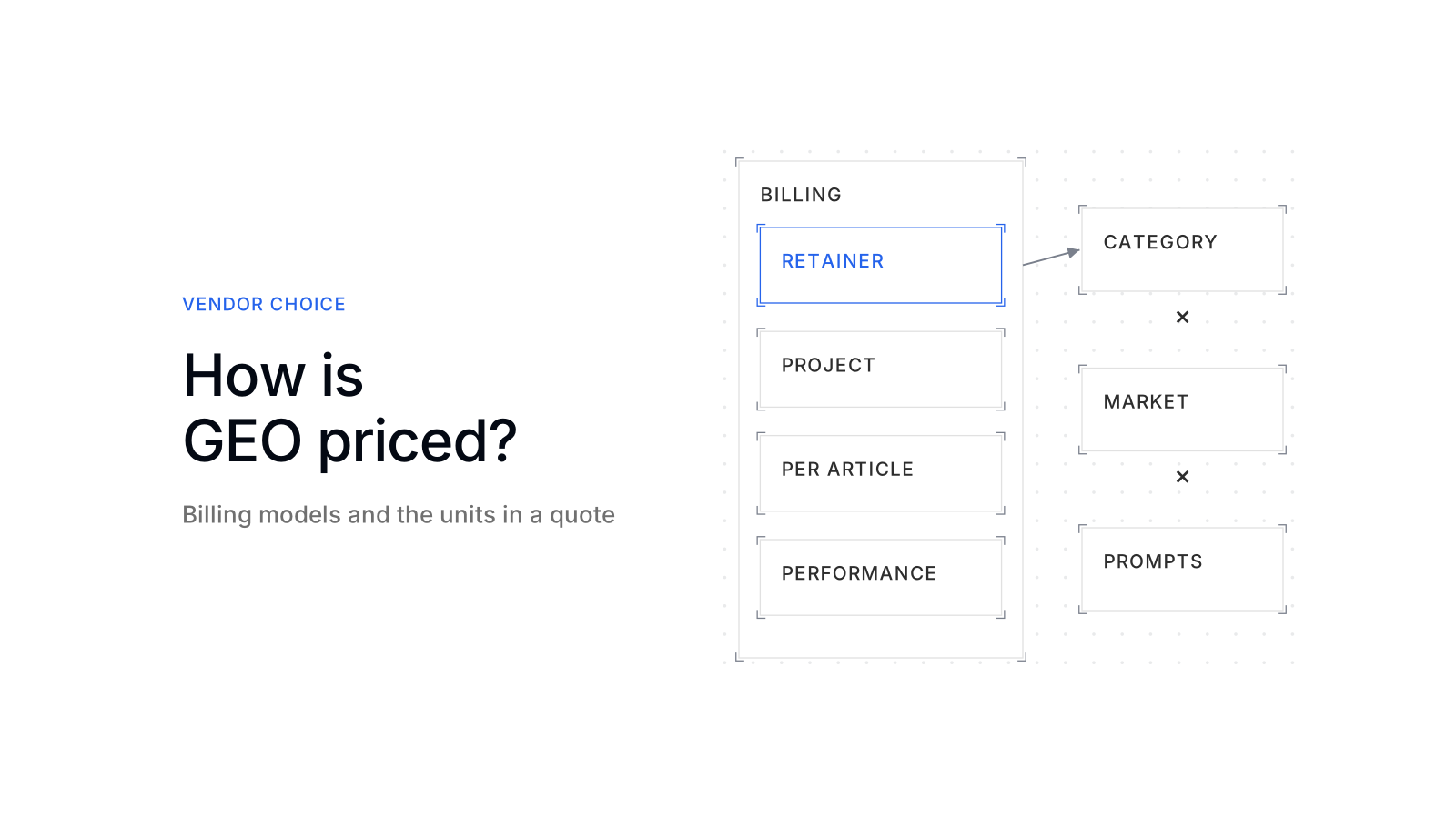
Most GEO is billed as a monthly retainer, sized by its units: product categories, markets and prompts. Per-article and performance deals leave out tracking, refreshes or a stable metric. scaile does Managed GEO, priced as one scoped plan.

Dora is a founding engineer at scaile. She studied computer science, psychology and neuroscience at TUM, which is the perfect fit for GEO: she has a deep understanding of technology and of the human side, and knows how to write and produce content that leads humans to buy and AI to show you in its answers.
Key takeaways
The monthly retainer is the most common billing model for generative engine optimization (GEO). Projects suit an audit, per-article fees suit one-off pages.
Performance pricing on AI citations rests on a metric that changes from one answer to the next. Agree a measurement before you agree a bonus.
A quote counts units: product categories, markets and languages, prompts times AI engines times collection frequency, and content volume.
A second category or market usually costs less than the first, because the setup is paid once. The total still grows, because each one needs its own prompts and pages.
scaile prices the whole plan after scoping it, recommends starting with one product in one market and guarantees no rankings or citations.
How is GEO priced?
GEO is usually priced as a monthly retainer, and the size of that retainer comes from the units in its scope. Gripped, a UK B2B agency, writes that “monthly retainers are the most common model for ongoing GEO work”. [1] Three other models exist next to it: a fixed project, a fee per article and a fee tied to performance. The units are the same in every model. They are the product categories covered, the markets and languages, the prompts tracked on each AI engine, and the content written and refreshed.
Buyers ask this in two forms. “How is the price calculated: per product category, market, country or number of prompts, and does it get cheaper with more categories?” And: “Is GEO billed as a monthly retainer, one-off, per article or by KPIs, and why is it an ongoing service?” This article answers both. What a monthly fee should contain, and what published retainers cost, is covered in what GEO costs per month.
Retainer, project, per article or performance: what each model buys
Each billing model buys a different slice of the work. WebFX, a US agency that sells GEO, warns that “retainers, fixed fees, and project quotes cover different scopes, and the differences matter when you’re comparing bids”. [2]
| Model | You pay for | What it leaves out | Fits when |
|---|---|---|---|
| Monthly retainer | Ongoing tracking, strategy, content, refreshes and reporting | Nothing by design; check the scope | You want AI answers to change and stay changed |
| Project | A fixed piece of work, such as an audit | Everything after the handover | You need a baseline or a one-off fix |
| Per article | Single pages | Tracking, strategy and refreshes around the pages | You only need pages and measure them yourself |
| Performance | A bonus when a metric moves | Certainty about what the metric means | The metric is agreed and measured cleanly |

A project is the right model for a defined job. Gripped describes project pricing as working “well for companies that want a one-off audit or a specific piece of work completed”. [1]
A fee per article looks simple and hides two costs. The first is your own time. Sight AI, which sells content software, advises you to “calculate your effective cost per article under each model, including revision rounds, briefing time”. [3] The second is everything around the page: nobody checks whether AI answers now cite it, and nobody updates it when the facts change.
Why paying per AI citation is fragile
Paying per AI citation is fragile because the citation itself is not stable. Performance pricing means “tying fees to citation gains or share-of-voice milestones”. Even a guide written for agencies that sell it warns: “Do not sign a performance deal on a metric you cannot yet track cleanly.” [4]
The answers move by themselves. SparkToro found “a <1 in 100 chance that ChatGPT or Google’s AI, if asked 100X, will give you the same list of brands in any two responses”. Its conclusion is that “visibility % across dozens to hundreds of prompts run multiple times is a reasonable metric”. [5] A bonus paid on a single citation pays for chance as much as for work. Why one screenshot proves little is explained in how to choose a GEO agency.
Guarantees are the same problem in another form. Google states that “no one can guarantee a #1 ranking on Google”. [6] If a performance deal is on the table, fix three things first: the prompt set, the share across repeated runs as the metric, and the baseline before work starts. scaile guarantees no rankings, citations, traffic or revenue. It commits to the agreed scope, the operating process and honest reporting.
Per category, market or prompt: the units in a GEO quote
A GEO quote counts four units, and each one multiplies the others.
Which products, services or business units the work covers. Each category brings its own buyer questions.
Each country, region and language is tracked and written for on its own. WebFX notes that “each location may need separate pages, local content, and optimized strategies”. [2]
The buyer questions tracked, on how many AI engines, how often. “Tracking tools usually price by the number of prompts and AI platforms they monitor.” [2]
How many pages are written, changed and refreshed for each category and market.

Prompts are where quotes differ most. For example, ten prompts on one engine once a week is a different service from a hundred prompts on nine engines every day, though both are called prompt tracking. scaile tracks up to nine answer engines, from ChatGPT and Perplexity to Google AI Mode, Microsoft Copilot and Claude.
Some units should not be counted at all. At scaile, seats, tracked domains, opportunities and prompt-research searches are unlimited. Projects, tracked prompts, collection frequency, model executions and content production are what the proposal scopes. Ask any provider which of its units are scoped and which are free, so you can see what an extra team member or competitor costs you.
Does GEO get cheaper with more categories?
Each additional category or market usually costs less than the first, but the total grows. The reason is how the work splits.
Part of the work is done once for the whole company: the knowledge of your offering, the tracking setup, the measurement connections and the technical fixes on your site. That is why the start is the expensive part. Gripped writes that “the first three months typically cost more than steady-state” and advises: “Plan for 20 to 30 percent higher costs in the first quarter.” [1]
The other part repeats for every category and market: its own prompts, its own pages, its own refreshes. A second category reuses the setup, so it does not pay for it again. It still needs its own content, so it does not come free.

This is also why scaile recommends starting small. One product in one market lets scaile build the framework, show results and then roll it out to further products and markets. A pilot of this kind answers the price question with your own numbers before you commit to every category.
Why GEO is billed as an ongoing service
GEO is billed as an ongoing service because the work does not end when a page goes live. AI answers keep changing, competitors keep publishing, and facts on your own pages go out of date. Gripped’s budget advice covers “a quarterly GEO audit, ongoing content optimisation for AI visibility” and “monthly monitoring of citation frequency and competitive share”. [1]
A one-off project can fix what is broken today. It cannot tell you next quarter whether the fix still holds. That needs the same prompts measured again, and pages refreshed when the answers move. scaile agreements run for a minimum of six months; the notice period and the exact terms after that are set in the proposal.
What to ask before you sign
Ask five questions about the billing itself before you compare totals.
- 1Which model, and why this one?
A retainer, a project, a fee per article or a performance share.
You checkThat the model matches the job you need done - 2What is the unit?
Categories, markets, prompts, engines, collection frequency or pages.
You checkWhich units the proposal limits and which come free - 3What does the next category or market cost?
Ask for the price of adding one, not only for the first.
You checkThat the setup is not billed twice - 4If performance counts, how is it measured?
Prompt set, repeated runs, baseline.
You checkThat no bonus rests on a single answer - 5What is the minimum term, and is there a pilot?
One product in one market first.
You checkThe term and what happens after it
GEO is priced by a billing model and a set of units. The model decides what is left out, the units decide the size, and the first category carries the setup that later ones reuse. Ask how each quote bills and what it counts before you compare totals. If your team wants to keep strategy and approval while someone else does the research, writing and publishing across your categories and markets, talk to scaile about Strategy with you.
FAQ
Does a combined SEO and GEO package cost more than SEO alone?
Usually, yes. Gripped puts combined SEO and GEO packages “typically at a 20 to 40 percent premium over SEO-only retainers”.
Does scaile charge per seat?
No. Seats are unlimited at scaile, so everyone who reviews or approves content can work in the platform without a licence count.
Sources
- How Much Does GEO Cost? A B2B SaaS Pricing Guide | Gripped
- GEO Cost: How Much Does Generative Engine Optimization Cost?
- SEO Content Creation Pricing: Stop Overpaying in 2026
- GEO & AEO Services Pricing: What to Charge Clients in 2026 | Ciela AI
- NEW Research: AIs are highly inconsistent when recommending brands or products; marketers should take care whe
- Do You Need an SEO? Tips for Hiring an SEO | Google Search Central | Documentation | Google for Developers