Where GEO content gets its expertise: interviews and knowledge bases
In short
The expertise comes from you first. scaile learns your company and your product from your documents and from working with your team, writes articles with deep expertise from that and shows the source of every claim. An author from your company reviews the finished article and is named as its author.

Dora is a founding engineer at scaile. She studied computer science, psychology and neuroscience at TUM, which is the perfect fit for GEO: she has a deep understanding of technology and of the human side, and knows how to write and produce content that leads humans to buy and AI to show you in its answers.
Key takeaways
The expertise comes from you first: your documents, your experts and your approved claims.
Google and AI search favour content with first-hand knowledge and original information, not rewritten web pages.
What makes your company different usually sits in sales calls and internal chats, so it has to be written down first.
A partner learns your niche quickly when it starts from your material, not from prior industry experience.
An author from your company works through everything with scaile, is named as the author and reviews the finished article, which they at most lightly edit.
What scaile does especially well: it builds your Brand Kit and Knowledge Base from your own documents and shows the source of every statement before you approve. The result is factually correct blog posts backed by sources.
Where does GEO content get its expertise?
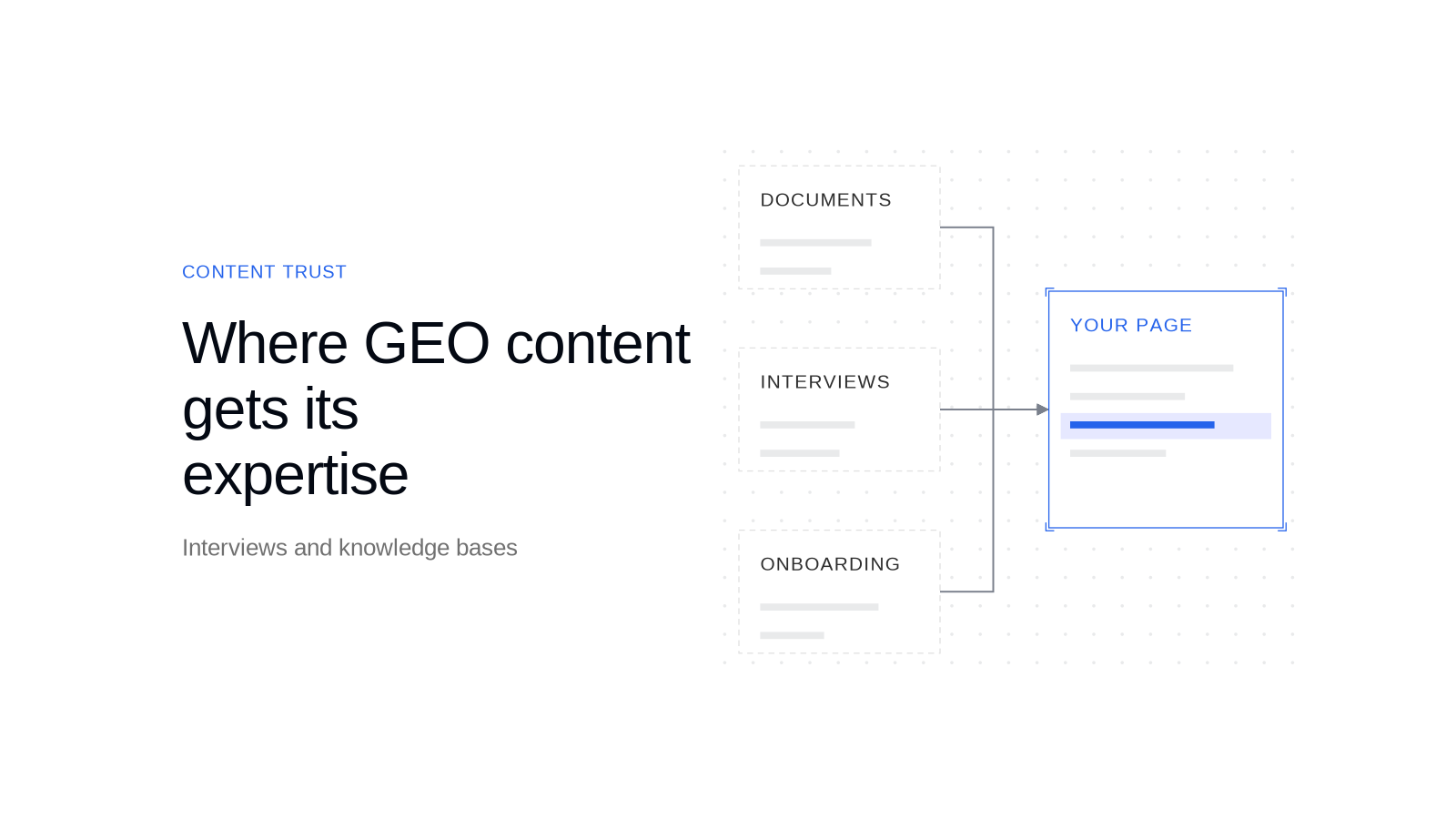
GEO content gets its expertise from your company, not from the AI model that helps write it. Three routes carry it onto the page: your documents, interviews with your experts, and an onboarding that writes down your offering, your buyers and your edge.
Generative engine optimization (GEO) means making your content the source that ChatGPT, Gemini, Perplexity and Google’s AI answers name and cite. A model can phrase an answer, but it cannot know why your product beats the usual approach. That knowledge has to reach the writer before the first draft.

Why AI search rewards first-hand expertise
AI search rewards first-hand expertise because both Google and the research on AI answers point to original, sourced content. Google asks site owners whether their content “clearly demonstrate[s] first-hand expertise and a depth of knowledge” and whether it provides “original information, reporting, research, or analysis”. [1]
Google also says that crediting other sources “doesn’t replace the need for original effort”. [1] Its AI Overviews and AI Mode have no extra requirements: the same SEO best practices apply. [2]
The paper that introduced GEO (Aggarwal et al., 2023) evaluated nine ways of editing a page to make it more visible in AI answers: [3]
- Citations, quotations and statistics: the three best methods, with a 30-40% relative gain in how much of the AI answer drew on the page, weighted by position.
- Keyword stuffing: the classic SEO move did not perform well.
- Domain: which method works best differs by subject area. [3]
Quotes and numbers nobody else has are exactly what an outsider cannot invent. They come from your experts, your data and your documents.
Your documents become a knowledge base
A knowledge base is the store of your company’s facts that every article is written from. scaile’s Knowledge Base takes PDFs, DOCX and other files as well as web pages by URL. During writing, its agents search the Knowledge Base, so each article is grounded in your own facts.
Good material for it is whatever your sales and product teams already use:
- Product documentation: specifications, manuals, release notes.
- Sales material: decks, objection handling, pricing logic you are allowed to publish.
- Approved claims: the wording legal or compliance has already cleared.
- Your own data: surveys, benchmarks, results you are ready to name.
The facts: what your product does, for whom, with which numbers
How it is said: voice, audiences, writing rules, sources you trust
The two together are what keeps a draft accurate and on brand. How AI writing and human review fit together is covered in AI content and human review.
Expert interviews capture what sits in sales calls
Expert interviews turn the knowledge your team uses every day into text a writer can cite. What your product and leadership teams know about why the usual approach breaks is the one input no competitor can generate. It usually sits in sales calls and Slack rather than on your site.

An interview of this kind is short and specific. These five questions bring out the material AI answers quote:
- The usual mistake: what do buyers in your market get wrong before they talk to you?
- The trade-off: when is your approach the right choice, and what does it cost the buyer?
- The number: what have you measured that nobody else publishes?
- The objection: which question comes up in almost every sales call?
- The wording: which terms do your customers use that your website does not?
Write the answers into the knowledge base, so they inform every later article, not only the first one.
How fast can a partner learn your niche?
A partner learns your niche as fast as your material reaches it, so the onboarding matters more than prior experience in your industry. scaile builds the foundation (Brand Kit, Knowledge Base and content plan) in the first weeks.
- 1Before the session · Preparation
scaile prepares from your website, your data and your competitors, so the time together goes into decisions
Your partShare what you have: documents, positioning, personas - 2Strategy session · Your offering
scaile asks you to review your offerings: their features, who each is for and what makes it special
Your partBring the people who can answer these questions, including the author from your company who will be named - 3First weeks · Brand Kit and Knowledge Base
What sets you apart is written down precisely enough to position you that way every time
Your partCorrect what is off - 4Every article · Review
Each draft shows its sources; your edits become rules for future content
Your partThe author from your team reviews the finished article, lightly edits it at most and approves before anything goes live
In regulated markets the onboarding carries one more input. For finance and insurance brands, scaile connects product terms, disclosures, policy wordings and approved marketing claims as sources. Conditions and exclusions are written into the answer instead of appended as small print.
The strategy session itself is described on Define your offering. Companies that work with scaile describe the result like this:
“We are held to the highest publishing-house guidelines, and everything we publish has to be factual and correct. scaile saw the problem, understood us, and made us more efficient and more effective without changing the way we work.” Serge Heitmann, CEO, Axel Springer Teaser Ad GmbH / AdUp Technology, BILD Reisen
“scaile helped us identify customer questions, understand AI systems and build high-quality blog content with human checks in the right places.” Kerstin Glanzer, Director Marketing, Beurer
How to check that the expertise reached the page
Check a draft by asking where each claim came from. If a sentence traces back only to the model, the expertise did not make it onto the page.
Every number and capability points to a document, an interview or a public source you can open.
The draft uses the words your customers and your experts use, not generic category language.
Every benefit still carries the condition your product terms attach to it.
Each article holds something only your company could say: a measurement, a trade-off, a customer pattern.
Nothing goes live before someone on your side has signed it off.
Before human review, automated checks cover links, numbers and uncited claims.
What scaile delivers
scaile turns your company’s knowledge into published, sourced content and keeps it current. The Brand Kit, Knowledge Base and published content stay yours. How much your team does depends on the way you work with scaile:
scaile tracks how AI search describes your brand and products, and which sources it cites instead.
You getA view of where your expertise is missing from AI answersA scaile strategist builds the strategy with your team; scaile writes from your Knowledge Base and your team approves in app.scaile.to.
You getYour experts’ knowledge in every article, with weekly strategy callsscaile takes over strategy, content, publishing and refreshes; you supply expertise and approvals.
You getA running GEO programme without building a content teamMore on what a partner does each month is in what a GEO agency does, and how to compare partners is in how to choose a GEO agency.
FAQ
Can AI write expert content without interviews?
It can write fluent text, but not knowledge your company has never written down. Without your documents or your experts’ answers, the article repeats what is already on other websites.
Does a GEO partner need prior experience in our industry?
Experience helps, but it does not replace your own material. A partner that works across several industries knows which content AI answers cite; your documents and experts supply what is true for your product.