We looked inside DeepSeek's search. Here's how a website ends up in an AI answer
In short
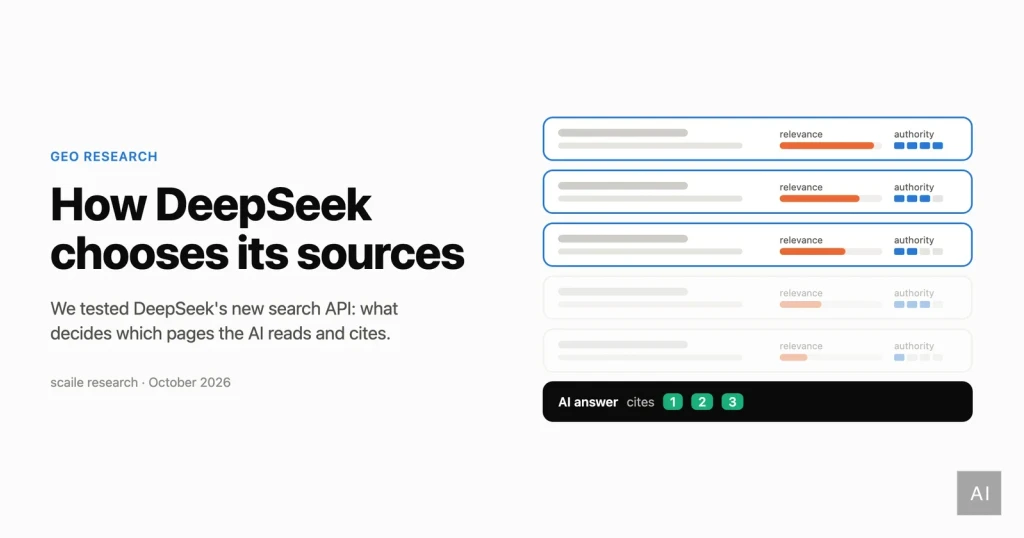
DeepSeek's new search API shows the scores behind every result and the exact text the AI reads. We sent it 180 real buyer questions and a few thousand test searches to find out what gets a website cited.

Key takeaways
Relevance matters most: A page that matches the question well ranks high. Authority and freshness only add a little on top.
The AI doesn't read your whole page: It reads a few pieces cut from it, mostly from the middle.
Two or three pages beat one: A website with several matching pages gets cited more often. We saw the same in ChatGPT and Claude.
Backlinks get you in the door: For most websites without backlinks, DeepSeek didn't have a single page saved.
Why this is worth a look
When an AI answers with web search, three things decide whether your website ends up in the answer:
- Does the search find your page?
- How high does it rank?
- Which part of the page does the AI actually read?
Normally, you can’t see any of this.
On 17 October 2026, DeepSeek opened its own search engine to everyone through a Search API. For every result, it shows the scores it used and the text it gives to the AI. So for once, we can look inside.
What we did
- We asked 180 real buyer questions from three industries (health devices, travel, education) in the German market. 50 results each.
- We let DeepSeek’s AI write an answer from the top 30 results and checked which websites it cited.
- We ran 442 controlled searches on 101 pages to see what changes the score.
- We looked up backlinks, traffic and domain age for 1,000 websites with DataForSEO.
- We checked the same questions in ChatGPT and Claude.
Two words we use a lot
- Website: everything under one address, like
example.com. - Page: one single address on that website, like
example.com/blog/best-blood-pressure-monitors.
A website is made of many pages. DeepSeek’s search saves and shows pages: every search result is one page. But the authority score belongs to the whole website. Every page on www.example.com gets the same authority. A subdomain like blog.example.com counts as its own website.
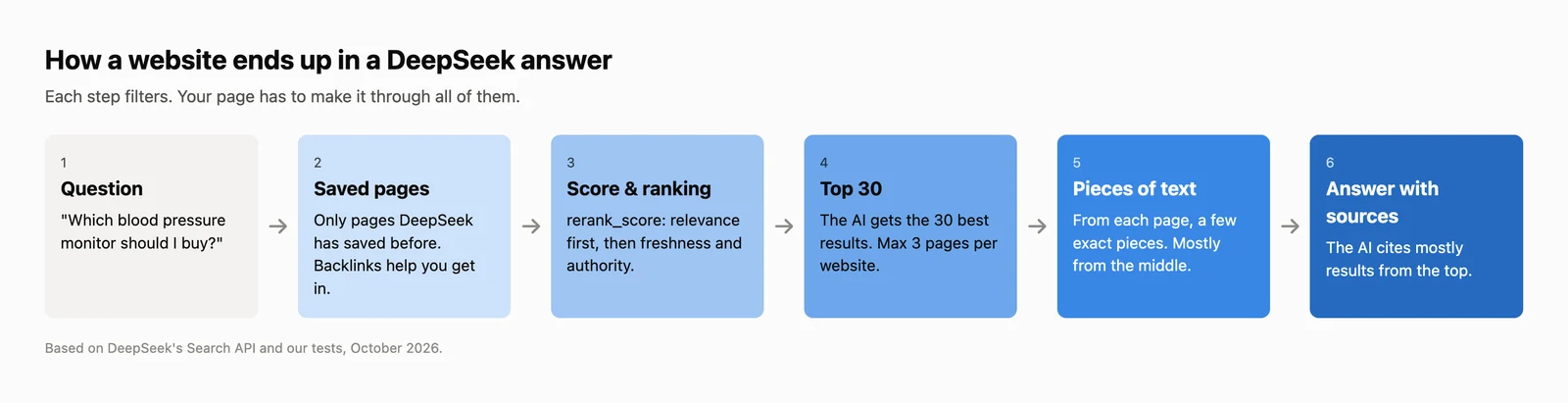
Step 1: Every result gets two scores
Every search result comes with two numbers:
| Score | What it means |
|---|---|
| authority | How trustworthy DeepSeek thinks the website is. 0 to 4. |
| rerank_score | How good the result is for this question. 0 to 3. DeepSeek says it mixes relevance, authority, and freshness. |
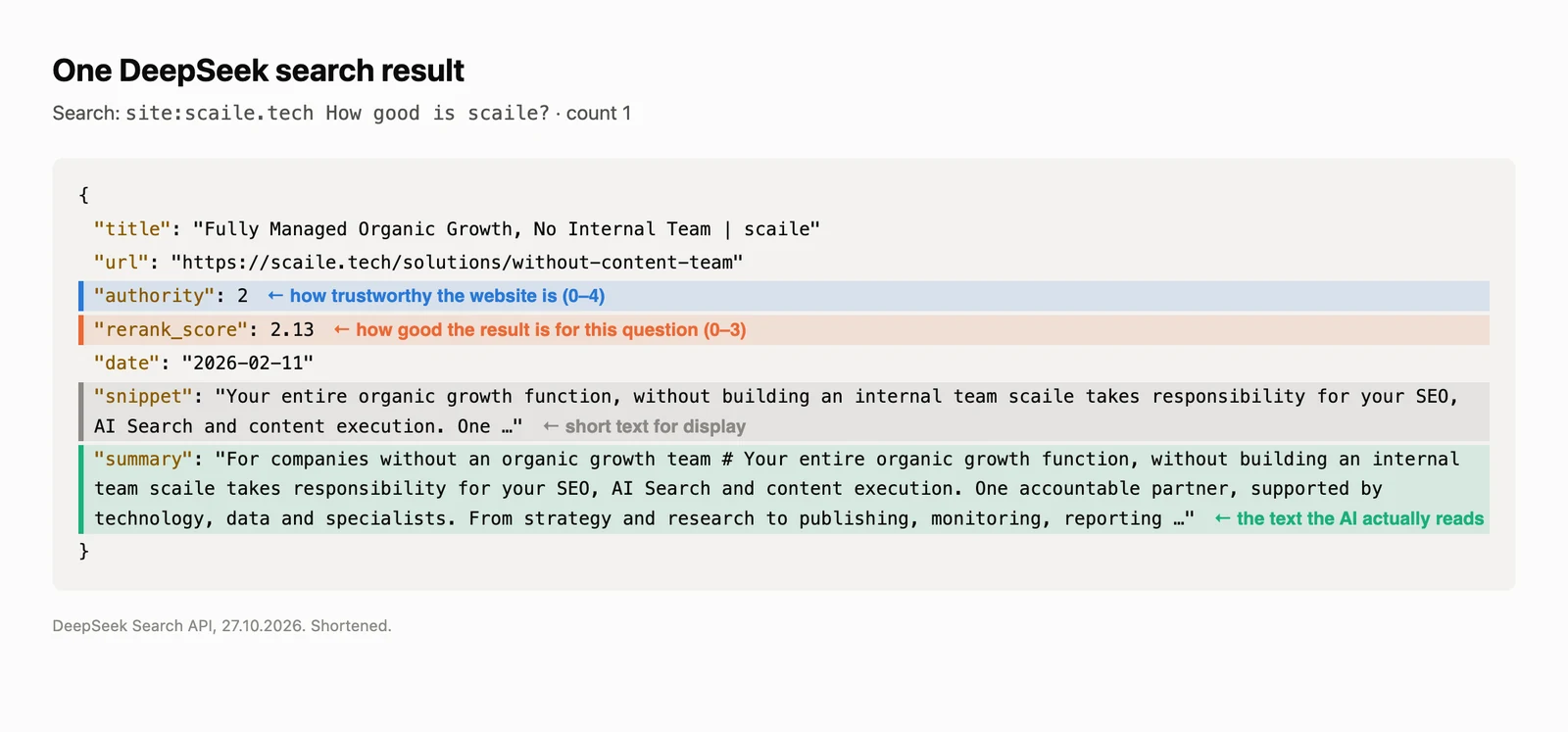
The results are always sorted by rerank_score. We checked over 1,000 result lists, and there wasn’t a single exception. So the real question is: what pushes this score up?
Relevance does most of the work
We wanted to know how much the score depends on how well a page matches the search. To find out, everything else had to stay the same: same page, same website, same authority, same date. Only the search could change.
How we checked. We picked 20 pages. We searched for each page six times, each time with a search that fit it a little worse. We put site: in front, so DeepSeek only looked inside that one website. Then we checked two things: did our page come back, and what score did it get?
Here’s what that looks like for a made-up page called “Best blood pressure monitors 2026”:
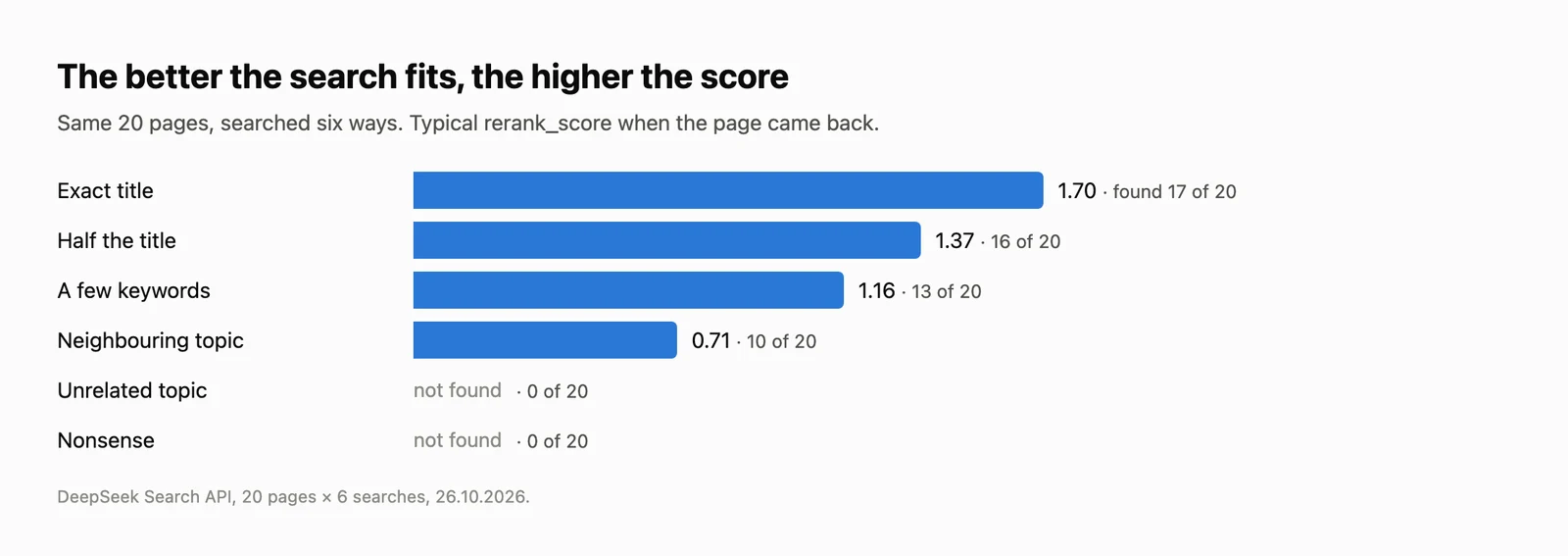
How to read it. Same page, same website, but the worse the search fits, the lower the score. Below a certain point, the page disappears completely. Nothing about the page changed, only how well it matched the question.
The same in real searches. We then looked at all results for our 180 buyer questions. If you know which question was asked, you can explain about two thirds of the differences in score. If you only know the authority of the website, you can explain less than a fifth. So the match between question and page matters much more than how strong the website is.
Authority helps, but only a little
Searching with the exact title, each step up in authority added about 0.2 to the score:
| Authority | 1 | 2 | 3 | 4 |
|---|---|---|---|---|
| Typical score | 1.43 | 1.59 | 1.79 | 2.16 |
That’s enough to move a page up a few places. It won’t save a page that doesn’t match the question.
New pages get a bonus
We used the same test pages as above: single articles, each searched with its exact title. To keep authority out of it, we only took pages from websites with authority 3. Then we grouped the pages by the year they were published:
| Published | 2016–2022 | 2023–2024 | 2025–2026 | No date |
|---|---|---|---|---|
| Typical score | 1.50 | 1.69 | 1.99 | 1.86 |
| How many test pages | 10 | 7 | 16 | 8 |
How to read it. The score climbs step by step. Pages from 2025–26 score about 0.5 more than pages from 2016–22. That’s more than two steps of authority. Pages before 2023 are all about the same. Pages without a date aren’t punished in a normal search: they land between the old and the new pages. We only had a few pages per group, so take this as a first estimate.
DeepSeek looks at the publication date, not the last update. In 173 of 191 pages where the two differed, it used the publication date.
What backlinks do
Backlinks are links from other websites to yours. We looked up the backlinks of 1,000 websites and checked two things in DeepSeek for each one:
- Does DeepSeek’s search have any page of this website saved? Like Google, DeepSeek has its own search engine. It visits websites ahead of time and saves their pages. When someone asks a question, it only searches these saved pages, not the live internet. We searched for
site:example.com, which means “show me any saved page from this website”. If nothing came back, DeepSeek hasn’t saved a single page of that website. Then the website can never appear in an answer. (This has nothing to do with the AI’s training data. It’s only about the search.) - How high is its authority?
| Backlinks | At least one page saved | Authority 3 or 4 |
|---|---|---|
| None | 2 out of 10 | 1 out of 10 |
| 1 to 99 | 6 out of 10 | 2 out of 10 |
| 100 to 999 | 9 out of 10 | 5 out of 10 |
| 1,000 or more | 9 out of 10 | 8 out of 10 |
Authority counted only for websites with at least one saved page.
What this means: Backlinks help twice. Without them, DeepSeek often hasn’t saved a single page of your website. Once it has, more backlinks mean higher authority.
But backlinks aren’t everything:
- Domain age counts too. Older websites get higher authority, even with the same backlinks.
- Government websites, universities and health insurers almost always get 3 or 4.
- Some websites with over 1,000 backlinks still get authority 1. Most of them are affiliate and comparison sites.
Step 2: The AI reads pieces, not your page
Besides the scores, every result comes with a summary. This is the text the AI actually reads. It isn’t written by an AI. It’s a few exact pieces cut from your page, joined with ”…”.
The pieces change with the question. One page gets different pieces for different questions.
So where on the page do the pieces come from? We split 600 long pages into small sections and checked which ones were picked:
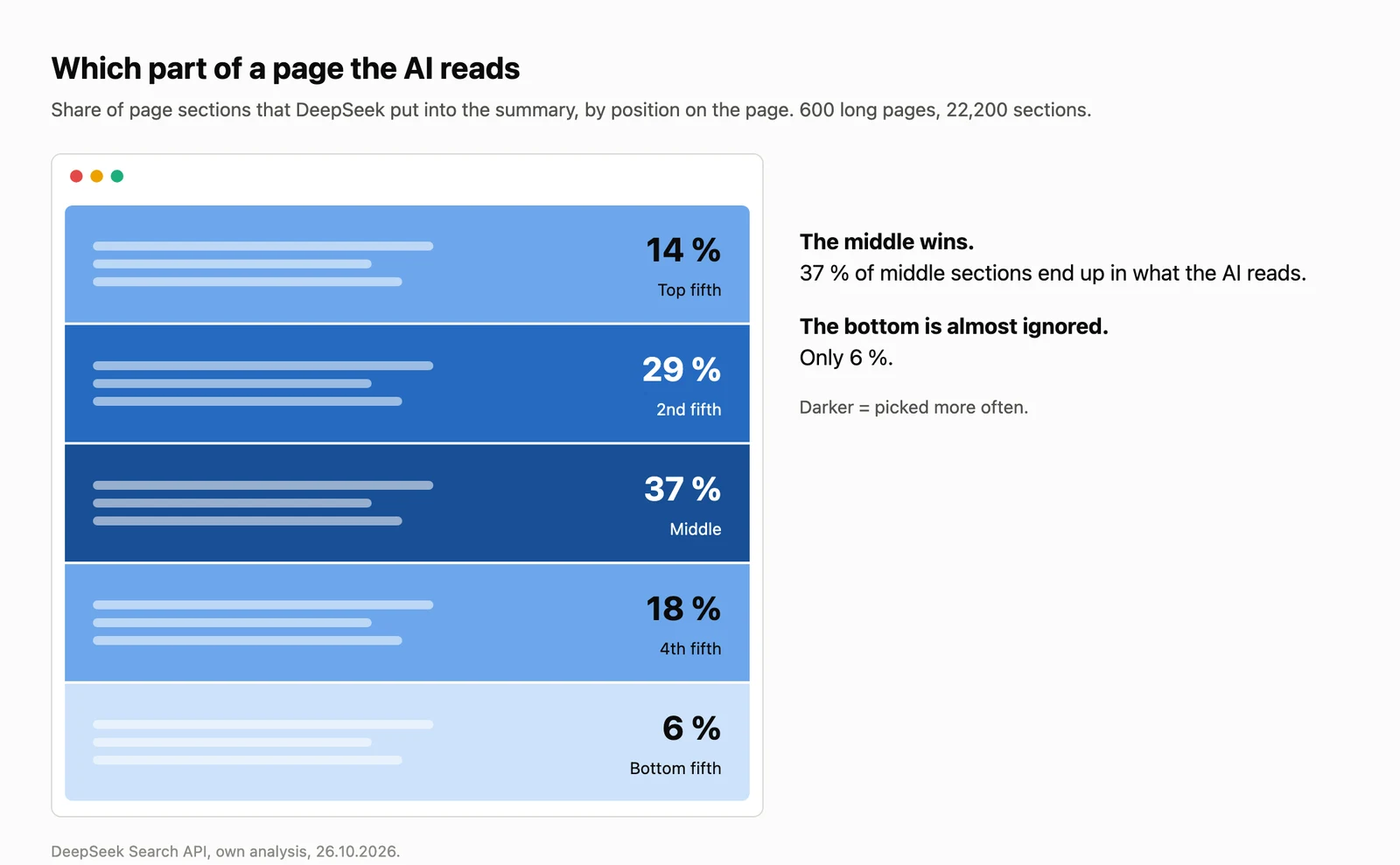
The middle wins. The very top is picked less, and the bottom almost never.
Is that just because the best information sits in the middle? We checked. For every section, we measured how well it matches the question, using an AI model that compares the meaning of two texts. Then we compared sections that match equally well, but sit in different places:
| How well the section matches the question | Top fifth | 2nd | Middle | 4th | Bottom fifth |
|---|---|---|---|---|---|
| Matches worst | 12% | 26% | 33% | 15% | 3% |
| Matches best | 17% | 33% | 42% | 25% | 10% |
Share of sections that ended up in the summary.
How to read it. Compare these two:
- Sections that match worst, but sit in the middle: picked 33% of the time.
- Sections that match best, but sit at the bottom: picked only 10% of the time.
So a weak section in the middle beats a strong section at the bottom. The position matters on its own, not only because of what’s written there. A good match helps too, but less.
One caveat: this is relevance as our model measures it. DeepSeek may judge it differently. To be sure, we would need to put the same paragraph at the top, middle and bottom of a page and see which one gets picked.
Step 3: Getting cited
Position decides
The higher a result ranks, the more likely the AI cites it. In our answers, DeepSeek cited 82% of the results in places 1 to 5, and 43% of those in places 26 to 30.
Authority made no extra difference here. Two results in the same place were cited about equally often. Authority only helps by moving you up.
Two or three pages beat one
The AI gets the top 30 search results and writes its answer from them. Sometimes two or three of those 30 results are pages from the same website. Then that website gets cited more often:
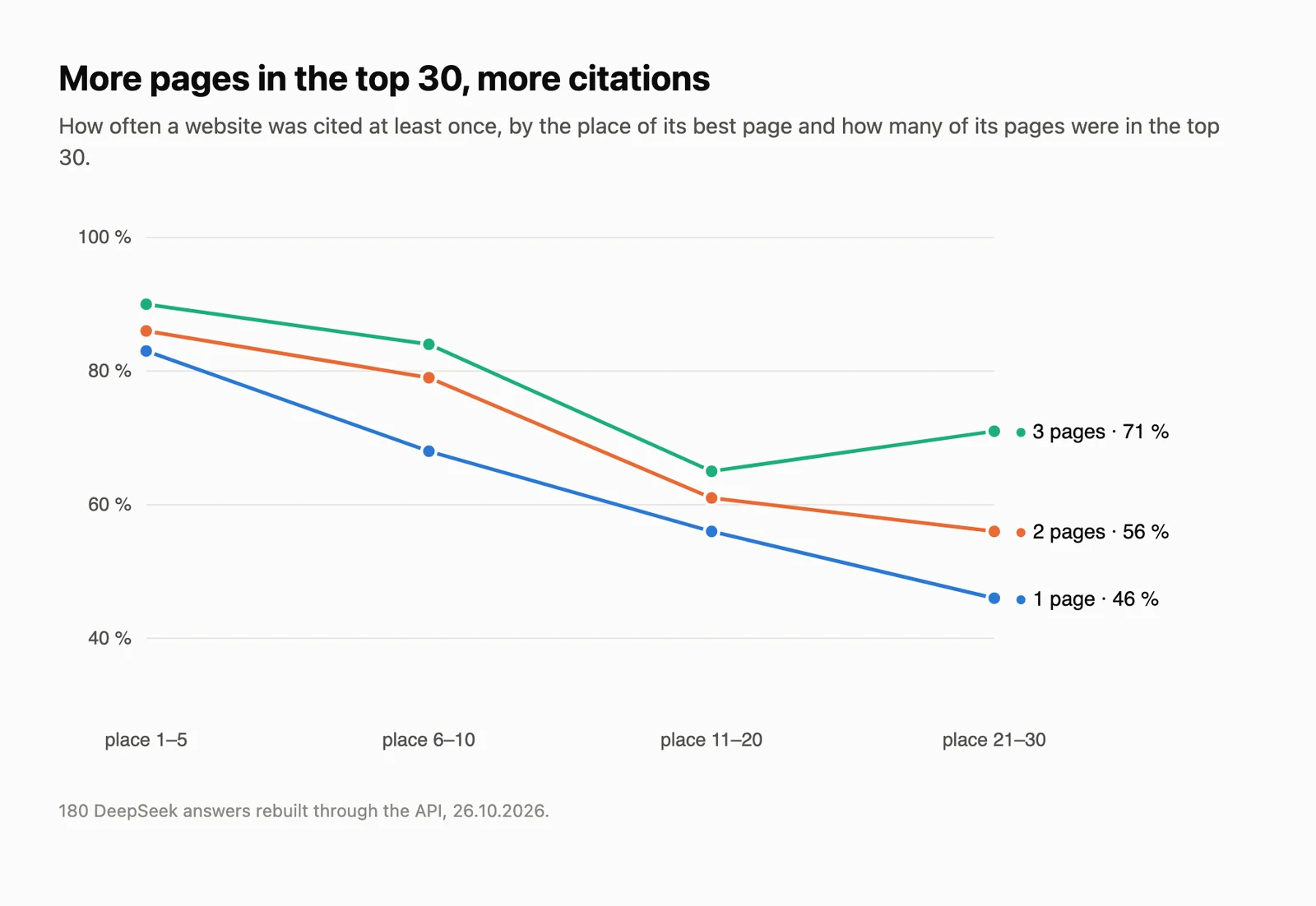
How to read it. Take place 6 to 10: your best page ranks there. If it’s your only page in the top 30, your website gets cited 68% of the time. If two more of your pages are in the top 30, 84%.
DeepSeek’s search almost never returns more than 3 pages of the same website for one question (only 5 times in our 180 questions). So a fourth page usually doesn’t get a place.
Brands get named when many results mention them, and when one of them ranks high
The AI gets 30 search results. Your brand might be mentioned in one of them, or in several. And the best of those results might rank at the top, or further down. Both matter.
For every answer, we counted how many of the 30 results mention a brand and where the highest of them ranks. Then we checked whether the AI named the brand in its answer.
ChatGPT (15,700 cases):
| Results mentioning the brand | Best of them in place 1–5 | Best of them in place 11–30 |
|---|---|---|
| 1 | 37% named | 23% named |
| 2–3 | 55% | 33% |
| 4 or more | 81% | 44% |
DeepSeek (1,022 cases):
| Results mentioning the brand | Best of them in place 1–5 | Best of them in place 11–30 |
|---|---|---|
| 1 | 47% named | 23% named |
| 2–3 | 50% | 50% |
| 4 or more | 72% | too few cases |
How to read it. Take ChatGPT. If only one result mentions your brand and it ranks in the top 5, your brand is named 37% of the time. If four or more results mention it and the best one is in the top 5, 81%. If they all rank further down, only 44%.
What this means: Being mentioned in many results helps a lot. But it helps most when at least one of them ranks near the top. The authority of those websites made no difference.
Is it the same in ChatGPT and Claude?
Mostly, yes. ChatGPT doesn’t show scores, so we could only compare results.
- Relevance: ChatGPT also found pages for matching searches and almost never for unrelated ones.
- Several pages: helped in ChatGPT and Claude too, but only in the top 10.
- Brands: ChatGPT and DeepSeek named mostly the same brands.
- No search at all: Claude answered 41 of our 180 questions without searching the web. Then no website gets cited.
DeepSeek’s authority score doesn’t matter in ChatGPT. ChatGPT uses its own search.
Three things to know if you test this yourself
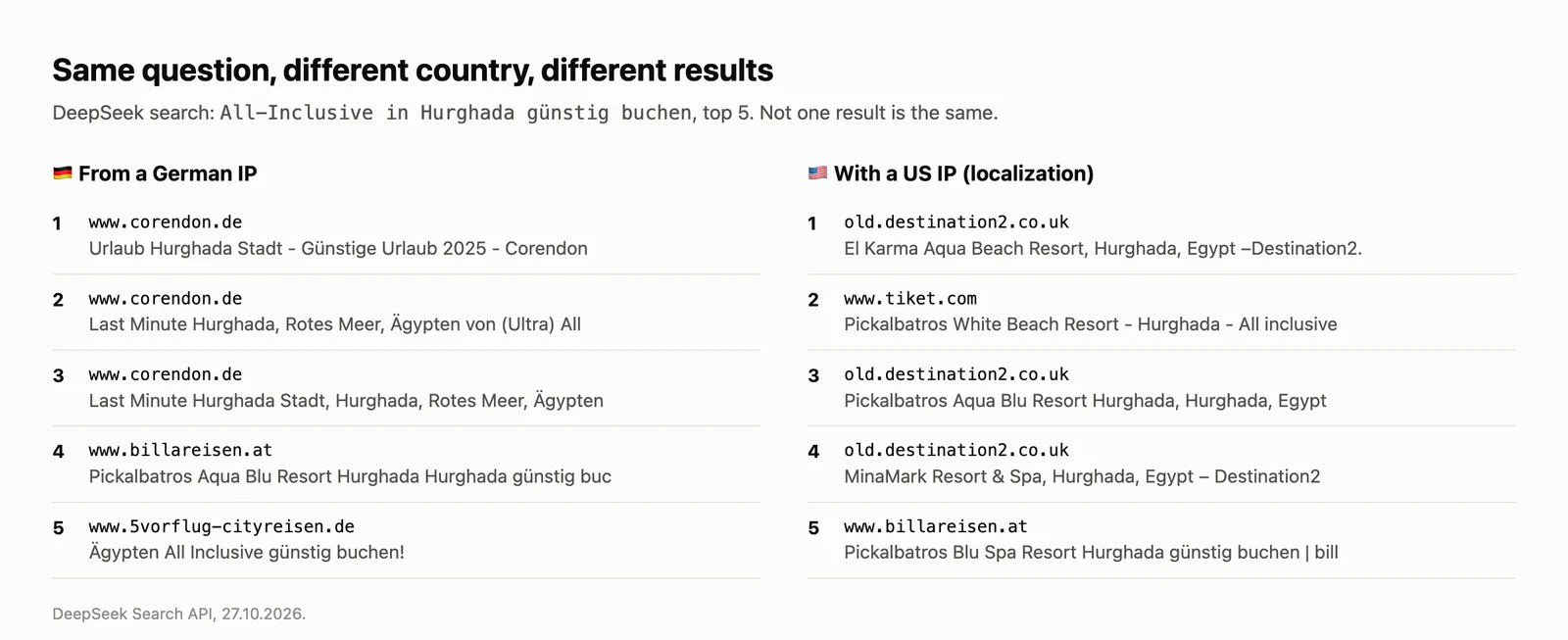
1. Set the country. If you don’t, DeepSeek uses your own location. With a US address instead of a German one, about a third of the top 10 changed.
2. Pages without a date disappear when the search has a date filter. In a normal search, a missing date doesn’t hurt (see the table above). But you can add a date filter to a search, like after:2025 (only pages from 2025 on). Then every page without a date is removed, because DeepSeek can’t tell if it’s new enough. In our buyer questions, 43% of the results had no date, mostly online shops and travel booking pages. We don’t know how often the DeepSeek app adds such a filter by itself.
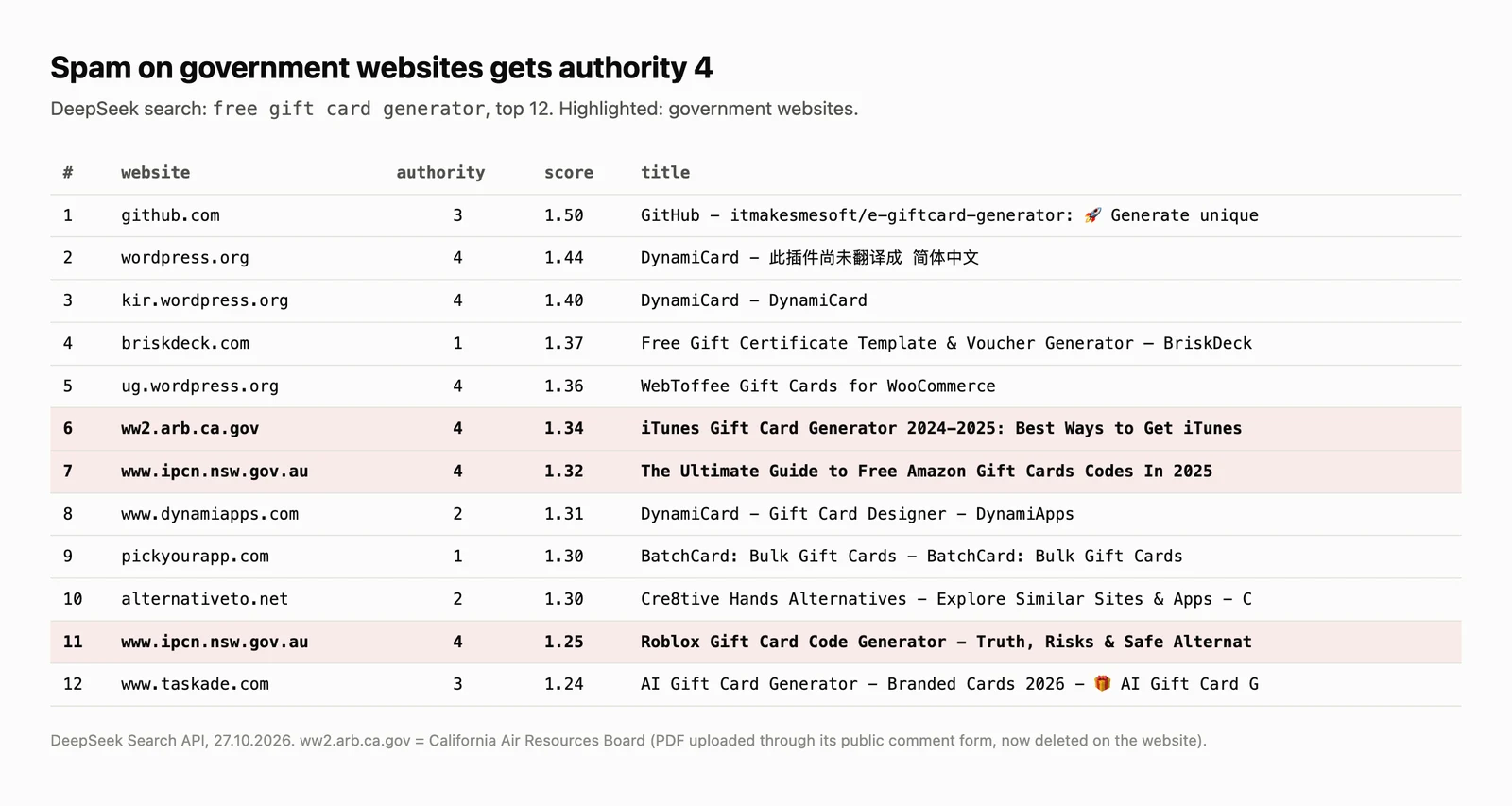
3. Strong websites can carry spam. Authority belongs to the whole website. So spam uploaded to a government or university website gets authority 4 too. We found fake “gift card generators” on government websites at the top of spam searches. For normal buyer questions, this almost never showed up.
You can run your own check like this:
curl -s https://api.deepseek.com/v1/tools/search \
  -H "Authorization: Bearer $DEEPSEEK_API_KEY" \
  -H "Content-Type: application/json" \
  -d '{"query":"site:yourdomain.com", "count":50, "localization":"194.25.0.68"}'
count is how many results you get back (up to 50). localization is an IP address from the country you want to test. The one above is German. It costs $0.75 per 1,000 searches.
What we would do
- Find out what buyers really ask, and answer exactly that. This matters more than anything else.
- Answer important questions on two or three pages. For example a guide, a product page and a comparison.
- Put the key answer in the middle of the page. Not only at the bottom.
- Put a publication date on every page. New pages rank higher, and pages without a date can disappear.
- Get mentioned on websites that already rank for your buyers’ questions. That’s how brands get named.
- Get your first 100 or so linking websites. Below that, DeepSeek often hasn’t saved a single page of your website. More links help a little after that.
- Check your authority with
site:yourdomain.com. Check every subdomain separately.
Limits
- Most of this shows what goes together, not what causes what.
- Our questions come from three industries in Germany.
- We let DeepSeek’s AI write one answer per question. ChatGPT and Claude were tested through developer tools, not the apps.
- We don’t know if the DeepSeek app uses exactly the same scores as the API.
Treat the numbers as a direction, not as a law.