Why does ChatGPT recommend my competitor instead of us?
In short
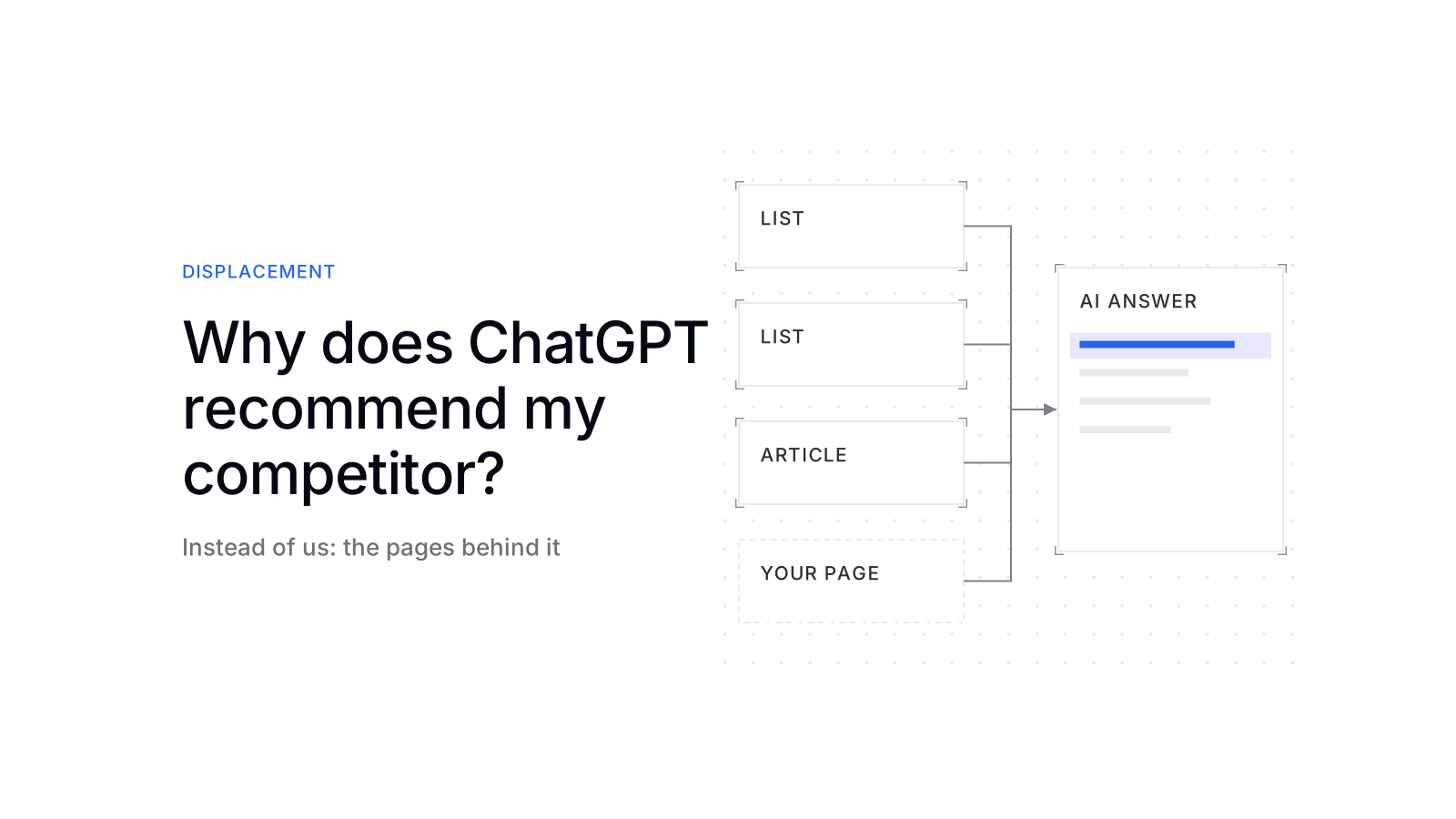
ChatGPT recommends the brands named in the pages it cites, and your competitor is on more of them. Find those pages before you change anything. scaile does this as Managed GEO: tracking, strategy and the work on your site.

Dora is a founding engineer at scaile. She studied computer science, psychology and neuroscience at TUM, which is the perfect fit for GEO: she has a deep understanding of technology and of the human side, and knows how to write and produce content that leads humans to buy and AI to show you in its answers.
Key takeaways
At least 92.7% of the brands ChatGPT recommends for software appear in the content it cites. Your Google ranking is not the input; those pages are.
A competitor wins for four reasons: it is on more cited pages, it sits higher on them, its own site is cited, and it stays cited.
Size is not the signal. 35% of the "best" lists ChatGPT cited sat on low-authority domains.
One answer proves little: AI assistants repeat the same brand list less than once in 100 runs. Check many runs of many questions.
“Page 1 for every category, and ChatGPT recommends our competitors”: why?
Because ChatGPT does not recommend from Google’s ranking. It recommends from the pages it reads for that question. One study tracked ChatGPT’s answers to “best software” prompts in 46 B2B categories. Asked to recommend software, ChatGPT searched the web 95.5% of the time. At least 92.7% of the brands it recommended were named in the content it cited. [1] How that search runs, step by step, is in how OpenAI ChatGPT search works.
Most of those pages are not yours. In an Ahrefs study of ChatGPT recommendation prompts, “best X” blog lists made up 43.8% of all page types among the source links. [2] Your page can rank first on Google and still be one of several pages ChatGPT reads, while the others are comparison lists that name your competitor.

Why does ChatGPT recommend my competitor instead of us?
Usually for one of four reasons, and each one is about the cited pages, not about your product. The same study of 46 B2B categories put numbers on them: [1]
Brands named in 6 or more cited URLs were on average 6 times more likely to be recommended than brands named in 1. The number of cited URLs naming a brand carried 35% of the explanatory power in the study’s regression.
The brand’s position in the cited content carried 31%. A higher place on a “best” list counts for more than a lower one.
A brand was 6 times more likely to be recommended when ChatGPT cited the brand’s own website. [3]
Recommended brands kept the recommendation 75% of the time when they stayed cited, and 13% of the time when they dropped out.
Getting onto one new page rarely flips the answer. Brands that appeared in cited URLs gained a recommendation 3.7% of the time, against 0.6% for brands that did not. And 96% of the brands that newly appeared in cited URLs were not recommended. [1] The data covers B2B software prompts and one researcher’s dataset, so treat the multipliers as direction, not as a law for every market.

Why does a smaller competitor get listed before me in ChatGPT?
Because ChatGPT does not weigh company size. It weighs who the pages it reads put first. Ahrefs found that 35% of the “best” lists ChatGPT cited were published on low-authority domains. [2] A small site’s list can be the page that decides the answer.
Many such lists are written by vendors. Across 250 “best X software” results pages on Google, 169 (67.6%) carried a list in which the company writing it ranks itself first. [2] A smaller competitor that publishes its own comparison and gets onto three trade lists has done the work ChatGPT reads. None of those pages measures your market share, headcount or brand budget.
The same pattern shows up beyond lists: in an Ahrefs study of 75,000 brands, ChatGPT seemed to rely less on traditional authority signals, which Ahrefs calls a possible route in for brands without a large footprint. [4]
Why does a smaller competitor outrank us in AI answers in general?
Because every AI assistant reads its own mix of sources, and none of them keeps a fixed ranking. In Google’s AI Overviews, 76.10% of cited pages rank in Google’s top 10, in an Ahrefs study of 1.9 million citations. [5] There your Google rankings count for a lot, so a competitor can lead in ChatGPT and trail you in AI Overviews for the same question.
The answers also move between runs. In a SparkToro study, 600 volunteers ran 12 prompts through ChatGPT, Claude and Google’s AI a combined 2,961 times. The assistants gave the same list of brands less than once in 100 runs. [6] Rand Fishkin’s conclusion: how often a brand appears across many runs is a usable measure, a “ranking position in AI” is not. A competitor that “outranks” you in one screenshot may, for example, appear in a third of the answers and you in a quarter: close, not a defeat.
How do you check who is actually winning your prompts?
Run your buyer questions many times, then read the sources, not just the names. Four steps:
- 1List the questions
Ten to twenty questions your buyers ask before they choose, without your brand name: “best X for Y”, “alternative to Z”, “X for a company of our size”.
Your partSales calls, support tickets and Search Console queries - 2Run each one several times
In a fresh session, in ChatGPT and in each assistant your buyers use. Count how often each brand appears.
Your partThe same wording every time - 3Record the cited pages
For every answer, note which pages ChatGPT cited and which brands each page names, in which position.
Your partOne sheet: question, page, who is on it, where you are - 4Sort each gap into a reason
Match what you found to the four reasons above. The diagram below shows which finding points to which reason.
Your partDecide which questions matter most

The method, and what one result is worth, is in the guide to a free AI visibility check. scaile’s AI Visibility Check is a shortcut: it identifies the questions your customers ask just before buying and tests them against real ChatGPT, Gemini and Perplexity sessions.
Where the fix starts: the pages that name your competitor
The fix starts with the cited pages where your competitor appears and you do not, because those pages build the answer. Work through them in this order:
- The lists and articles that cite your competitor. Ask the publisher to review your product, send data or a customer case, and correct outdated entries.
- Your own answer page. A page on your site that answers the question gives ChatGPT a reason to cite you directly.
- Staying cited. Keep both current, because a brand that drops out of the sources loses the recommendation far more often than one that stays.
The five steps from here to a mention, with the places ChatGPT looks, are in how to get your business mentioned in ChatGPT.
One case on scaile.tech shows the competitor situation and what changed it:
At BILD Reisen, AI assistants answering German travel questions recommended competing tour operators and booking portals. With scaile, AI-generated search mentions tripled, with a similar SEO effect.
ChatGPT recommends your competitor because the pages it reads name your competitor: more often, higher up, on its own site, and month after month. Check many runs of your buyer questions, read the cited pages, and start with the ones where your competitor is and you are not. To see which competitor wins which question, and from which pages, talk to scaile about Track. scaile finds the questions with you and tracks the answers and their sources in its own platform.
FAQ
Is ChatGPT just confusing my brand with a competitor?
Sometimes, when two companies share a name or a category term and nothing on the web separates them clearly. A page that states your company facts in one place helps; see grounding pages and entity SEO.
Should we publish our own “best X” list?
It can be cited, but say it is yours. In the Ahrefs software sample, when the publisher was recommended, its own self-promotional list still showed up in more than a third of the ChatGPT responses. A list that only praises its author helps neither the reader nor your credibility with the people who check it.
Sources
- How much can you influence which brands ChatGPT recommends?
- Do Self-Promotional “Best” Lists Boost ChatGPT Visibility? Study of 26,283 Source URLs
- The importance of getting your content cited by ChatGPT, quantified
- Top Brand Visibility Factors in ChatGPT, AI Mode, and AI Overviews (75k Brands Studied)
- 76% of AI Overview Citations Pull From the Top 10
- NEW Research: AIs are highly inconsistent when recommending brands or products; marketers should take care whe