GEO agency vs tool vs in-house vs DIY: how to decide who does GEO
In short
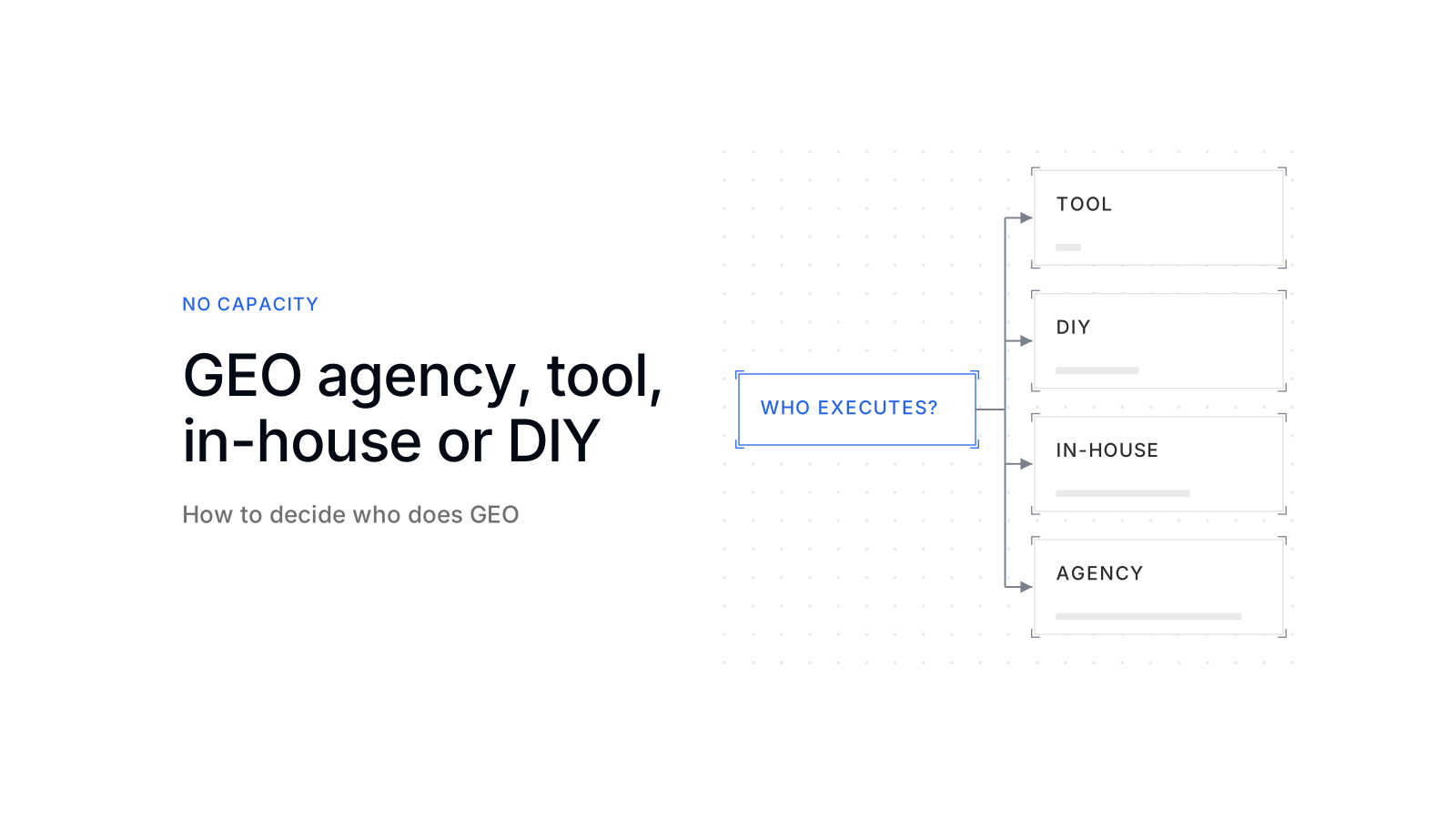
Choose between a GEO agency, an AI visibility tool, an in-house team and DIY by asking who will do the execution every month. A tool measures where AI answers name you; it does not change your pages. In-house works when your team already turns strategy into monthly output. DIY costs a marketer's hours. An agency fits when nobody has those hours. scaile finds the prompts your buyers ask, tracks your brand in AI answers and builds the strategy with you through a human strategist. It makes the changes on your site, or runs the whole job while your team approves.

Dora is a founding engineer at scaile. She studied computer science, psychology and neuroscience at TUM, which is the perfect fit for GEO: she has a deep understanding of technology and of the human side, and knows how to write and produce content that leads humans to buy and AI to show you in its answers.
Key takeaways
Generative engine optimization (GEO) consists of four jobs: tracking, strategy, execution and measurement. The paths differ in who does the execution.
An AI visibility tool is not an alternative to an agency. It is the measurement every path needs.
In-house GEO works when your team already keeps core SEO moving and publishes every month. If it struggles with SEO today, GEO will move slowly too.
DIY is a tool plus somebody's working day each week. Those hours are the real price.
You can start with an outside team and build your own later, as long as the content and the knowledge behind it stay yours. scaile works that way.
Agency, in-house, tool or DIY: how do you decide?
Decide by who will do the execution every month, because that is the job that changes what AI answers say. GEO has four jobs. Tracking shows where ChatGPT, Gemini, Perplexity and Google AI Overviews name you and where they name a competitor. Strategy decides which buyer questions to win. Execution rewrites and publishes the pages that answer them. Measurement shows what moved.
Every path covers tracking; only some cover execution. Content work is what moves the result. The paper that named generative engine optimization reports that GEO methods raised visibility in generative engine responses by up to 40% in its own benchmark. It is an arXiv preprint, not peer reviewed. [1] The technical part is less exotic than offers suggest. Google states there are “no additional requirements to appear in AI Overviews or AI Mode, nor other special optimizations necessary”. [2]
So the sourcing question is a capacity question. Count the hours your team can give to rewriting and publishing pages each month, then pick the path that fills the gap.
What does each path actually cover?
Each path covers tracking, strategy, execution and measurement to a different degree, and whatever a path leaves open stays with your team.
| Path | Tracking | Strategy | Execution (pages written and published) | What stays with your team |
|---|---|---|---|---|
| AI visibility tool | Yes | Hints and gap reports | No | Every rewrite, every page, every decision |
| DIY (tool plus your hours) | Through the tool | You | You, when you find hours | All of it |
| Freelancer or fractional specialist | Usually a tool | One person | Partly, one person’s hours | Volume, approvals, missing skills |
| In-house team | Through a tool | Your team | Your team | Hiring, training and covering every skill |
| GEO agency | Yes | Yes | Yes | Context, expertise and approvals |
Prices for each path are a separate question, answered with published numbers in what generative engine optimization costs. Compare paths by the last column first: it is the work you still own after you pay.
Is a GEO tool an alternative to an agency?
No. A GEO tool and a GEO agency do different jobs, so one rarely replaces the other. GEO Toolbox, a vendor of GEO software, puts it plainly on its own blog: software is “your measurement layer”, and services, meaning an agency or consultant, are “your execution layer”. [3] The same guide adds that “most GEO software flags and suggests. It does not execute.” [3]
Where does AI name us, where does it name a competitor, and did that change since last month?
Which pages do we rewrite or publish this month so the answer changes?
A tool is the right purchase when your team has the hours to act on the data every week. Without them, the dashboard reports the same gap every month. The useful decision is which prompts to track, covered in which prompts to track for AI visibility, and who acts on them.
What does running GEO in-house take?
Running GEO in-house takes a team that already turns strategy into published pages every month. WebFX describes in-house GEO as the business owning “the full strategy and execution process internally”. An SEO lead, the content team or a digital marketing manager usually owns it, “often with help from technical SEO, analytics, web, and content contributors”. [4]
That list is the honest requirement. One hire rarely covers it. GEO needs someone to choose the questions, someone to write with evidence, someone to change templates and structured data, and someone to read the numbers.
The best predictor is your SEO today. An in-house SEO team can handle parts of generative search in the early stages, according to Digital Agency Network, if it already produces high-quality content and maintains strong technical foundations. [5] WebFX gives the reverse test: “If your team struggles to keep core SEO work moving, in-house GEO will likely move slowly too.” [4]
In-house fits when three things are true: the people exist, they have room on the roadmap, and someone owns the result. It also builds knowledge that stays in the company. If one of the three is missing, an outside team is the alternative to a new hire: scaile works for many companies at once, brings what it learns across all of them, the way a consultancy does, and costs less than one in-house GEO position.
When do DIY or a freelancer make sense?
DIY makes sense when the gap is small: a handful of pages to fix, one market, and a marketer who can give the work a fixed share of each week. GEO Toolbox names the trap: if a marketer spends one day a week on GEO, “that time is the real cost of the ‘DIY’ path”. [3] Budget that day before you buy the tool.
A freelancer or fractional specialist makes sense when your team can produce but lacks direction. One experienced person can set the strategy, review your pages and train your writers. The limit is volume: one person’s hours set the pace of execution, and the skills that person lacks stay open.
Both paths work as a start. They stop working when the list of pages to change grows faster than the hours available to change them.
A decision tree for your situation
Answer four questions in order. The first “no” usually decides the path.
- 1Do you know where AI answers name you and your competitors?
If no, start with tracking: a tool, or the free AI visibility check.
If yesGo to question 2 - 2Does someone on your team have at least one day a week for GEO?
If no, you need an outside team that executes: an agency or a partner that runs the function.
If yesGo to question 3 - 3Does your team already publish and keep core SEO moving every month?
If no, add a strategist or freelancer who sets direction, and keep the scope small.
If yesGo to question 4 - 4Can your team produce the pages at the pace the strategy needs?
If yes, run GEO in-house with a tool. If no, keep strategy and approval in-house and hand research, writing and publishing to a partner.
ThenReview the choice every quarter against what moved
A CMO whose team is already full stops at question 2 or 4. The board still wants a defensible answer on AI search.
Can you combine paths or switch later?
Yes. Paths combine well: a tool for measurement and a team, inside or outside, for execution. The question is how to switch without starting from zero.
Plan the exit when you choose the entry. If an outside team runs GEO first, make sure the strategy, the knowledge it works from and the published pages belong to you. scaile, for example, can install and operate the function while a company builds its own team. The Brand Kit, Knowledge Base and published content stay with the client.
The reverse switch matters as well. A team that started in-house can hand over execution when capacity runs out and keep the strategy. Building Radar is a case where outside execution worked without new hires: the company doubled its qualified inbound leads in 90 days with no increase in marketing headcount.
For what an agency actually does in a month, see what a GEO agency does. For a scored list of providers, see the best GEO agencies in 2026.
The sourcing decision comes down to one honest number: the hours your team can give to execution each month. If that number is close to zero, the work needs a team that executes for you. Talk to scaile about We run it: scaile runs strategy, content, publishing and reporting with a dedicated strategist, and your team approves.
FAQ
Do I need a GEO agency?
You need outside help when AI answers name competitors instead of you and nobody on your team has the hours to change your pages every month. If your team has those hours and already publishes well, a tool and a clear strategy can be enough.
Should we hire a GEO agency or buy a tool?
Buy the tool if your team will act on its data every week. If it will not, hire a team that does the execution for you. You may need both, because the tool measures what the agency changes.
Can a GEO freelancer replace an agency?
A freelancer can replace the strategy part and review your work. Production volume is the limit: one person’s week sets how many pages change.
Should GEO sit with the SEO team?
Usually yes, because the technical foundations and the publishing workflow are the same. The SEO team needs extra capacity for the content work, either new hires or an outside team.
Sources
- 2311.09735 GEO: Generative Engine Optimization
- AI Features and Your Website | Google Search Central | Documentation | Google for Developers
- GEO Services vs Software: Hire an Agency or Use a Tool?
- In-House GEO vs. Agency GEO: Which Is Better?
- Do You Actually Need a GEO Agency — or Can Your SEO Team Handle Generative Search?