Do your customers even use AI search? Is GEO worth it for your niche and size?
In short
Find out where your customers come from. scaile also sees in your Search Console and GA4 data whether there is demand, and analyses a large amount of data from the web to find out whether your customers use AI search.

Dora is a founding engineer at scaile. She studied computer science, psychology and neuroscience at TUM, which is the perfect fit for GEO: she has a deep understanding of technology and of the human side, and knows how to write and produce content that leads humans to buy and AI to show you in its answers.
Key takeaways
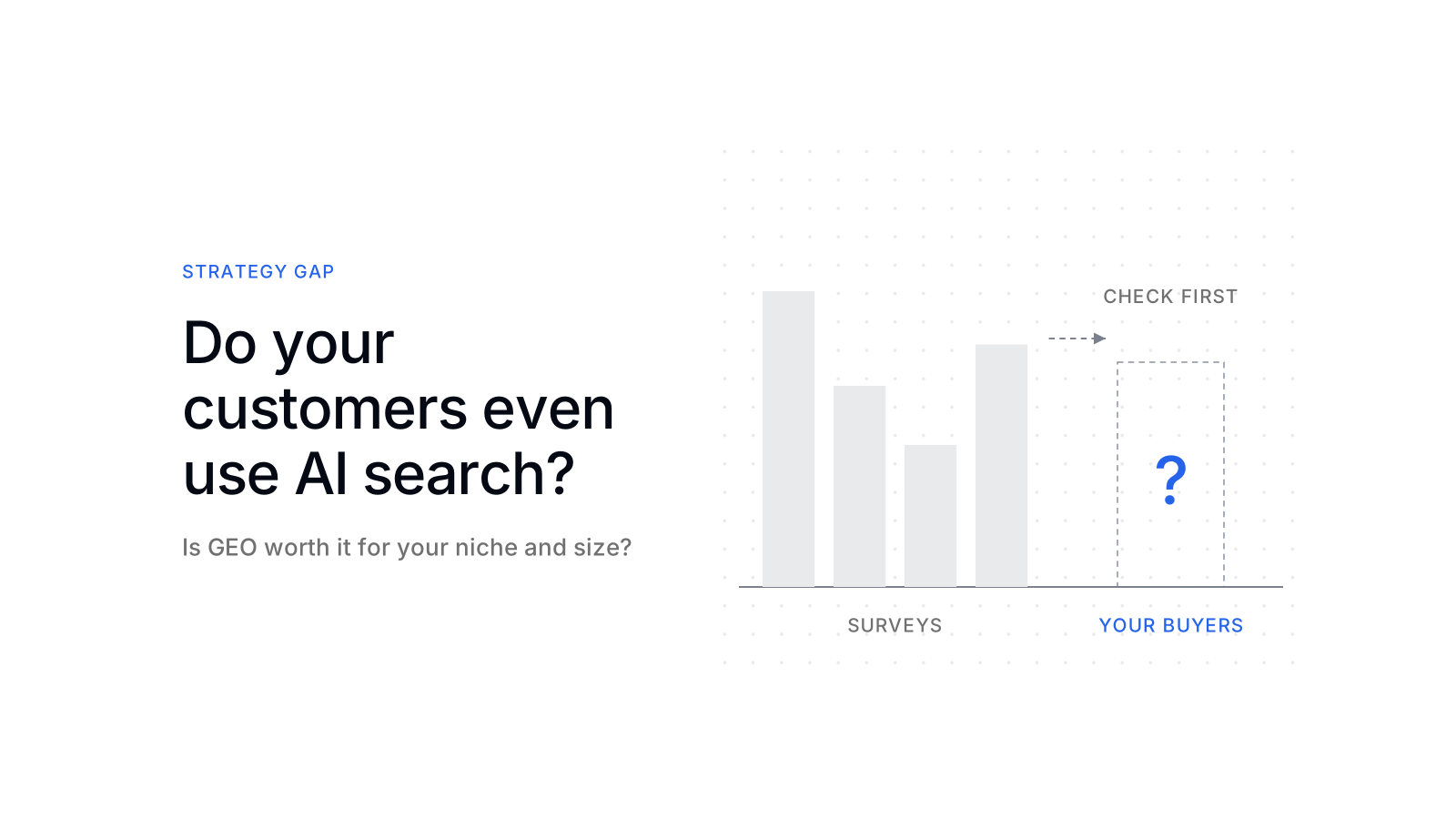
Surveys only show a direction: buyers in tech, in the US, in large companies and under 30 use AI search most. Your own data decides for your market.
Where your customers come from is in your CRM and your sales calls.
Whether there is demand, scaile reads from your Search Console and GA4.
Whether your buyers ask AI, and who gets named there, scaile finds in data from the open web and in tests run directly in ChatGPT, Gemini and Perplexity.
A niche is not too small for GEO. When the signals are unclear, start with a small, measured test.
Do your customers even use AI search?
Some of your customers probably do, but no survey tells you how many. Only your own data does. Industrial software houses, travel companies and construction-tech startups ask this in first calls in these words, because generative engine optimization (GEO) only pays when your buyers read the answers of ChatGPT, Gemini, Perplexity or Google’s AI features before they decide.
The surveys show where to look. In Germany, half of internet users at least sometimes use an AI chat instead of classic search, and two thirds of 16- to 29-year-olds do. [1] Among B2B buyers the segments are far apart: 48% of US buyers find new vendors with generative AI, against 14% in other regions. [2] Buyers at companies with 1,000 to 5,000 employees name AI search as a top research source 55% of the time, smaller businesses 35%. [3]

Responsive sells proposal software and G2 runs a software review site, so both have a stake in the topic. For a German mid-sized company outside tech, that means a minority of your buyers probably find suppliers through AI today. Whether that holds for you is in the three sources below.
Find out where your customers come from
The quickest evidence is already in-house: your customers have told you how they found you, often just not in a field you report on.
- 1The source field in your CRM
Add “AI assistant such as ChatGPT” to “How did you hear about us?” and check after a few weeks how often it is picked.
Shows youEnquiries that never show up as a click - 2Your sales calls
Ask sales to note when a buyer mentions ChatGPT, Perplexity or a Google AI answer, and read your call transcripts for it.
Shows youWhether AI already shapes the shortlist you are on
Many assistants send no referrer, so some of these customers appear in analytics as direct visits. That is why what customers say counts for more than any click.
What your Search Console and GA4 show about demand
With access to your Search Console and GA4, scaile sees whether there is demand for your offer and whether some of it already comes through AI. In GA4 that means sessions from chatgpt.com, perplexity.ai, gemini.google.com and copilot.microsoft.com: how many, where they land and whether they turn into enquiries. In Search Console it means long queries phrased as questions, and pages with many impressions but few clicks.
One limit applies: Search Console reports traffic from AI Overviews and AI Mode inside the normal “Web” search type, so it cannot be separated there. [4] That is why scaile puts this data in the same report as the measured AI visibility, so the two can be read together.
What scaile finds in data from the web
What your own data does not show can still be measured: how your buyers ask, and what answer they get, scaile finds in a large amount of data from the open web. The result is a list of the questions your buyers ask just before they buy, each with its weight.
Questions and recommendations in forums, social media and news, including ones with no search volume that still lead to a purchase.
Google Also Asked, Google Trends, autocomplete in Brave and other search engines, and search volumes.
The sub-searches an assistant runs in the background to answer a question, and the pages it reads for them.
scaile asks the questions in ChatGPT, Gemini, Perplexity, Claude and Google AI Overviews and measures who gets named, at which position and with which sources.
The last one counts most. If AI answers already name a competitor for your buying questions, someone in your market is reading them. How to spot-check this yourself is in free AI visibility check; how scaile finds the questions is on find customer intent.
Is a niche too small for GEO?
Rarely, because what counts is not how many people search but whether the few who buy ask an assistant first. In a narrow market few companies answer the same questions well, so a handful of pages can be enough to get named. The risk lies elsewhere: if your buyers never type their question into a search box or an assistant, there is nothing to be named for.
Braun & Kollegen, a Munich law firm for succession, foundations and business law, was on 21 September 2026 the firm AI answers named most often: first of 25 Munich firms, on 32 of its clients’ questions in ChatGPT, Gemini, Perplexity and Google AI Mode. Its Google clicks went from 218 to 1,101 a month, August 2025 to August 2026.
Building Radar, which sells construction intelligence, doubled its qualified inbound pipeline in 90 days with 50 AEO-optimised pages.
Both are results on one account each, not a forecast for yours.
Worth it now, test first, or wait
The data leads to two checks: do your buyers ask an AI before they buy? Is a competitor already named where you are missing? Both yes: worth it now. Unclear: a small test. Both no: it can wait.

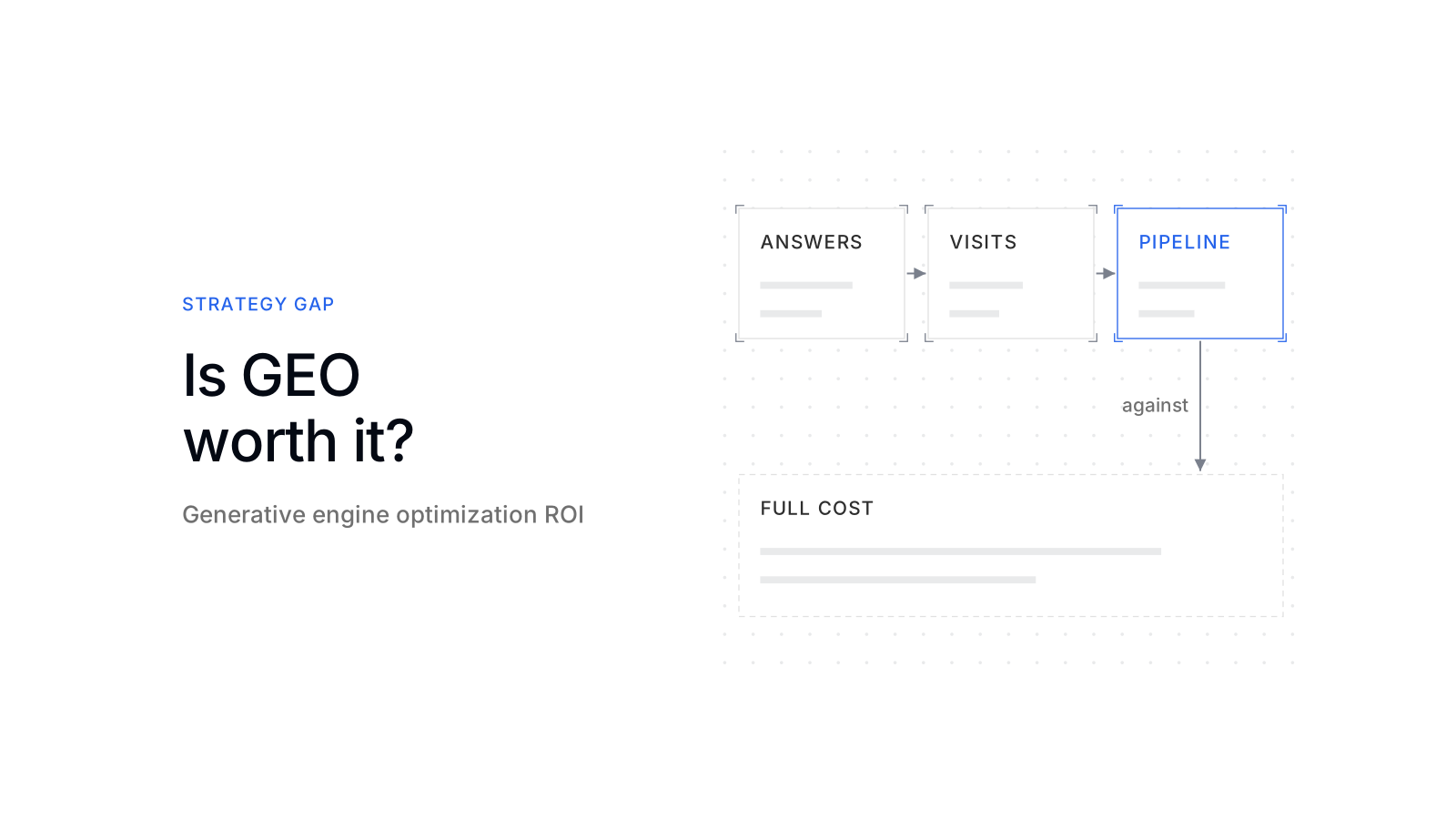
A test means a limited set of buying questions, a few pages and fixed measurement over a few months; what a GEO pilot should include sets out the scope. Waiting is a fair result too, as long as you read the signals again every few months. Once they say yes, the ROI evidence for GEO shows how to work out the return.
What scaile delivers
scaile first delivers the evidence of whether your buyers use AI search, then does as much of the work as you want.
scaile tracks your buying questions in its own platform, app.scaile.to, across ChatGPT, Gemini, Perplexity, Claude, Copilot, Google AI Mode and AI Overviews. Tracking only, and it can be extended at any time.
You getWhether your brand appears, at which position, and which competitors and sources are named insteadA scaile strategist builds the GEO strategy from this data, and scaile executes it: website changes, content and refreshes.
You getThe pages your buyers’ questions need and a weekly strategy callYour teamReviews and approves every stepscaile runs GEO end to end: strategy, website changes, content, publishing, refreshes and monitoring. This also fits a small company without a marketing team.
You getReports and the plan for what comes nextYour teamBrings expertise and approvalsIf you want to see first whether your buyers use AI search, talk to scaile.
Frequently asked questions
What data does scaile need from us?
Access to your Search Console and GA4, plus whatever sales and customer success have: call transcripts, support tickets or the questions that land in your inbox. Without internal data, scaile starts with your website, your competitors and the open web.
We sell through tenders and long-standing relationships. Does AI search still matter?
Often yes, but earlier in the process. Buyers use AI answers to understand a problem and build a first vendor list before a tender is written. If your buyers only buy from existing relationships, the effect is smaller.
How many buying questions should a mid-sized company track?
Enough to cover each offering just before purchase: usually a few dozen, not hundreds. Start with the questions sales hears most often.