AI share of voice: how to measure it against competitors
In short
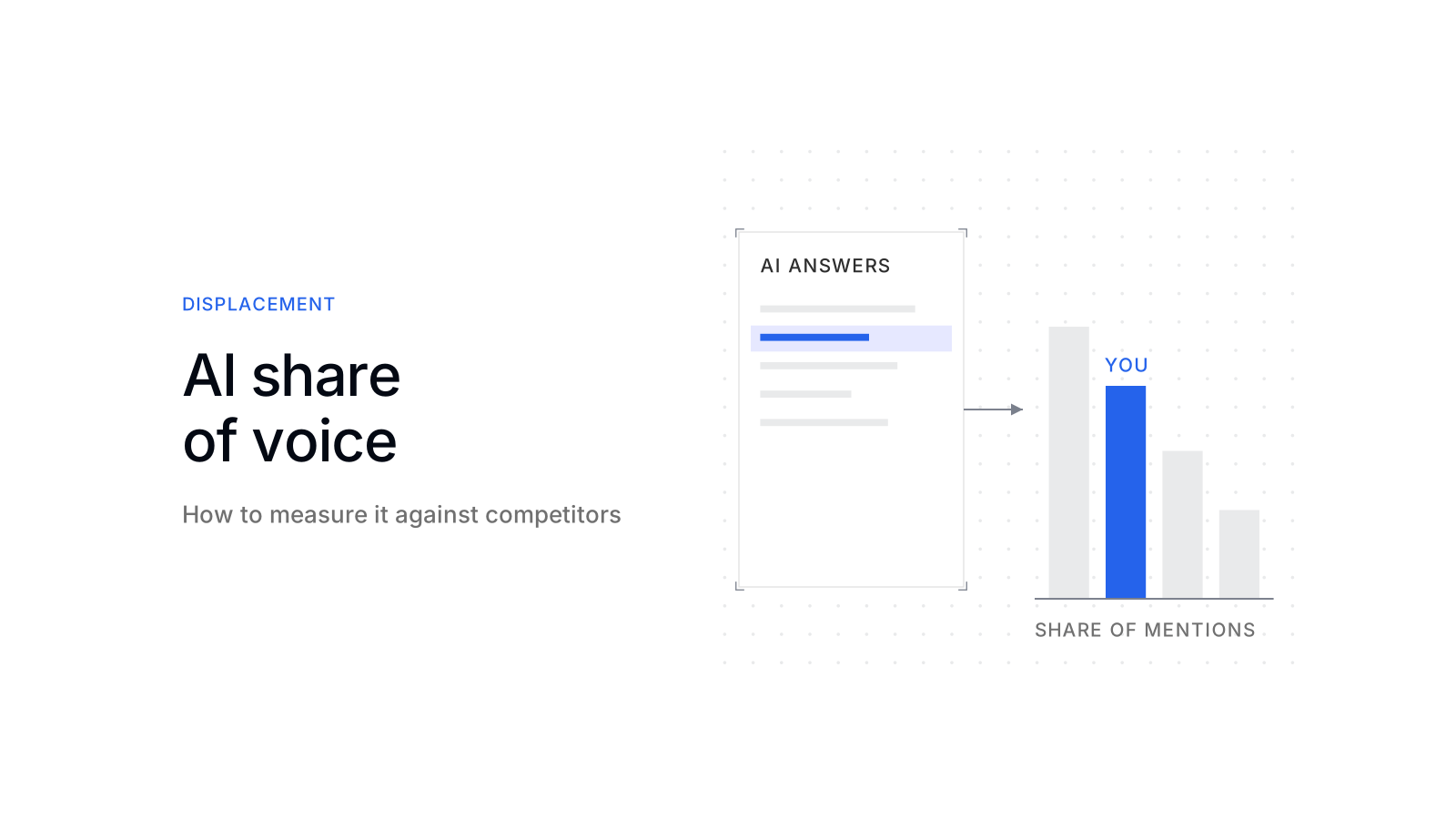
AI share of voice is your brand's share of all brand mentions in AI answers to a fixed set of buyer questions. The formula, the competitor list and the sample size decide the number. scaile measures it as Managed GEO.

Dora is a founding engineer at scaile. She studied computer science, psychology and neuroscience at TUM, which is the perfect fit for GEO: she has a deep understanding of technology and of the human side, and knows how to write and produce content that leads humans to buy and AI to show you in its answers.
Key takeaways
AI share of voice shows how often AI assistants name your brand compared with the competitors you track.
The same AI answers can give very different numbers depending on how you count. Always say which way you counted.
Adding or removing one competitor from your list changes your share, even when no answer changed.
Being cited as a source and being recommended by name are two different things. Measure both.
Ten questions asked once tell you almost nothing. Use dozens of questions, several AI assistants and repeated runs.
What is AI share of voice?
AI share of voice is the share of AI visibility your brand captures compared with the competitors you track, across the questions you care about. [1]
Semrush defines it as the percentage of mentions your brand receives in AI-generated answers compared with competitors in your market. [2] The term comes from advertising, where it meant a brand’s share of all advertising in its category, usually measured by spend. [3]
The number depends on three choices you make before the first answer comes in:
- Questions: which buyer questions you ask. Which prompts to track covers how to find them.
- Engines: which AI assistants you ask, and from which market.
- Competitors: which brands count in the total.
How to calculate AI share of voice: four formulas
There is no single AI share of voice formula. Four common ones count the same answers differently:
Your appearances ÷ the appearances of all tracked brands. Each brand counts once per answer that names it. [3]
Answers that name you ÷ answers that name any tracked brand. [1] Several brands can share one answer, so the shares of all brands add up to more than 100%.
Answers where you are named first ÷ all answers with a tracked brand in them.
Each mention weighted by its place in the answer, so a first mention counts more than a fifth. The paper that introduced generative engine optimization (GEO) reduces a citation’s weight by an exponentially decaying function of its position. [4]
Answer presence, the answers that name you divided by all answers, sits beside them. It is a rate, not a share. [3] It does not move when the competitor list changes, which is why it belongs in the same report. [3]
A worked example: 1,200 answers from our own tracking
On the same 1,200 answers, the leading brand’s share of voice ranged from 16.7% to 53.3%, depending only on the formula.
The panel: 60 questions buyers ask when they choose a GEO agency or an AI visibility tool, in English and German, none naming scaile. Each went to ChatGPT, Gemini, Perplexity and Google AI Mode on five days between 2 and 16 November 2026. The brands are anonymised; all are tools or agencies in scaile’s own market.
375 of the 1,200 answers named at least one brand. Together they named 11 brands 790 times. The five brands named most often:
| Brand | Appearances | Appearance share | First-named share | Position-weighted share | Answers citing its site |
|---|---|---|---|---|---|
| Brand A | 200 | 25.3% | 34.7% | 32.6% | 62 |
| Brand B | 171 | 21.6% | 20.0% | 23.5% | 55 |
| Brand C | 143 | 18.1% | 8.5% | 15.0% | 55 |
| Brand D | 85 | 10.8% | 22.4% | 9.4% | 33 |
| Brand E | 73 | 9.2% | 1.9% | 6.9% | 0 |

The table changes the story twice:
- Brand D has the fourth-largest share but is named first in 84 of its 85 answers. On first-named share it beats Brand B.
- Brand C is named often but late. Its share halves when position counts.
How the competitor set and the prompt set move the number
Share of voice is a share of a list you chose, so a change in the list changes the number. In our panel, Brand A’s appearance share was:
- Against all 11 brands: 25.3%
- Against the top five: 29.8%
- Against the top three: 38.9%
No answer changed between those three readings. A report that says share of voice fell four points because someone added a rival has reported a change in the list. [3] Fix the list for each reporting period and note the date when it changes.
The question set moves the number in the same way. Questions that name your brand inflate your own share, so keep them in a separate group (branded or unbranded prompts).
Weighting by how often people ask a question changes it too. In an Ahrefs example, a brand named in two of three tracked prompts dropped to a 31% weighted share because its mentions came from the questions people ask least. [1]
Named or cited: why you need both shares
An AI assistant can read your page and still recommend someone else. In the same panel, scaile was named in 13 answers, a 1.6% appearance share. Yet scaile.tech was cited as a source in 79 answers, more than the site of any brand in the list.
The opposite also happens. Brand E was named 73 times, and its own site was cited in none of those answers.
A mention measures whether the answer recommends you. A citation measures whether your page was among the sources the engine read. Report both, because each gap needs different work:
Your pages inform the answer but do not make the case for you. Check whether they state clearly what you offer and for whom.
The engine recommends you from other people’s pages. Your position depends on sites you do not control.
You are absent from the answer and from its sources. Outranking a competitor in AI answers covers the plan.
How many answers before the number holds
A share of voice from a small sample is a range, not a number. We drew random samples from the 1,200 answers and recalculated Brand A’s appearance share 1,500 times for each size. In 90% of the draws the result fell inside these ranges:
- 10 questions, one engine, one day: 0% to 50%
- 20 questions, four engines, one day: 19% to 31%
- 30 questions, four engines, two days: 22% to 29%
- 60 questions, four engines, one day: 24% to 26%

On the full panel, Brand A moved between 24.1% and 25.9% from one measurement day to the next. Brand D, with fewer mentions, moved between 9.1% and 13.3%.
Smaller brands swing more, so a change counts only when it is larger than that day-to-day range. Why answers vary between runs at all is covered in what an AI visibility score measures.
The engines also disagree. Brand A’s share was 21.2% in ChatGPT and 31.7% in Google AI Mode, and in ChatGPT Brand B led. Calculate per engine before you pool.
How to report AI share of voice to leadership
Report one headline number, and next to it the definition and scope that make it reproducible. Ahrefs puts it plainly: every number depends on which prompts, platforms and competitors you track, where and when. [1] A board-ready slide carries five lines:
- The number: appearance share across all engines, with the trend over the last periods.
- The scope: “60 non-branded buyer questions in four AI assistants, against 10 named competitors, 2 to 16 November.”
- The noise band: the day-to-day range, so nobody reads a two-point move as progress.
- The split: share per engine, and cited versus named.
- The next step: the questions you lose, and what you will publish or change for them.
What scaile delivers
scaile keeps one question panel, one competitor list and one formula fixed across reports, so a change in the number is a change in the answers. A strategist turns the questions you lose into the content and offsite work that can win them. For BILD Reisen, mentions in AI answers to travel booking questions tripled in eleven weeks (case study).
Tracking only, in scaile’s own platform app.scaile.to, across ChatGPT, Gemini, Perplexity, Claude, Copilot, Google AI Mode and AI Overviews.
You getAppearance, first-named and citation share per engine, against your named competitorsA scaile strategist builds the strategy and scaile executes it, with weekly strategy calls.
You getA plan for the questions you lose, then the content and page changesYour teamReviews and approves every step in app.scaile.toscaile takes over completely: strategy, website changes, content, publishing, refreshes and monitoring.
You getReports and what scaile plans to do nextAI share of voice is a useful number once its formula, competitor list and question panel stay fixed and the sample is large enough to separate a change from noise. Report it per engine, with mentions beside citations. To see where your brand stands on a fixed panel against your competitors, talk to scaile about Track.
FAQ
What is a good AI share of voice?
There is no universally good figure. Against one rival, 20% is weak; against twenty, it can lead the field. Compare yourself with the brand in first place and with your own last period.
Can I measure AI share of voice by hand?
For a first look, yes: ask a dozen buyer questions in a clean session and count who is named. A trend needs repeated runs on a fixed panel, which is where a tracker comes in.
Is AI share of voice the same as an AI visibility score?
No. A visibility score is usually your presence alone, or a composite. Share of voice always sets you against a named list of competitors.