How to outrank a competitor in AI answers: a 90-day plan
In short
Find the questions and cited pages your competitor wins, make your pages the better-sourced answer, get listed where it is named, and count many runs. scaile does this as Managed GEO: tracking, strategy and the work.

Dora is a founding engineer at scaile. She studied computer science, psychology and neuroscience at TUM, which is the perfect fit for GEO: she has a deep understanding of technology and of the human side, and knows how to write and produce content that leads humans to buy and AI to show you in its answers.
Key takeaways
Start from your positioning: find where your product creates real value, build on it and fill that field with the right articles. Not every question your competitor wins is worth winning for you.
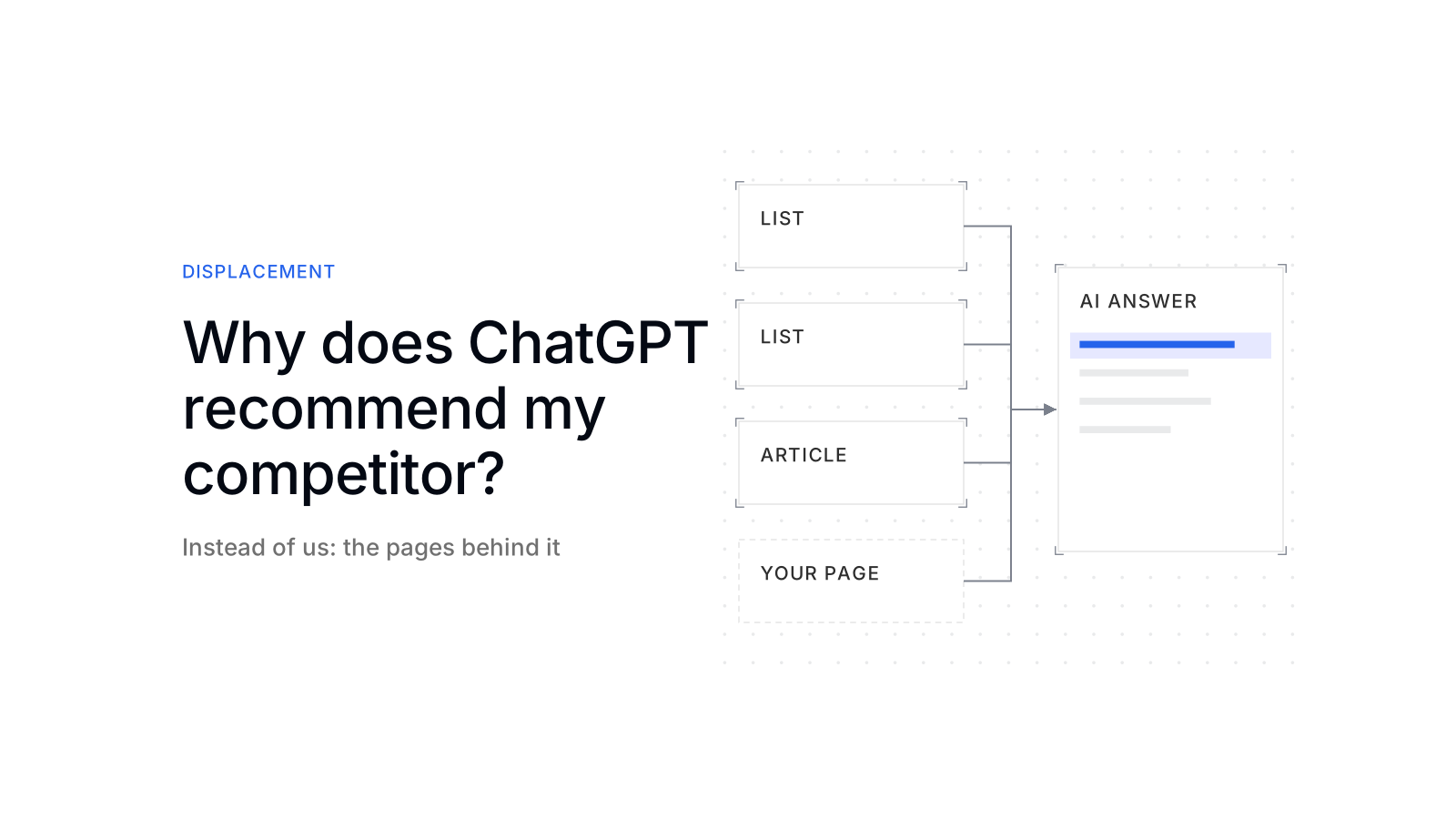
AI assistants build each answer from pages they look up for that question. You win by being the better source on those pages, not by pushing the competitor out.
In a research test, pages that added sources, quotes and numbers showed up far more often in AI answers, most of all pages that ranked lower on Google.
AI assistants tend to cite newer pages than Google does, so a competitor's lead fades when its pages go stale and yours stay current.
Plan the work in three months: find where you lose, publish and get listed, then refresh and measure again.
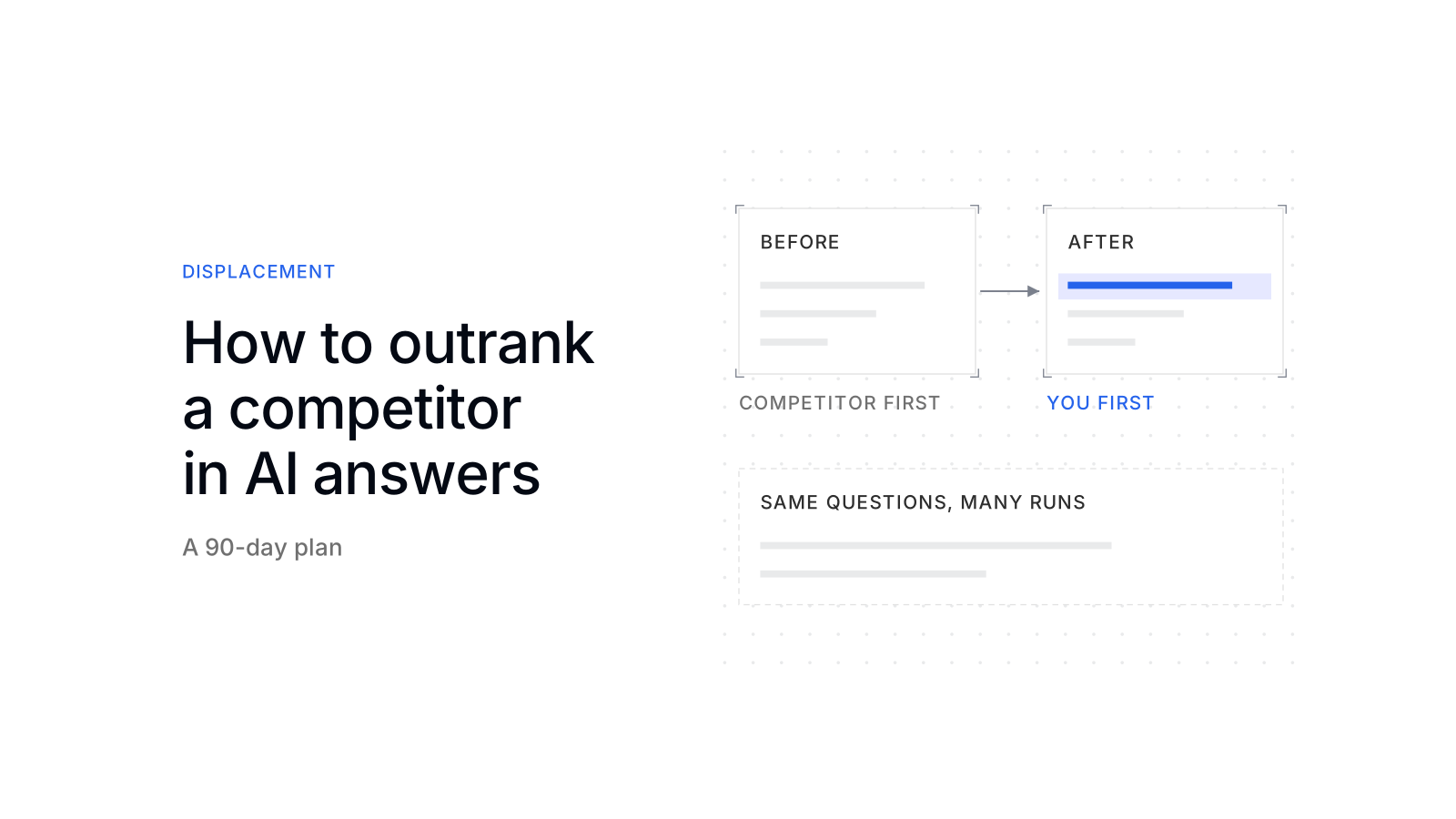
Judge the result by how often you are named across many runs of the same questions, not by one screenshot.
How do you outrank a competitor in AI answers?
You outrank a competitor in AI answers by becoming the better source for the questions where your product creates real value. Settle your positioning first and, of the questions the competitor wins, choose the ones that fit it. Then find those questions and the pages the answers cite. Add the evidence your own pages lack, and get listed on the third-party pages that cite the competitor. Keep it current and count the result over many runs. You cannot remove a competitor from an answer, but you can give the assistant a better page to use.
This works because of how the answers are built. Retrieval-augmented generation combines what a model learned in training with documents it retrieves for the question. [1] You cannot edit the trained part. The retrieved part is web pages, and pages can change this month. Google says AI Overviews and AI Mode may run several related searches across subtopics and sources for one response. [2] A competitor can win a single sub-question while you hold the rest.
If you have not yet worked out why your competitor is named, start with why ChatGPT recommends your competitor. This article is the fix.
Start from your positioning
Before you write a page, work out where your product creates real value: for which customers, which use and which problem it is better than the competitor’s. That is where you build. A question where your product is not the best choice is one you rarely win, and if you do, the buyer leaves your site again.
Make that positioning the foundation, then fill it with the right articles: one page that says clearly what your product stands for, and around it articles that answer the buyer questions in that field, such as comparisons, alternatives and concrete use cases. Every article supports the same claim, and that is how an assistant learns what to name you for.
Find the questions and pages where you lose
Start with the buyer questions in your field that your competitor wins and, for each one, the pages the answer cites. A loss is always specific: one question, one assistant, a handful of pages. Note who is named across several runs, which pages are cited and whether one is yours. Then sort each lost question by its gap:
The answer cites the competitor’s page or a guide, and none of yours answers as directly. Close the evidence gap on your own site.
Lists, reviews and trade articles name the competitor and not you. Get onto those pages.
You were named before and are not now. Refresh the page.
Questions close to a buying decision come first: “best X for Y”, “alternative to Z”, “X for a company our size”. Which ones to track, and how many, is in how to decide which prompts to track.
Close the evidence gap on your own pages
Close the evidence gap by giving the assistant what the competitor’s cited page lacks: a direct answer, named sources, quotations and numbers. The study that named generative engine optimization (GEO) tested this. Its methods raised visibility in generative engine responses by up to 40%. [3] Among them, Cite Sources and Quotation Addition add citations and quotations from credible sources, and Statistics Addition replaces qualitative discussion with numbers. [3]
The result that matters for outranking is who gained most. Cite Sources raised visibility by 115.1% for websites ranked fifth in search results, while the top-ranked website lost 30.3% on average. [3] A page that is not first on Google can overtake the one that is, if its evidence is better.

These are benchmark results from a test engine: directions, not numbers to plan with. In practice, write one page per lost question: the answer first, the facts a buyer checks, a linked source for each number, and structured data. More in how to get cited in AI answers. Google says its AI features need no extra requirements or special optimization beyond SEO. [2] See how to appear in Google AI Overviews.
Get onto the pages that name your competitor
Where the answer cites lists, reviews and trade articles, your own page alone will not change it: you need to be listed there too. Start with the third-party pages that come up for several lost questions, because one entry counts in several answers. Give each publisher a reason to include you: current product facts, data to quote, a customer case.
The assistant also has to recognize that these mentions mean your company. Keep your name, category and core facts identical on your site, profiles and directories, and state them in one place on your site. Grounding pages and entity SEO explain how.
Why yesterday’s winner is not tomorrow’s
A competitor’s lead in AI answers holds only as long as its cited pages stay current, because AI assistants lean toward newer pages. Ahrefs analysed 17 million citations across 7 AI search platforms. [4] Pages cited by AI assistants were on average 1,064 days old, against 1,432 days for pages in Google’s organic results: 25.7% fresher. [4]

ChatGPT was the most likely to cite newer pages, Google’s AI Overviews and organic results the most likely to cite older ones. [4] In ChatGPT, a current page has a better chance against an older winner. In AI Overviews, an established page holds longer and your Google ranking counts for more.
Timing cuts both ways. A competitor’s untouched page from two years ago is open to a current, better-sourced one, and so is your own winning page next year. scaile’s content refresh checks first whether a competitor now covers the topic better, rewrites on the same URL, and compares citations, share of answer and traffic before and after.
A 30/60/90-day plan to replace a competitor in AI answers
Plan the work in three blocks of about a month each: measure and choose, publish and get listed, then refresh and measure again.
- 1Days 1-30 · Positioning, baseline and choice
Work out where your product creates real value, fix 10 to 20 buyer questions in that field, run each several times in every assistant your buyers use, record who is named and which pages are cited, and sort every lost question by its gap.
Your partPositioning, questions from sales and support, the products that matter most - 2Days 31-60 · Evidence and listings
Publish or rewrite one page per chosen question, and contact the publishers of the third-party pages that come up most often.
Your partFacts, data and customer cases; approval of every page - 3Days 61-90 · Refresh and measure again
Run the same questions again, refresh the pages that did not move, and add the next set of questions.
Your partRead the results and decide the next questions
The order matters more than the dates: a new page can be cited within days or only after a crawl, and a list updates on its publisher’s schedule. Typical timelines are in how long GEO takes to show results.
How do you know it worked?
You know it worked when your share of answers on the same questions rises across many runs and the cited pages include yours. In a SparkToro study, 600 volunteers ran 12 prompts through three AI tools a combined 2,961 times. [5] There was less than a 1 in 100 chance that ChatGPT or Google’s AI gave the same list of brands twice. [5] Instead, SparkToro says the share of answers a brand appears in is probably a reasonable measure. [5]
So compare the same questions in the same assistants, many runs, before and after. Count how often you are named, how often your pages are cited and who appears instead. Then follow AI assistant visits in GA4 and the enquiries they bring. What a good score looks like is in what is a good AI visibility score.
In May 2026, AI engines answered Beurer’s 14 core buying questions mainly from test portals, video and retailers, and used beurer.com in 17% of answers. By September it was 42%, more than any other website, on the same questions.
At BILD Reisen, assistants recommended competing tour operators and booking portals. Its mentions in AI answers tripled in 11 weeks.
What scaile delivers
scaile delivers the whole loop: finding the questions a competitor wins, writing the pages that answer them better, and measuring again on the same questions. SEO and GEO run as one job.
scaile finds your buyer questions with you, from data, and tracks them in its own platform, app.scaile.to. Tracking only, no strategy or content.
You getWhich competitor is named for which question, at which position, and the sources the answers citeA dedicated GEO strategist builds the plan from your AI-visibility, search and analytics data. scaile writes and refreshes the pages, and your team reviews and approves every step.
You getEvidence pages, refreshes and a weekly strategy call on your share of answersYour teamReviews and approvesscaile takes over completely: strategy, website changes, content, publishing, refreshes and monitoring.
You getReports and what scaile plans nextYour teamProvides expertise and approvalsYou outrank a competitor in AI answers question by question: settle your positioning and build where your product creates real value, find where it wins and which pages carry it, make your pages the better-sourced answer, get listed where it is named, keep it current and count many runs. No one can guarantee the result, but the method is measurable. If you want a strategist to plan this with your team and scaile to do the work, talk to scaile about Strategy with you.
FAQ
Can I get a competitor removed from ChatGPT’s answers?
No. Neither you nor an agency decides which brands an assistant names. What you can change is the set of pages it reads for a question: yours, and the third-party pages that mention you.
Should my own pages name the competitor?
For “alternative to” and “X vs Y” questions, a fair comparison page can be the page an assistant cites. Argue from the competitor’s own published pages and say what it does well before saying where you differ.
Sources
- Retrieval-Augmented Generation for Knowledge-Intensive NLP Tasks
- AI Features and Your Website | Google Search Central | Documentation | Google for Developers
- GEO: Generative Engine Optimization
- New Study: AI Assistants Prefer to Cite “Fresher” Content (17 Million Citations Analyzed)
- NEW Research: AIs are highly inconsistent when recommending brands or products; marketers should take care when tracking AI visibility