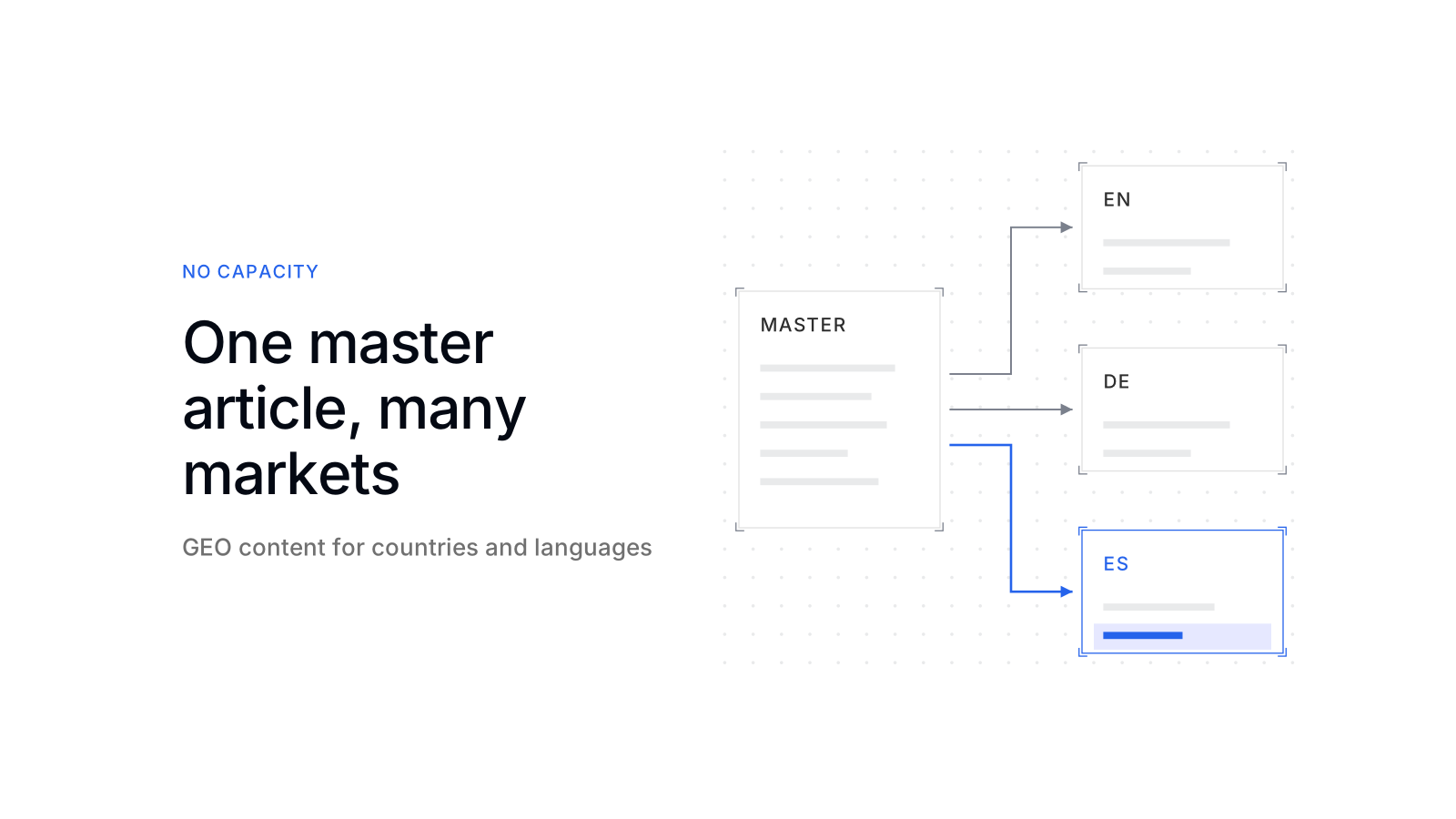
One master article, many markets: adapting GEO content across countries and languages
In short
Yes, a master article translates well into many languages. But the sources, reviews and entities have to change with the market. scaile has already adapted articles for other markets: it looks at each market for your company, decides which sources and entities matter there, and writes each article to fit that market while still answering the same question. A plain copy of the master is very rarely a good idea.

Dora is a founding engineer at scaile. She studied computer science, psychology and neuroscience at TUM, which is the perfect fit for GEO: she has a deep understanding of technology and of the human side, and knows how to write and produce content that leads humans to buy and AI to show you in its answers.
Key takeaways
One German article can be the starting point for every market. The research, the structure and your own data do not need to be done again.
A master article translates well, but a plain copy is rarely enough. Each market relies on different sources, reviews and entities, so each market needs its own check.
Go through the article section by section. Keep what is true everywhere, rewrite what depends on the country, and give local topics their own page.
Prices, laws, seals and test verdicts, examples, competitors and number formats change from country to country, so these parts need a local rewrite.
Measure your AI visibility separately in every language you sell in. A good result in German does not tell you how you do in Spanish.
Can a German master article be adapted for other markets?
Yes. Use the German master article as the source of facts, structure and evidence, and translate it, but do not copy it one to one. For each market, check which questions buyers ask in that language and which sources, reviews and entities AI answers name there. Then decide section by section: carry it over, adapt it, or replace it with a market version.
Buyers ask this in sales calls almost word for word. It is the right question, because the expensive part of an article is the research behind it: the questions, the evidence, the expert input and the approvals. That part travels. What does not travel is everything that depends on where the reader sits and what their AI assistant reads: the sources, the reviews and the entities, meaning the brands, authorities, testing bodies and competitors an answer names in that country.
Why do AI answers differ by language and country?
The language of the question can change which sources an AI answer cites. The same question in two languages can produce two different source lists, and a brand cited in one can be missing from the other.
One direct measurement comes from an audit of questions about Lebanon. It asked 40 matched questions in English and in Arabic across ChatGPT Search, Gemini, Perplexity and Copilot, 320 responses in total. [2] In English, Lebanese sources made up 31.6% of the citations. In Arabic, 56.7%. [2] English answers leaned on international organizations and reference sites, Arabic answers on Lebanese government sources and local news. [2]

The gap appeared on all four systems, from 18.5 percentage points on ChatGPT to 34.8 on Gemini. [2] The study covers questions about one country, captures one point in time and does not explain why the difference occurs. [2] Its lesson for a multi-market plan is still clear: your visibility in one language does not tell you your visibility in another.
Which parts of a master article carry over, and which do you rewrite?
The research and the logic carry over; anything tied to a country is rewritten or replaced. Read the master article section by section and sort each part into one of three groups.
The answer, the structure, your own data and studies, how your product works, definitions. These are true in every market and only need a good translation.
Examples, prices and currencies, laws and standards, the sources you cite, seals and test verdicts, the entities named, number and date formats, the call to action. Same point, local facts.
Pages whose subject is local: rankings of providers, city pages, market regulations. The new market gets its own page with its own research.
Reviews show why this matters. Beurer’s products have won different awards in different countries. The Swiss consumer magazine saldo named the LB 300 Plus humidifier its test winner in 2025, based on a Stiftung Warentest test. [5] The Guardian in the UK picked the HK 77 Heaty rechargeable heat pad as its rechargeable choice in a 2026 test of 20 hot-water bottles. [6] An article for Switzerland therefore names the saldo verdict, an article for the UK the Guardian pick.
scaile ran this split on its own blog. scaile.tech publishes its articles in English and German, each edition under its own URL, and the two editions point to each other with hreflang. When the general articles went to the Spanish site, they carried over. The local pages did not. scaile.tech has a ranking of agencies in Germany, Austria and Switzerland and city pages for Berlin, Munich, Hamburg and Frankfurt. The Spanish site has its own ranking of 14 agencies in Spain and pages for Madrid and Barcelona.

One language can also cover several countries, and then the rules get finer. scaile’s Spanish never addresses the reader with tú or vos, because Spain and parts of Latin America use tú, while Argentina, Uruguay and parts of Central America use vos. Spain and Argentina write 1.234,56, Mexico usually writes 1,234.56. And a price always carries its currency code, because ”$” can mean US, Mexican or Argentine dollars. None of this changes what the article says. All of it decides whether a reader in that country trusts it.
What does Google expect from translated and multilingual pages?
Google expects one language per page, a separate URL for every language version and an explicit link between the versions. It reads the language from the visible text, not from code.
Google determines the language from the visible content, not from lang attributes or the URL. It advises one language for content and navigation and no side-by-side translations. [3]
hreflang tells Google that pages are localized variations of the same content. Each language version must list itself and all other versions. [4]
Google advises against redirecting users from one language version to another based on a guess about their language. [3]
Google says not to adapt content by IP address: location detection is unreliable, and most Google crawls come from the US. [3]
These rules are written for Google Search. They also make sense for AI assistants: a page in one language with its own URL can be retrieved and quoted for that language, while a page that changes with the visitor’s location may show a crawler only one of its versions.
The quality rule matters as much as the technical ones. Google lists automated transformations such as translating among the examples of scaled content abuse, where many pages are produced with little value for users. [1] A translated article is not spam. A hundred machine-translated pages that answer no local question can be. An adapted article with local examples, sources and reviews adds the value Google expects. What Google changed in its documentation on AI content points the same way.
How do you run one master article across several markets?
Run the master article once, then give each market its own check before publishing and its own measurement after. Six steps, in this order:
- 1Find the market’s questions
Collect the questions buyers ask in that language, from sales, search data and AI answers. Do not translate the German keywords.
Your partQuestions from the local sales team - 2Check the local sources and entities
Ask AI assistants those questions in that language and note which pages they cite and which brands, testing bodies and seals they name.
ResultThe local sites, reviews and media that shape answers there - 3Sort the sections
Mark each section of the master as carry over, adapt or replace.
ResultA short list of what has to be rewritten - 4Adapt and review
Translate what carries over, rewrite what changes, and have a native speaker who knows the market read it.
Your partLocal facts, prices and approvals - 5Publish with linked versions
One URL per language, hreflang on every version, no automatic redirects.
ResultEvery version is findable on its own - 6Track per market
Measure the buyer questions in each language separately, in the AI assistants that matter there.
ResultA visibility figure per market, not one average
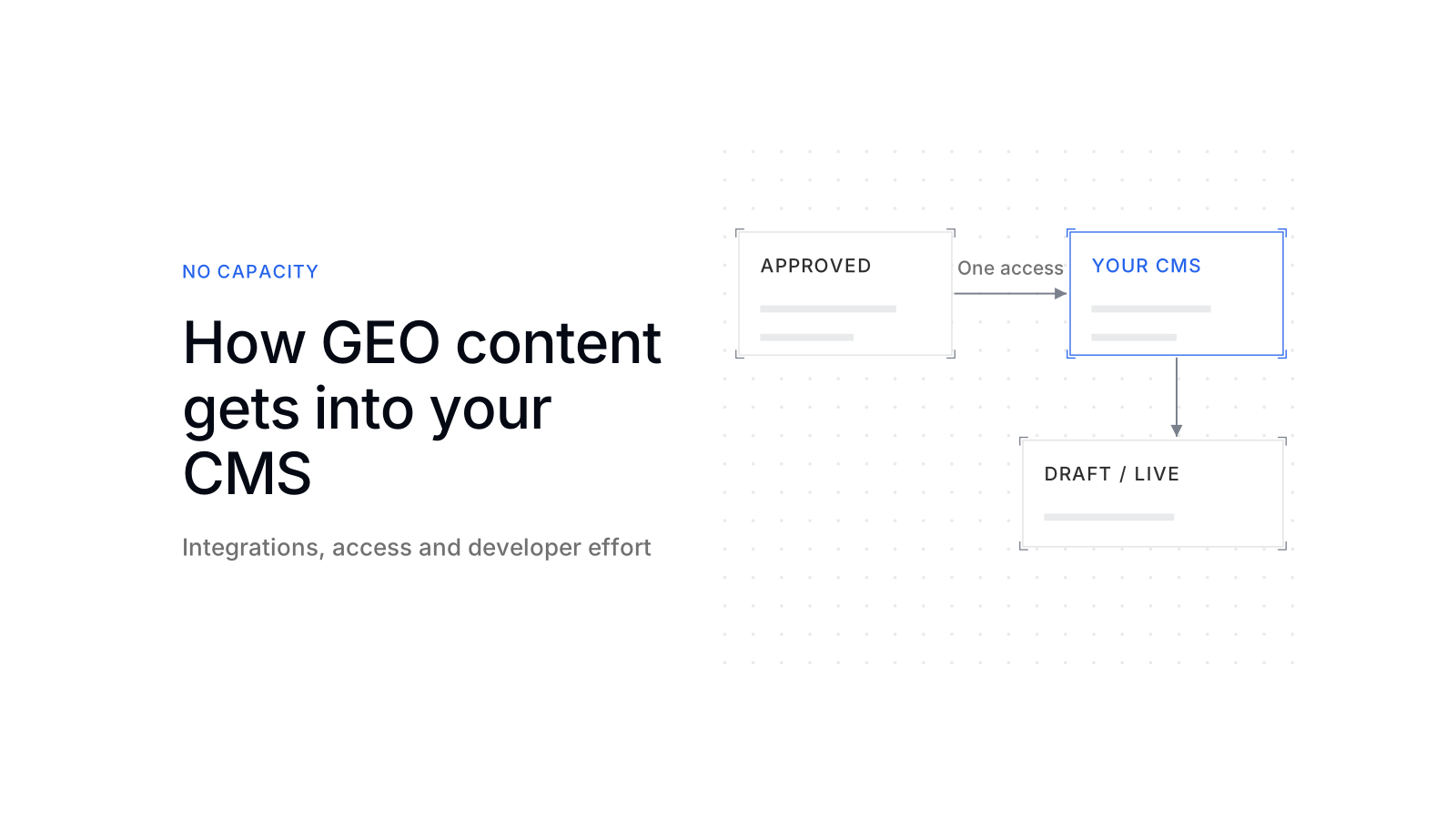
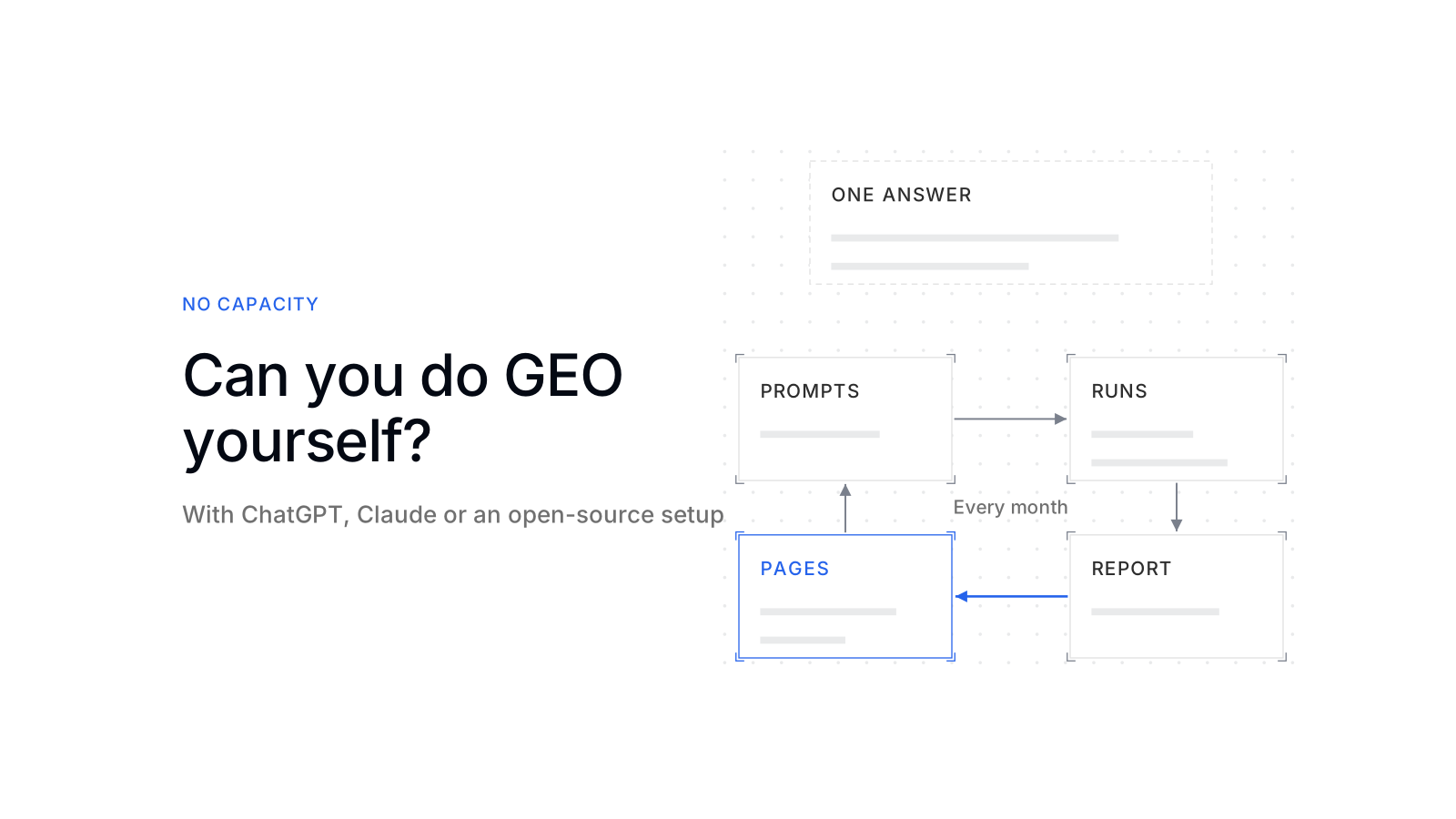
Step 6 is the one that is easy to skip: tracking in English or German only and assuming the other markets look the same. The Lebanon audit shows why that assumption does not hold. How to choose the questions themselves is in the prompt-tracking playbook; how approved articles reach several CMS instances is in how GEO content gets into your CMS.
What scaile delivers
scaile runs several markets as one programme with one research base and one Brand Kit. A dedicated AI search strategist meets your team every week, and scaile researches, structures, publishes, refreshes and reports.
scaile finds your buyers’ questions in each language, from data, and tracks them in its own platform, app.scaile.to.
You getYour AI visibility per market and language, and the local sources each answer citesA strategist sorts the master article for each market and plans the local pages; scaile writes and publishes them.
You getOne master plan with a version for each market, and a weekly meeting on resultsYour teamLocal facts and approvalsscaile takes over the whole job across your markets, from questions and content to refreshes and reporting.
You getEvery market covered without extra hours from your teamYour teamProvides context and approvalsNo provider can guarantee rankings, citations, traffic or revenue in any market, and scaile does not either.
The research behind a master article is done once. What each market needs on top is its own questions, evidence from local sources and reviews, and its own measurement. To plan it for your markets, talk to scaile about Strategy with you.
FAQ
Is machine translation good enough for GEO?
For the parts that carry over, a machine translation reviewed by a native speaker is a reasonable start. It is not enough for the parts that depend on the market: examples, prices, laws, seals and test verdicts, entities and the sources the local AI answers cite.
Should each country get its own domain or a folder?
Google’s documentation lists both as options. A country domain such as example.de gives clear geotargeting but needs more infrastructure and targets one country; a folder such as example.com/de/ is easy to set up and maintain; URL parameters are not recommended. Choose the setup your team can maintain.
Which market should we adapt first?
Start where buyers already ask AI assistants about your category and your sales team can supply local facts. A market with demand but no local input produces translations, not answers.
Sources
- Spam Policies for Google Web Search | Google Search Central | Documentation | Google for Developers
- AI Shows Different Sources Depending on Your Language
- Managing Multi-Regional and Multilingual Sites | Google Search Central | Documentation | Google for Developers
- Localized Versions of your Pages | Google Search Central | Documentation | Google for Developers
- Luftbefeuchter im Test: Beurer und Xiaomi befeuchten die Luft gut | saldo
- We tested 20 hot-water bottles – these are the best in the UK for comfort and cosiness | The Guardian