Can you do GEO yourself with ChatGPT, Claude or an open-source setup?
In short
To get started, yes. But ChatGPT and Claude give you the path everyone gets, your competitors included. Standing out in AI answers takes expertise in the field. scaile does Managed GEO: it tracks, plans and executes.

Dora is a founding engineer at scaile. She studied computer science, psychology and neuroscience at TUM, which is the perfect fit for GEO: she has a deep understanding of technology and of the human side, and knows how to write and produce content that leads humans to buy and AI to show you in its answers.
Key takeaways
ChatGPT and Claude are good research and drafting partners for generative engine optimization (GEO). They do not know your prices, customers or cases, and they do not publish anything.
One answer in a chat window is one sample. AI assistants rarely give the same list of brands twice, so a useful measurement needs many runs of the same question.
A self-built tracker is a small software project: prompts, API calls with web search on, repeated runs, name extraction and a report. Someone has to maintain it when the models change.
Google does not object to AI-written pages as such. It objects to many pages that add no value for users, however they were made.
ChatGPT, Claude or open source: the tool is not the bottleneck. GEO is ongoing work. Someone has to measure every month where your brand shows up in AI answers and update your pages based on that. Settle first who on your team has that time.
Can you do GEO yourself with ChatGPT, Claude or an open-source setup?
To get started, yes. ChatGPT and Claude give you the average of what has been written about GEO: the path every team gets when it asks the same question, your competitors included. That brings you level with everyone else, not ahead of them. Getting named in AI answers where others are missing takes someone who understands the field and sees options the average never shows.
ChatGPT and Claude can do real work in generative engine optimization (GEO): they help you research buyer questions and give your pages a clearer structure. An open-source or self-built script can send your buyers’ questions to AI models through their APIs and record which brands come back. What none of these tools gives you is a ready-made, reliable measurement, or the hours to change your pages every month.
Marketing teams ask it in exactly these words: “Can’t we do GEO ourselves with Claude, ChatGPT or an open-source setup instead of hiring a provider?” The honest answer depends less on the tools than on the work around them. Google says generative AI “can be particularly useful when researching a topic, and to add structure to original content”. [1] It does not say the tool replaces the person who knows the content.
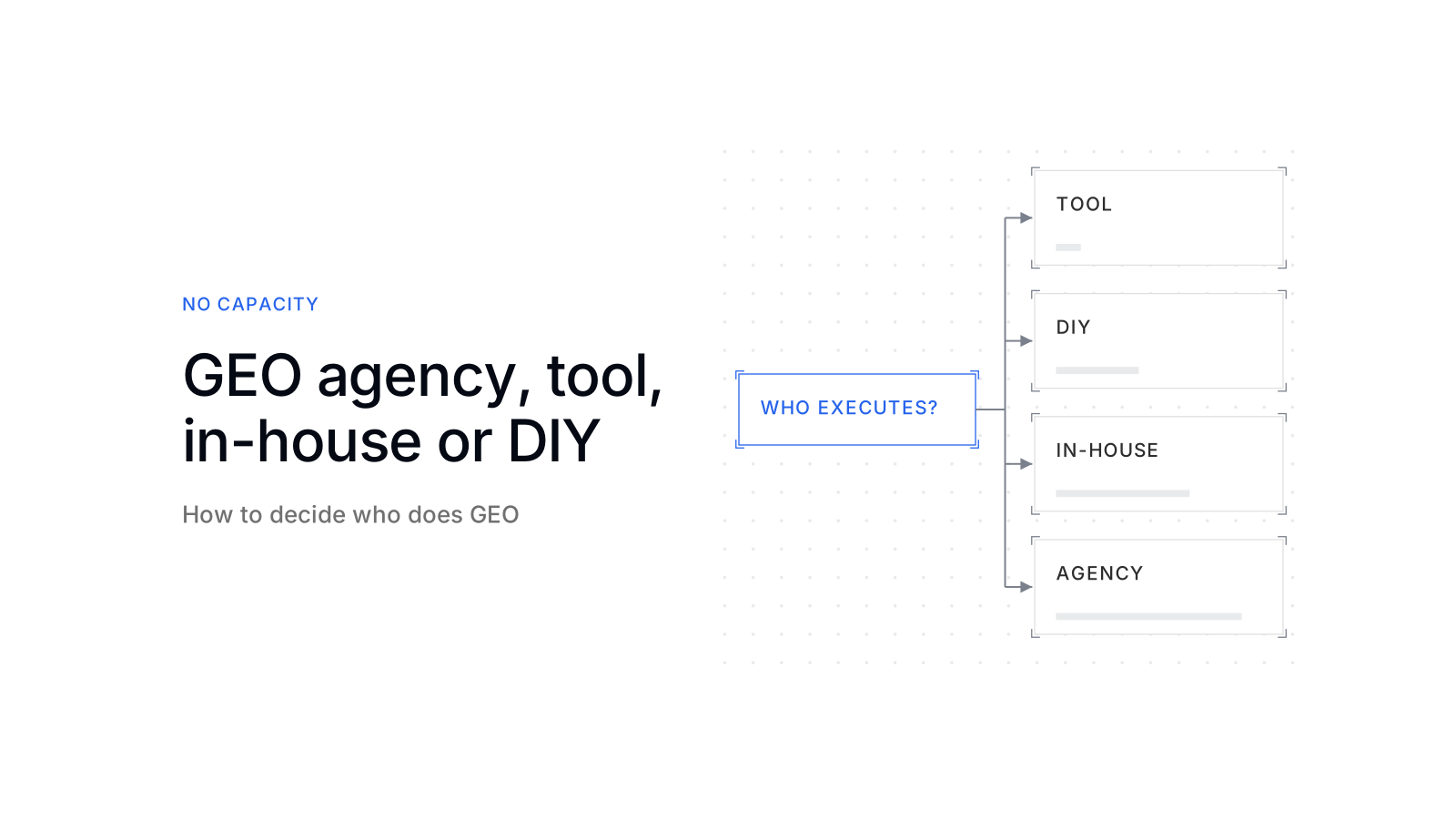
Whether GEO should sit with an agency, a tool, your team or one marketer’s spare hours is a broader question, answered in GEO agency vs tool vs in-house vs DIY. This article stays with the do-it-yourself stack: what the assistants do, what a home-made tracker takes, and where it stops.
What ChatGPT and Claude can do in your GEO work
ChatGPT and Claude are useful at the start of most GEO tasks and weak at the end of them. They draft, summarise and restructure quickly. They cannot supply the facts only your company has, and they cannot decide what is true about your offer.
Collect the questions buyers might ask, group them by buying stage and suggest which pages could answer them
You still addWhich questions your customers really ask in sales callsTurn an existing page into an answer-first version, write a first FAQ, suggest structured data
You still addPrices, cases, numbers, and a check of every claimSummarise a competitor page or a cited source, compare two versions of your own page
You still addThe judgement whether the change is worth makingThe limit is knowledge, not language. An assistant writes a fluent paragraph about your product from what it learned in training, and that paragraph is only as current and as specific as that training. The parts that make a page worth citing are first-hand: your own numbers, your customers’ questions, your cases. Those come from your team, and someone with authority has to approve them before they go live.
Why asking ChatGPT yourself is not tracking
Asking ChatGPT about your market is a sample of one, not a measurement. SparkToro had 600 volunteers run 12 prompts through ChatGPT, Claude and Google’s AI a combined 2,961 times. Its finding: “AIs rarely give the same list of brands or recommendations twice (<1 in 100 times, no matter the question)”. [2]
That does not make measurement pointless. It changes what you measure. SparkToro calls the share of runs in which a brand appears “(probably) a reasonable way to know how prominent or invisible your entity is”. [2] A share needs many runs, many questions and a record of each answer. A marketer asking a few questions by hand on a Friday afternoon gets an impression, not a share.
To see how a do-it-yourself tracker behaves, scaile ran one buying question through Google’s Gemini API 20 times: “Which agencies can help a mid-sized company in Germany get recommended by ChatGPT and other AI assistants? Name up to five.” Ten runs had Google Search grounding switched on, ten had it off. With search on, no two of the ten answers named the same set of agencies. Together they named 21 different agencies; the most frequent one appeared in 9 of 10 answers. With search off, 6 of the 10 answers named no agency at all, only types of agency. It is one question on one model, so it shows the behaviour, not a market ranking.

The second result matters as much as the first. Whether the model searched the web changed the answers completely. If you want a free manual check done properly, with clean sessions and several assistants, the method is in how to check your AI visibility for free.
What a self-built or open-source tracker takes
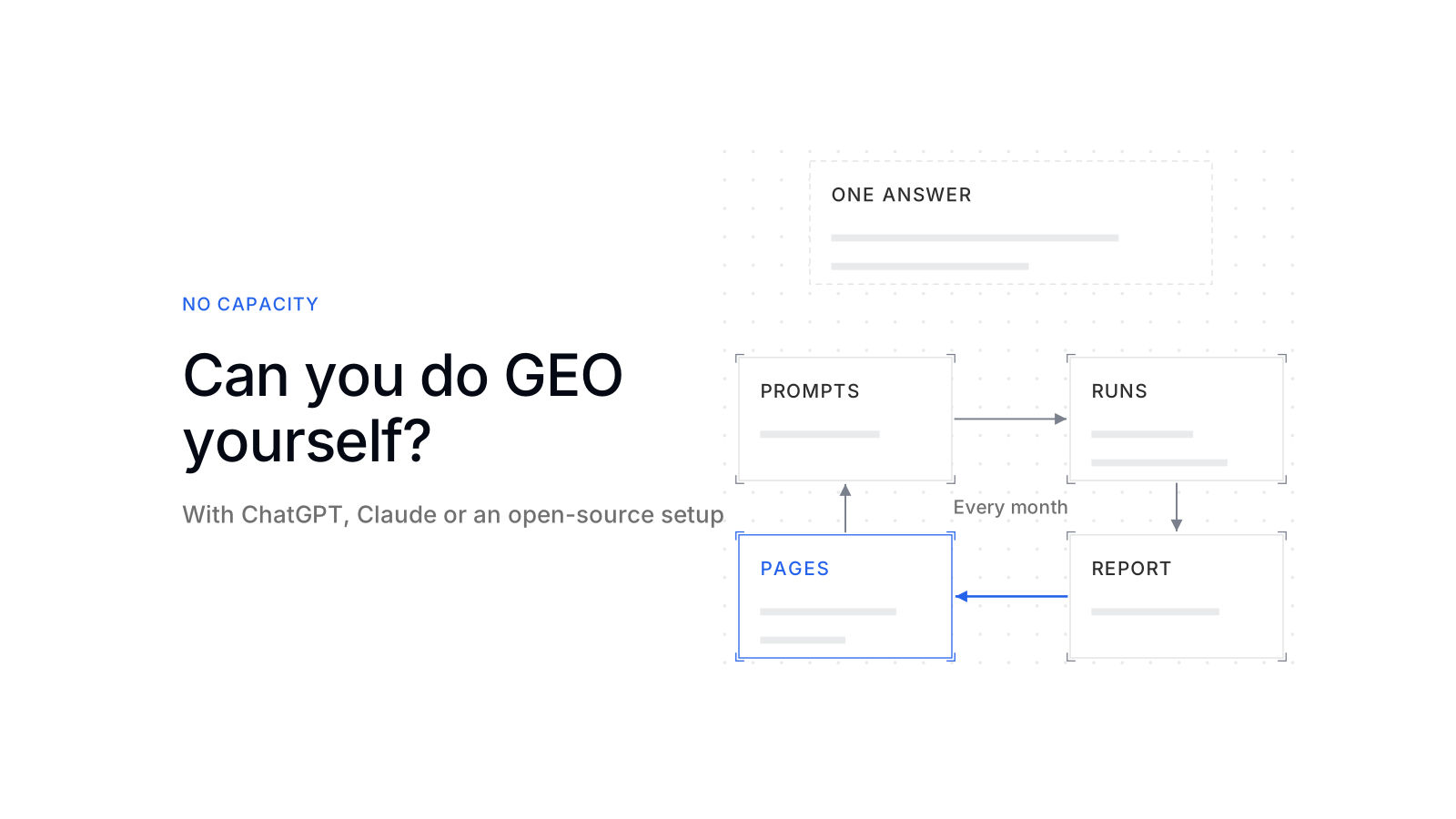
A self-built tracker is a small software project that has to keep running after it is built. The idea is simple: send the questions your buyers ask to each AI model on a schedule, store the answers and count which brands and sources appear. Every part of that sentence needs a decision.
Which questions, in which languages and markets, grouped how. A tracker is only as good as the questions it asks; how to pick them is covered in which prompts to track.
In OpenAI’s API, web search is a tool you switch on in the request. Even then “the model can choose to search the web or not based on the content of the input prompt”. [3] A script without it measures the model’s memory, not the answer your buyers see.
Each question several times on each model, because one run is one sample. Every run is a paid call.
Turning free text into brand names. Spellings vary, names come with legal suffixes, and some answers list categories instead of companies.
A database of answers and a view your team will read every week, with a baseline to compare against.
API keys, rate limits, failed calls, and new model versions that change the answers under you.

The direct costs are visible on the providers’ price pages. Web search on the Claude API, for example, costs “$10 USD per 1,000 searches, plus standard token costs for search-generated content”. [4] That bill grows with every question, model and repeat. It is still only part of the cost: someone has to keep the loop running and turn its numbers into decisions.
Open-source projects can save you the first version of the code. They do not save you the prompt set, the API keys and their bills, or the weekly hour in which someone reads the result and decides what to change.
Where AI-written pages go wrong
AI-written pages go wrong when they add nothing, not because a model wrote them. Google’s guidance says using generative AI “to generate many pages without adding value for users may violate Google’s spam policy on scaled content abuse”. [1] The policy itself applies to unoriginal content at scale “no matter how it’s created”. [5]
Google’s own self-check for helpful content asks: “Are you using extensive automation to produce content on many topics?” [6] A do-it-yourself setup that turns a list of prompts into a list of drafts and publishes them is the pattern this question warns about.
The fix is not a special AI format. Google states there are “no additional requirements to appear in AI Overviews or AI Mode, nor other special optimizations necessary”. [7] What helps is a page that answers the question first and carries facts nobody else has. How to split the work between the model and the reviewer is covered in AI content vs human content.
When doing GEO yourself is enough
Doing GEO yourself is enough when the scope is small and somebody owns it. The scope and the hours decide it.
One market, a few dozen buyer questions, a person with fixed hours each week, and pages your team can change without a long approval chain.
Several markets or languages, a tracker nobody has time to maintain, or a list of pages to change that grows faster than the hours to change them.
Many teams end up in between. They keep what only they have: the product knowledge, the customer cases and the approval, and they keep using ChatGPT or Claude for their own drafts. They hand over the parts that need continuity: the prompt set, the tracking across models, the plan for which pages to change next, the page work and the reporting. That split keeps the knowledge in your team and the routine work out of its week.
You can do a real part of GEO yourself: research and drafts with ChatGPT or Claude, and a first tracker from an open-source project. The work that decides the result is the repetition: the same questions measured again and again, and pages changed and approved every month. This is where scaile adds value: scaile finds the questions your buyers ask AI assistants from data, measures where your brand shows up in the answers, and a dedicated AI search strategist plans with you every week which pages change next. You get a plan for your market instead of the path everyone gets, and nothing goes live without your approval. If your team wants to keep the decisions and the approval and hand over tracking, planning and page work, talk to scaile about Strategy with you.
FAQ
Can we just use ChatGPT to check if we show up?
For a first impression, yes. Ask the buying questions, not your brand name, in a clean session and in more than one assistant. For a number you can report, you need many runs and a record of each answer.
Is an open-source GEO tool free?
The code can be free. The API calls, the web search fees, the hosting and the hours to maintain it are not.
Will Google penalise content written with ChatGPT or Claude?
Not for the tool used. Google acts on pages produced at scale without adding value for users, however they were made.
Does it matter which model we use?
Less than how you use it. Your buyers use several assistants, and each answer changes from run to run, so a single model is one view of the market.
Sources
- Google Search’s Guidance on Generative AI Content on Your Website | Google Search Central | Documentation | Go
- NEW Research: AIs are highly inconsistent when recommending brands or products; marketers should take care whe
- Web search | OpenAI API
- Web search tool - Claude Platform Docs
- Spam Policies for Google Web Search | Google Search Central | Documentation | Google for Developers
- Creating Helpful, Reliable, People-First Content | Google Search Central | Documentation | Google for Develope
- AI Features and Your Website | Google Search Central | Documentation | Google for Developers