How to choose an AI visibility platform: the checklist
In short
Choose an AI visibility platform on how it measures: a prompt set built from buyer demand, repeated runs, the cited sources and your search data beside it. No tracker proves revenue alone. scaile's Managed GEO combines tracking, execution and attribution.

Dora is a founding engineer at scaile. She studied computer science, psychology and neuroscience at TUM, which is the perfect fit for GEO: she has a deep understanding of technology and of the human side, and knows how to write and produce content that leads humans to buy and AI to show you in its answers.
Key takeaways
An AI visibility score is a share of answers across many prompts and runs. A single "rank in ChatGPT" is not a stable number.
The prompt set decides the score. Prompts written from your own pages flatter you; prompts built from buyer demand show where you lose.
Test data quality with questions about runs, frequency, raw answers and history, not with a feature checklist.
Agencies need one workspace per client, with its own users, data and reports.
No tracker proves revenue. That needs your revenue data connected to your content.
How do you choose an AI visibility platform?
You choose an AI visibility platform on how it measures, not on how many features it lists. AI answers are generated, not looked up. Retrieval-augmented generation, the method behind AI search, combines a model’s own memory with documents it retrieves for the question. [1] So the same question can return a different answer each time. SparkToro found “a <1 in 100 chance that ChatGPT or Google’s AI, if asked 100X, will give you the same list of brands in any two responses”. [2]
A platform therefore samples a process that never answers the same way twice. The requirements follow from that: which prompts it asks, how often, on which engines, what it records and what it cannot measure. What the resulting number means is explained in what a good AI visibility score is. Whether you need a tool, an agency or your own team at all is covered in GEO agency vs tool vs in-house.
What should an AI visibility platform track?
An AI visibility platform should track six things, and the prompt set comes first, because every other number is a share of it.
The buying questions your customers ask, built from demand data such as search, sales calls and forums. A set written from your own pages measures what you already cover. How to build one is shown in which prompts to track.
ChatGPT, Claude, Gemini, Perplexity, Google AI Overviews and AI Mode read different sources, so a brand strong in one can be missing from another. scaile tracks up to nine answer engines.
Whether you are named, how early and in what tone, next to the competitors named instead.
The pages the answer used. They show where an answer about your category is decided, and which page you would need to be on.
Each region, language, product and persona as its own segment, because answers differ by market.
Rankings, clicks and impressions from Google Search Console and GA4 in the same report, so AI search and classic search are read together.
Is AI visibility tracking worth it for you yet?
AI visibility tracking is worth it when your buyers ask AI before they buy and someone on your side will act on what it shows. A dashboard nobody acts on changes nothing in the answer.
Buyers ask AI to compare suppliers in your category, you need a baseline before you change pages, and a team or partner will turn each gap into a page or a refresh.
Nobody owns the follow-up, the prompt set is a handful of brand searches, or you only want a one-off answer to “do they name us?”
For the one-off answer, a manual check is enough. How to check your AI visibility for free shows the method and what its result is worth. Tracking starts to pay once you want the same questions measured again after your pages change.
How do you compare data quality, not feature lists?
You compare data quality by asking each vendor how a number is produced. Every platform lists engines, dashboards and exports. The differences sit in the method behind them.
| Ask the vendor | A good answer | A red flag |
|---|---|---|
| How many times is each prompt run? | Repeated runs, reported as a share of answers | One run per prompt, shown as a rank |
| How often are prompts collected? | A fixed schedule you agree, per engine | “Regularly”, with no stated frequency |
| Where do the prompts come from? | Buyer demand, including questions you do not yet write for | Your own pages or keywords you already rank for |
| Can you see the raw answers? | Every answer and its cited sources, as returned | Only the score |
| Is history kept? | From the start, so you can compare against a baseline | Only the last period |
| Can you take the data out? | Exports and an API to recompute the numbers | Screens only |

SparkToro ran the same prompts many times. Its conclusion: “visibility % across dozens to hundreds of prompts run multiple times is a reasonable metric”, but “any tool that gives a ‘ranking position in AI’ is full of baloney”. [2] That is the test for any score: ask what it is a share of.
At scaile the prompt count, coverage and collection frequency are agreed in the proposal. Seats and tracked domains are unlimited. Exports come as CSV, JSON, Excel and Google Sheets, with API access, and history is kept from the start of the project for the whole engagement, as the pricing page lists.
What agencies need from a multi-client platform
An agency needs a platform that keeps each client separate and lets the agency own the relationship. Three requirements decide it.
Its own knowledge, users, permissions and data, so nothing mixes between accounts.
You checkClient access is optional and per workspacePrompts, engines, markets and collection frequency set for each client, not shared.
You checkEach client’s coverage is written into the termsChosen data, exported as a client-ready report.
You checkThe vendor does not contact your clients unless you askscaile’s Agency Partner Program works this way. Each client includes 50 tracked prompts, five content clusters and up to 50 articles per month, alongside monitoring and reporting, so the agency can deliver the work as well as track it.
What your IT security review will ask
An IT security review asks how the vendor handles your data. An AI visibility platform touches more of it than it seems: user accounts, Search Console and GA4 access, and revenue data if it attributes. Five questions come up.
- Contract. Under GDPR Article 28, a company may use only processors “providing sufficient guarantees to implement appropriate technical and organisational measures”, and the processing is governed by a binding contract. [3] Ask for the data processing agreement and the list of sub-processors.
- Location. Ask where the data is processed and stored, and where the AI engines are queried from.
- Access. Single sign-on (SSO) and permissions per user and per workspace.
- Certificates. If your policy requires an ISO 27001 certificate or a SOC 2 report, ask for it before the trial, not after.
- Exit. How you export your data and how it is deleted when the contract ends.
scaile’s data processing agreement is GDPR-aligned, the data stays in the EU, audit logs are available for your review, and SSO is included.
What no AI visibility tool can prove
No AI visibility tool can prove, on its own, that being named brought you revenue. A tracker measures presence in a sample of answers. What happens after the answer is outside its view.
Two gaps sit between the answer and the sale. Google counts sites that appear in AI Overviews and AI Mode in the overall search traffic in Search Console, reported “within the ‘Web’ search type”. [4] And many AI assistants send no referrer, so a visit from an answer often arrives looking like a direct visit. A rising score with flat revenue does not prove the work failed. Rising revenue does not prove the score caused it.

Closing that gap takes attribution: your revenue data connected to the content that was read. scaile’s reporting connects your content to your actual revenue data and goes through the result with you every week. No setup removes every limit, so ask any vendor which part of its revenue figure is measured and which is estimated.
The requirements checklist for your decision
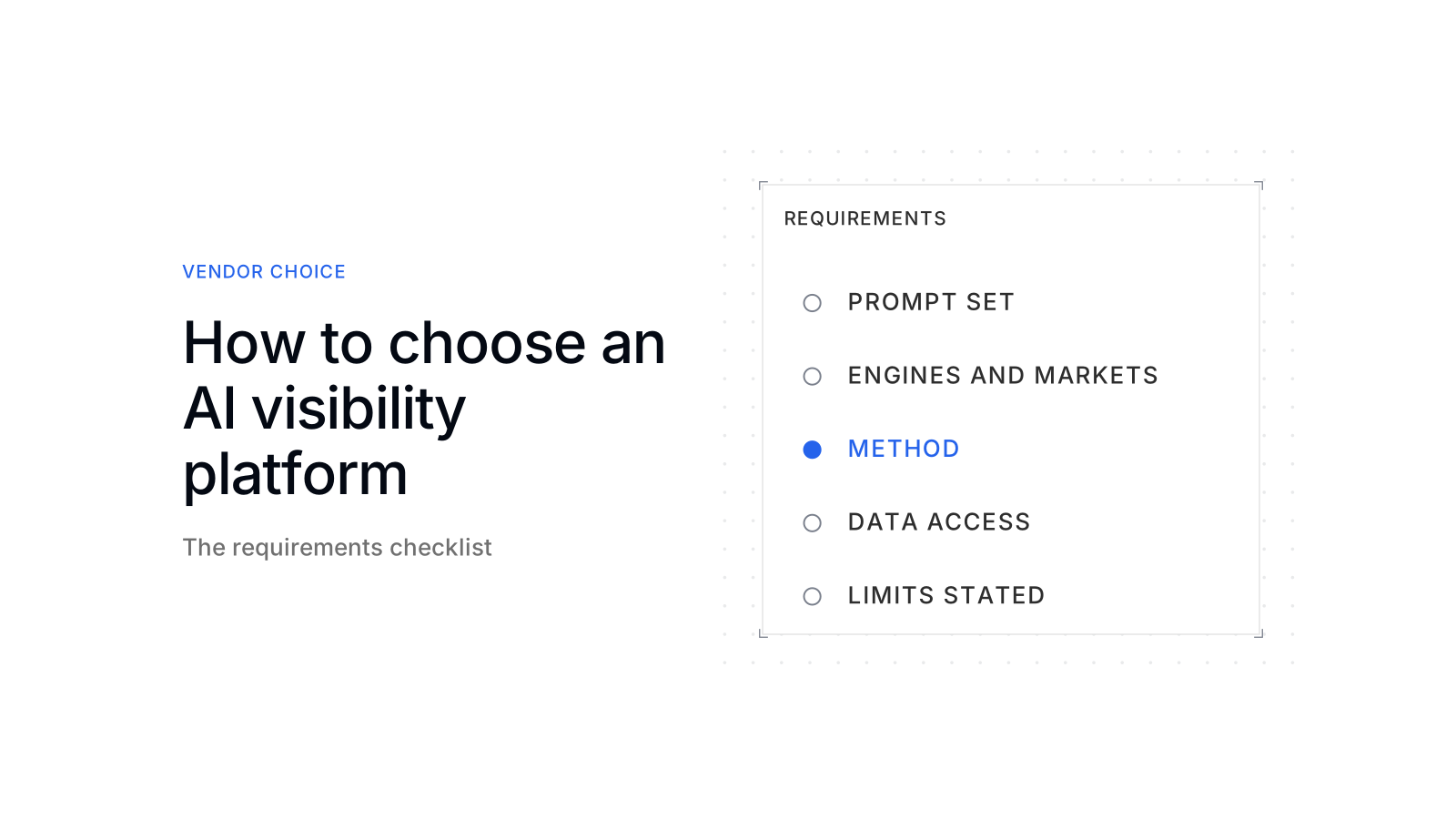
Take these six requirements into the decision and ask every vendor the same questions.
- 1Prompt set
Built from buyer demand, covering questions you do not yet answer.
You checkWho writes the prompts, and from what data - 2Engines and markets
Every engine and market your buyers use, as separate segments.
You checkThe list, in writing - 3Method
Repeated runs on an agreed schedule, raw answers and cited sources visible.
You checkWhat the score is a share of - 4Data access
History from the start, exports and an API.
You checkThat you can recompute a number yourself - 5Agencies and security
One workspace per client, SSO, a data processing agreement.
You checkThe documents your IT review needs - 6Outcomes
Search data beside the score, and a stated path to revenue attribution.
You checkWhich figures are measured and which are estimated
An AI visibility platform is worth what its method is worth. Choose the one whose prompts come from your buyers, whose score is a share of many runs, whose raw answers you can read, and whose limits are stated. Then connect it to revenue, because no score does that for you. If you first want to see where your brand stands in AI answers, measured on buyer questions and next to your search data, talk to scaile about Track.
FAQ
Can a free AI visibility checker replace a platform?
For a first look, yes. scaile’s free AI visibility check asks ten buying questions in ChatGPT, Gemini and Perplexity and shows who was named and which pages were cited. It is a snapshot, not a trend: assistants disagree with themselves between runs, so a platform is needed once you want to see change over time.
Do we have to drop the tracking tool we already use?
No. scaile runs next to your current tool, and next to your agency if you work with one.
Sources
- 2005.11401 Retrieval-Augmented Generation for Knowledge-Intensive NLP Tasks
- NEW Research: AIs are highly inconsistent when recommending brands or products; marketers should take care whe
- Art. 28 GDPR – Processor - General Data Protection Regulation (GDPR)
- AI Features and Your Website | Google Search Central | Documentation | Google for Developers