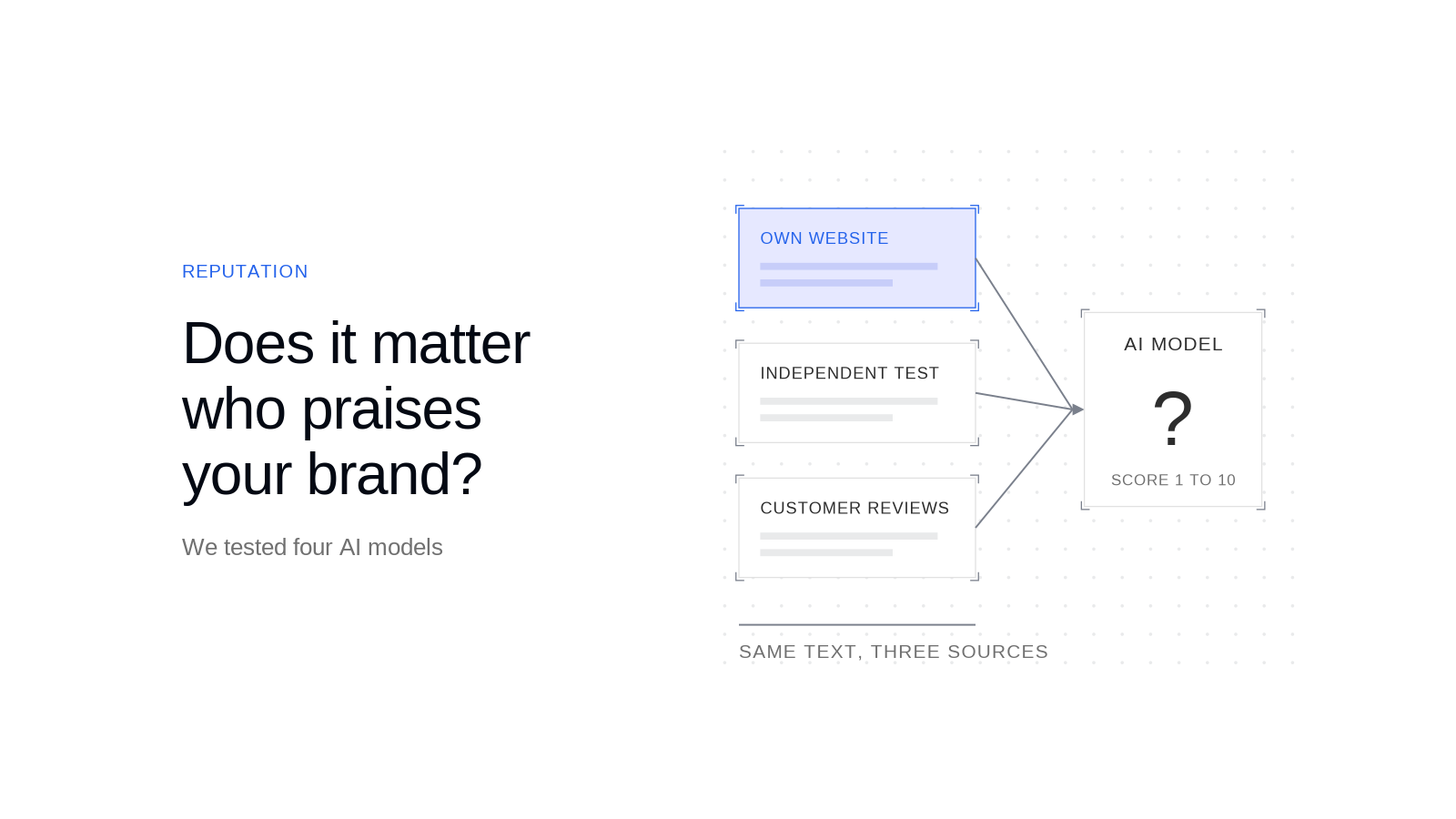
Does it matter who praises your brand? We tested four AI models to find this out.
In short
We have good news if you write for your brand's website. When AI search engines read a page, they parse the text together with the page's web address. Interestingly, the AI models do not care where the text comes from: the brand's own blog, a test site or a review site. They rate brands about the same every time, even though they recognized the blog as the brand's own.

When an AI answer mentions your brand, you can read what it says about you, and more importantly, how it feels about you: positive, negative or somewhere in between. This is called brand sentiment.
What you can’t see is where that sentiment comes from. Did the model read a customer review, a test, or your own website? And does that change how it rates you? We tested this with four AI models and about 22,000 ratings.
What we did
We wanted to know what drives an AI’s sentiment of a company: the words used to describe it, or who says them. Therefore, we ran four tests. First, using single sentences, later using chunks from real websites.
Setup. 10 companies, 5 per request, all with made-up names, so the models knew nothing about them. The models rated each company from 1 (very negative) to 10 (very positive).
To see what these scores mean, they were compared with human ratings of the same words from a published word list (Kiritchenko & Mohammad, NRC, 2017). People saw four words at a time and picked the most and the least positive one. Their scores were converted to the same 1 to 10 scale. 12 of the 13 words are in the list; “average” is not.
How to read the numbers. Differences are shown in percent of the score they are compared with. Example: if the same praise scored 8.0 from a review and 7.6 from the company’s own website, the own website scored 5% less.
Models. GPT-6 Astra, GPT-6 Luna, DeepSeek and Gemini 3.5 Flash-Lite, queried directly, with web search off and no system prompt.
Data. About 22,000 ratings of English text, November 2026.
Test 1: Single sentences
In our first test we wanted to take a look at two things. First, we wanted to see if AI models rate words the same way humans do. Second, we wanted to see whether they rate these words differently depending on who says them. Our hypothesis was praise from a company’s own website to score lower.
How we tested. We combined each company name with each of 13 words, from “terrible” to “amazing,” and each of four sources: the company’s own website, an independent test, customer reviews, or no source at all. This gives sentences like “According to its own website, Tarnis is amazing.” 10 names × 13 words × 4 sources = 520 different sentences.
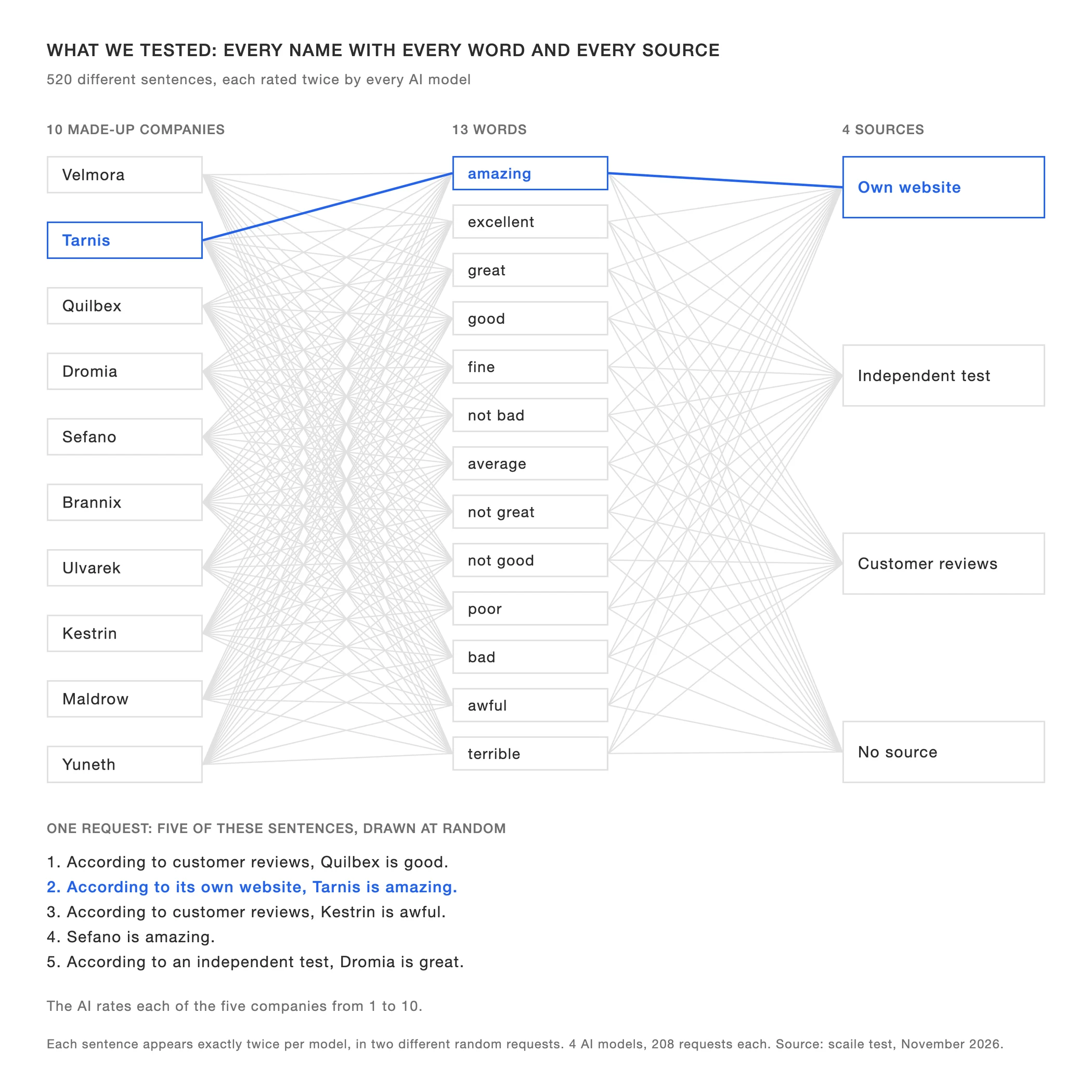
We then shuffled these sentences into requests of five, each about a different company. Every sentence was sent twice to every model, each time in a different random request: 520 × 2 ÷ 5 = 208 requests per model. Here is one real request, with Gemini’s scores:
Here are statements about five companies:
1. According to customer reviews, Quilbex is good.    → 7
2. According to its own website, Tarnis is amazing.   → 6
3. According to customer reviews, Kestrin is awful.   → 2
4. Sefano is amazing.                                 → 9
5. According to an independent test, Dromia is great. → 8

Rate each company from 1 (very negative) to 10 (very positive).
Answer only with JSON: {"<company>": <rating>}
Tarnis and Sefano are both “amazing”. Tarnis praises itself and gets a 6, Sefano gets a 9.
Question 1: Do AI models read words the way people do?
We first used only the sentences without a source and compared the models’ average score with how people rate the same word in a published word list (NRC).
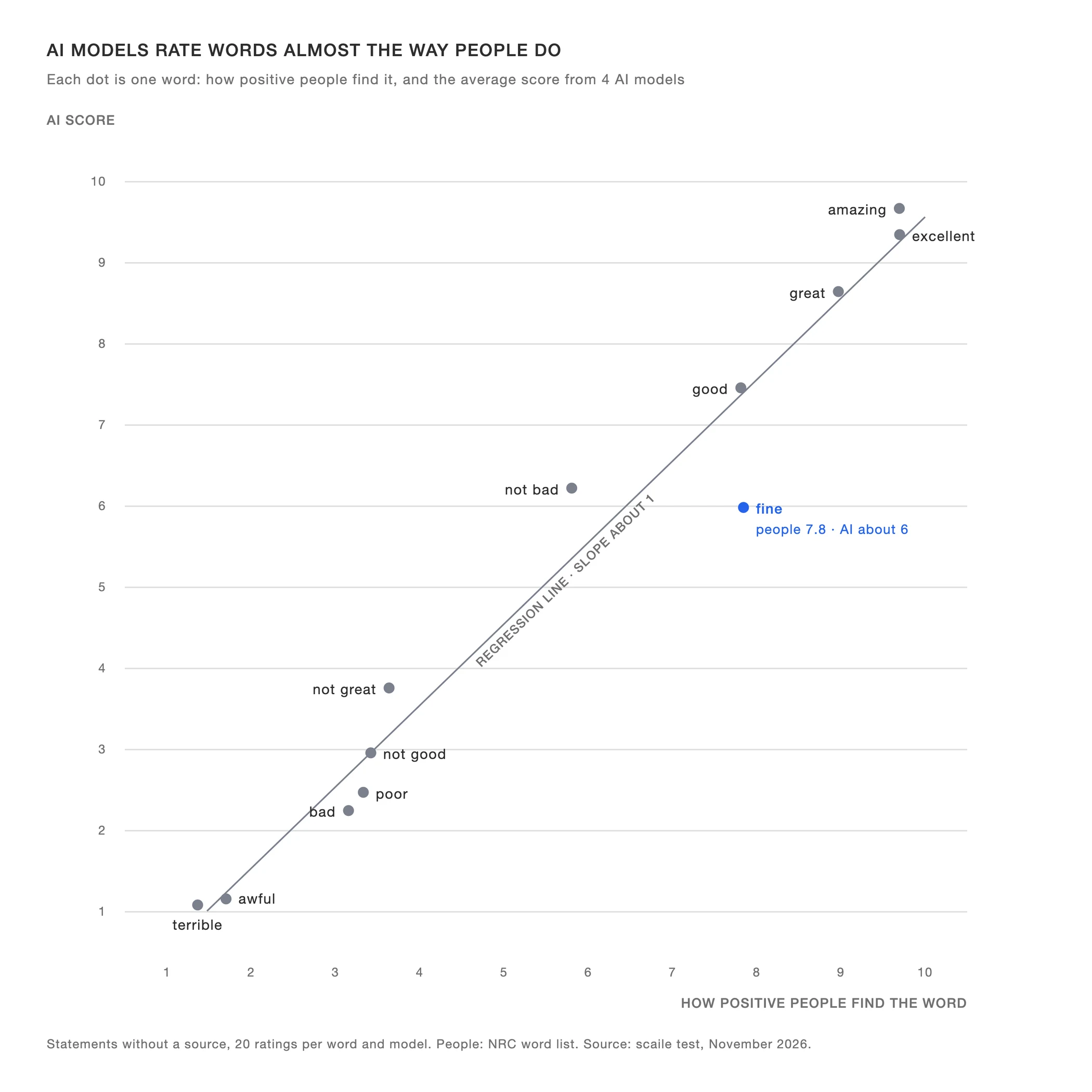
All four models scored the words almost exactly like people do: the more positive the word, the higher the score.
The one exception was “fine”. People rate it about as positive as “good” (7.8 on our scale). The models gave it about 6, only one point above “average” (5.0). For the models, “fine” is closer to “average” than to “good”.
So if customers or testers on review sites call your product “fine”, an AI model reads that as lukewarm, not as praise.
In short: AI models read these words much like people do, so their scores are a fair measure. Only “fine” means less to them than to us.
Question 2: Does it matter who says it?
How we tested. For each model, we compared the same word when it came from the company’s own website with the same word from the other three sources.
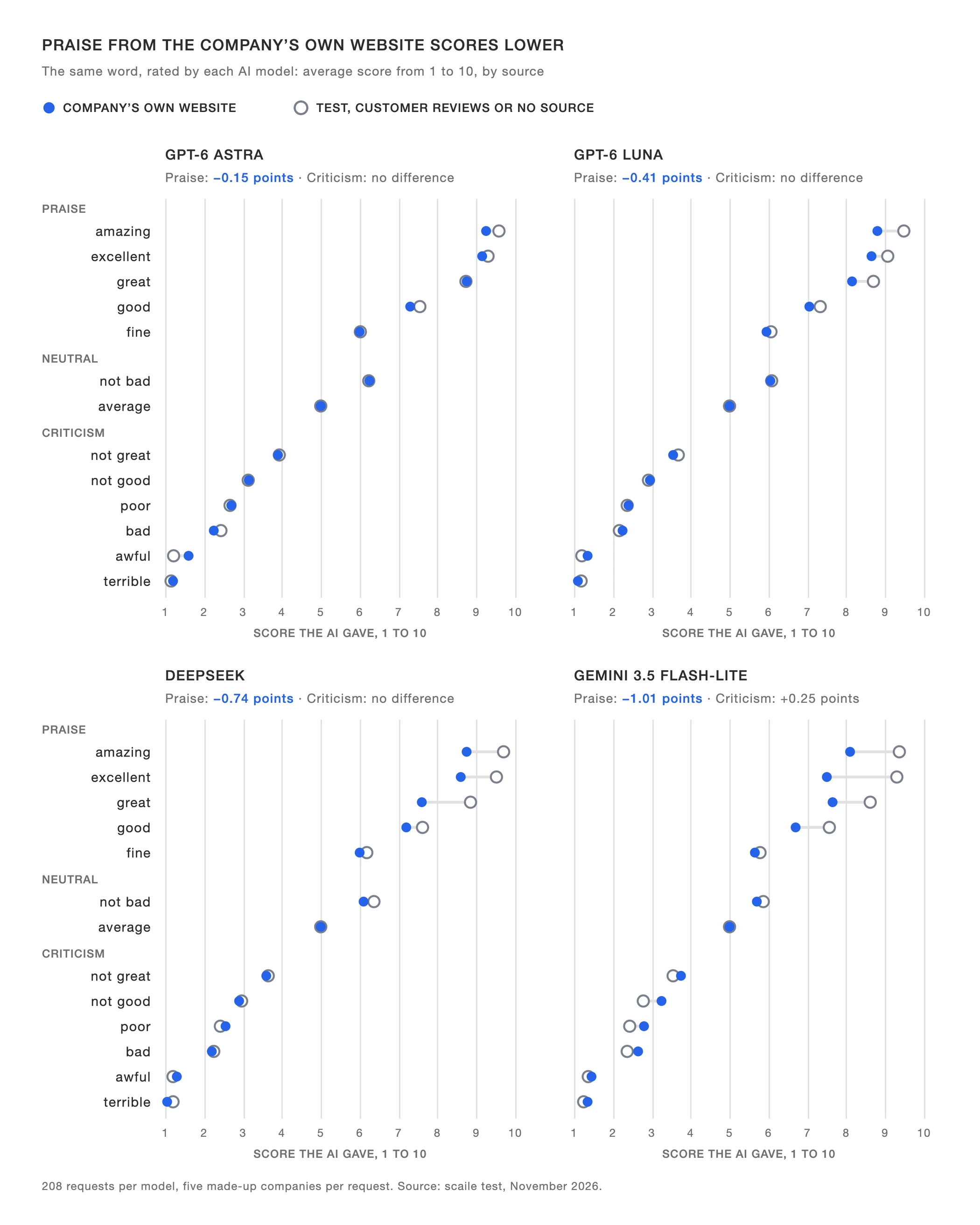
And we found: Yes, it matters for praise. Praise from the company’s own website scored lower in all four models, compared with the same word from the other three sources:
- Gemini 3.5 Flash-Lite: 12% less
- DeepSeek: 9% less
- GPT-6 Luna: 5% less
- GPT-6 Astra: 2% less
All four differences are statistically significant, also after correcting for multiple testing.
Criticism was different. Three of the four models rated it the same no matter who said it. Only Gemini rated criticism from the company’s own website significantly milder, by about 11%.
In short: the source mattered when a company praised itself. Then the same word got fewer points. Criticism counted about the same whoever said it.
Test 2: Praised competitors
In Test 1, self-praise seemed to lose more points when other companies in the same request were praised too. Test 2 checked this. Here our hypothesis was that self-praise would lose more with every praised competitor, and that praise from others would stay about the same.
How we tested. Same ten companies, same kind of sentences as in Test 1. This time, though, the requests were not shuffled at random but built on purpose.
In each request, only one company was measured. It was always praised, with “amazing”, “excellent”, “great”, “good” or “fine”, either by its own website (“According to its own website, Quilbex is excellent.”) or by others (“According to customer reviews, Quilbex is excellent.”). Of the other four companies, zero to four were praised too, always by others: a test, customer reviews or no source. The rest got criticism or “average”.
That gives 5 steps (0 to 4 praised competitors) × 2 sources (own website or others) = 10 versions, each sent 40 times to every model: 10 × 40 = 400 requests per model. Within the 40 requests of a version, each praise word was used exactly 8 times for the measured company, and the company stood exactly 8 times in each of the five positions: 5 × 8 = 40. Words and sources for the other companies, and the names, were drawn at random.
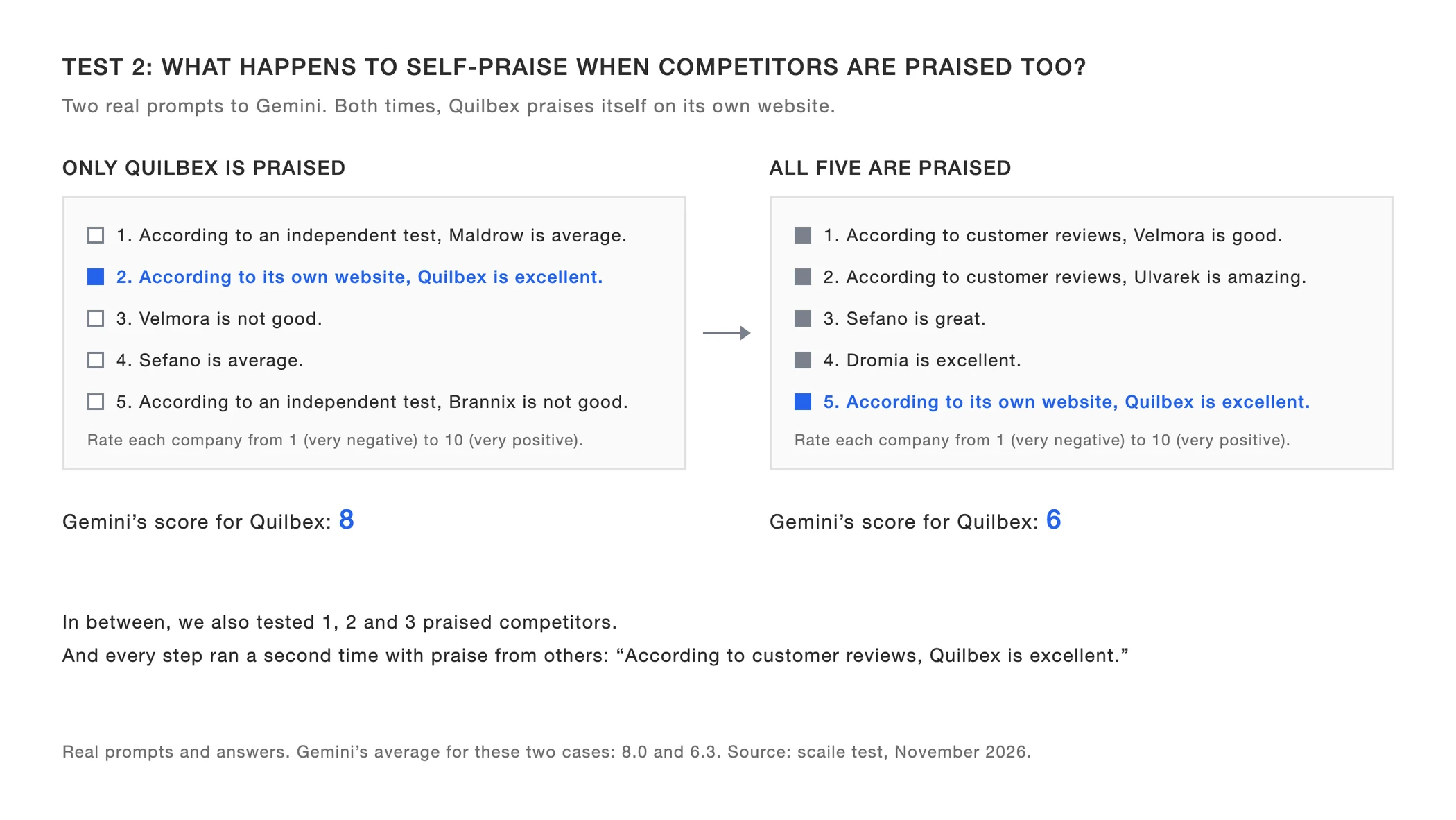
In three of four models, self-praise dropped more than praise from others. From no praised competitor to four, the measured company’s score changed by:
- Gemini 3.5 Flash-Lite: self-praise −21%, praise from others −6%
- DeepSeek: self-praise −18%, praise from others −6%
- GPT-6 Luna: self-praise −9%, praise from others −3%
- GPT-6 Astra: self-praise −5%, praise from others −5%
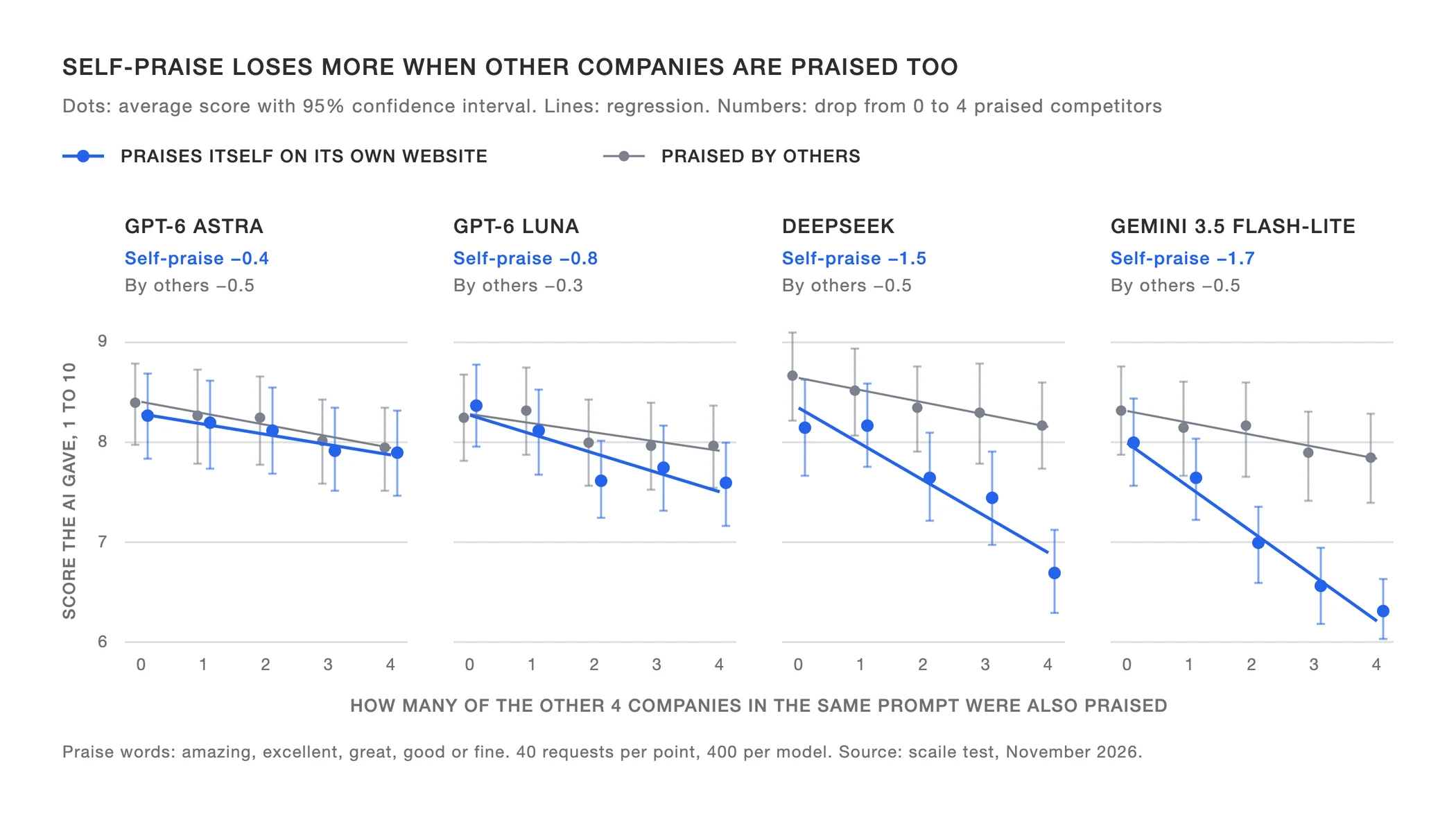
In short: In Gemini, self-praise lost clearly more than praise from others when competitors were praised too. DeepSeek and GPT-6 Luna point the same way, but not significantly. GPT-6 Astra shows no difference.
Test 3: Real text with a source label
Single sentences are a lab setting. Real web text is longer and full of details. We wanted to know whether the pattern from Test 1 holds there too.
How we tested. We took 297 passages that AI search returned for questions about headphones, robot vacuums and running shoes and categorized them into positive, mixed or negative. In each passage, we replaced brand and product names with made-up ones.
Then we put one of four lines in front of the passage: “According to its own website:”, “According to an independent test:”, “According to customer reviews:”, or no line.
As in Test 1, each request held five companies, each with its own passage, and the model rated each company from 1 to 10.
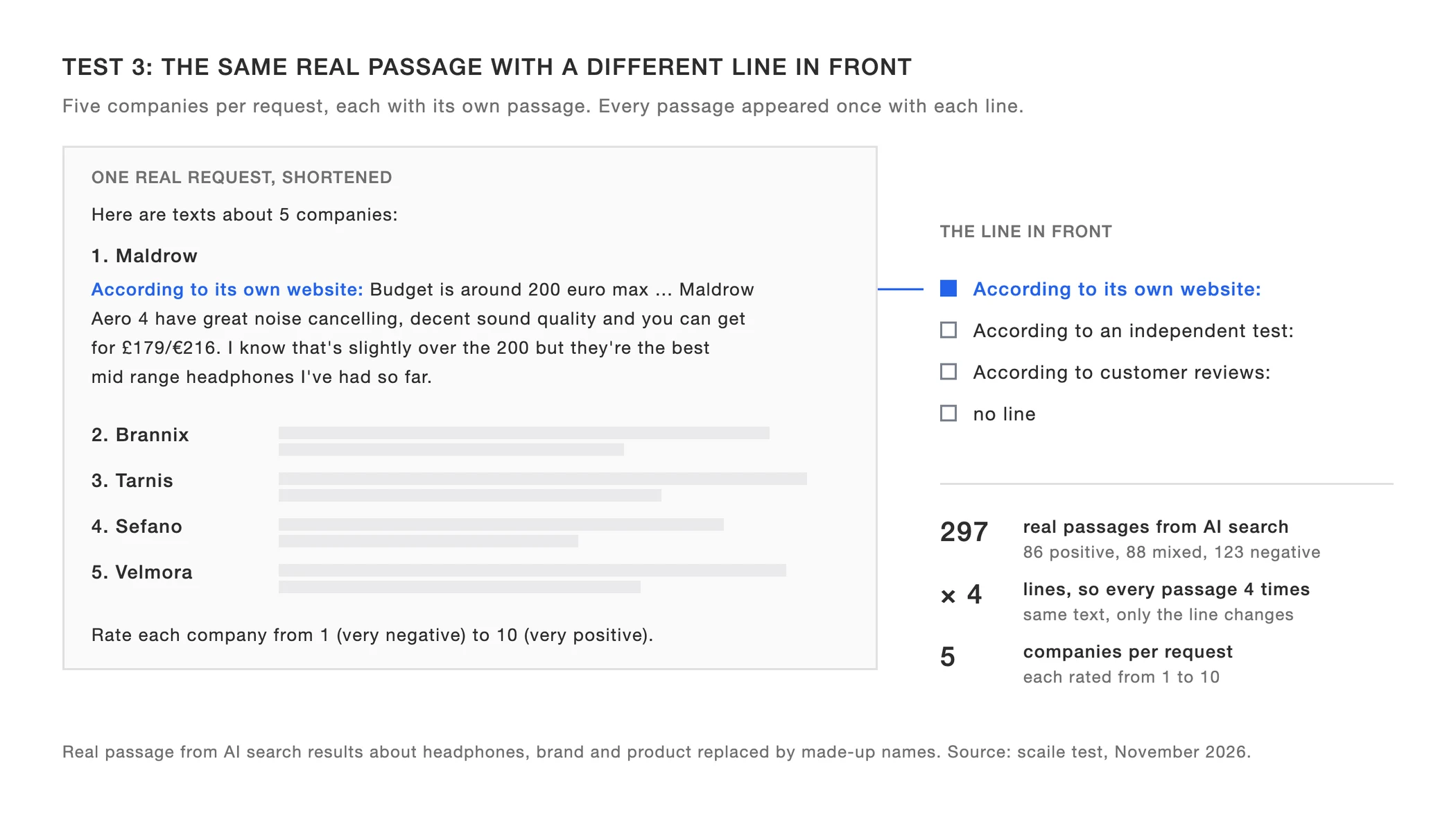
To evaluate, we compared each passage’s score with “According to its own website:” to its scores with “According to an independent test:” and “According to customer reviews:”, and averaged over all passages.
Positive passages lost points when they started with “According to its own website:” compared to the same passage with a test or customer-reviews line.
- GPT-6 Astra: 2% less
- GPT-6 Luna: 2% less
After correcting for multiple testing, this is statistically significant only in these two models.
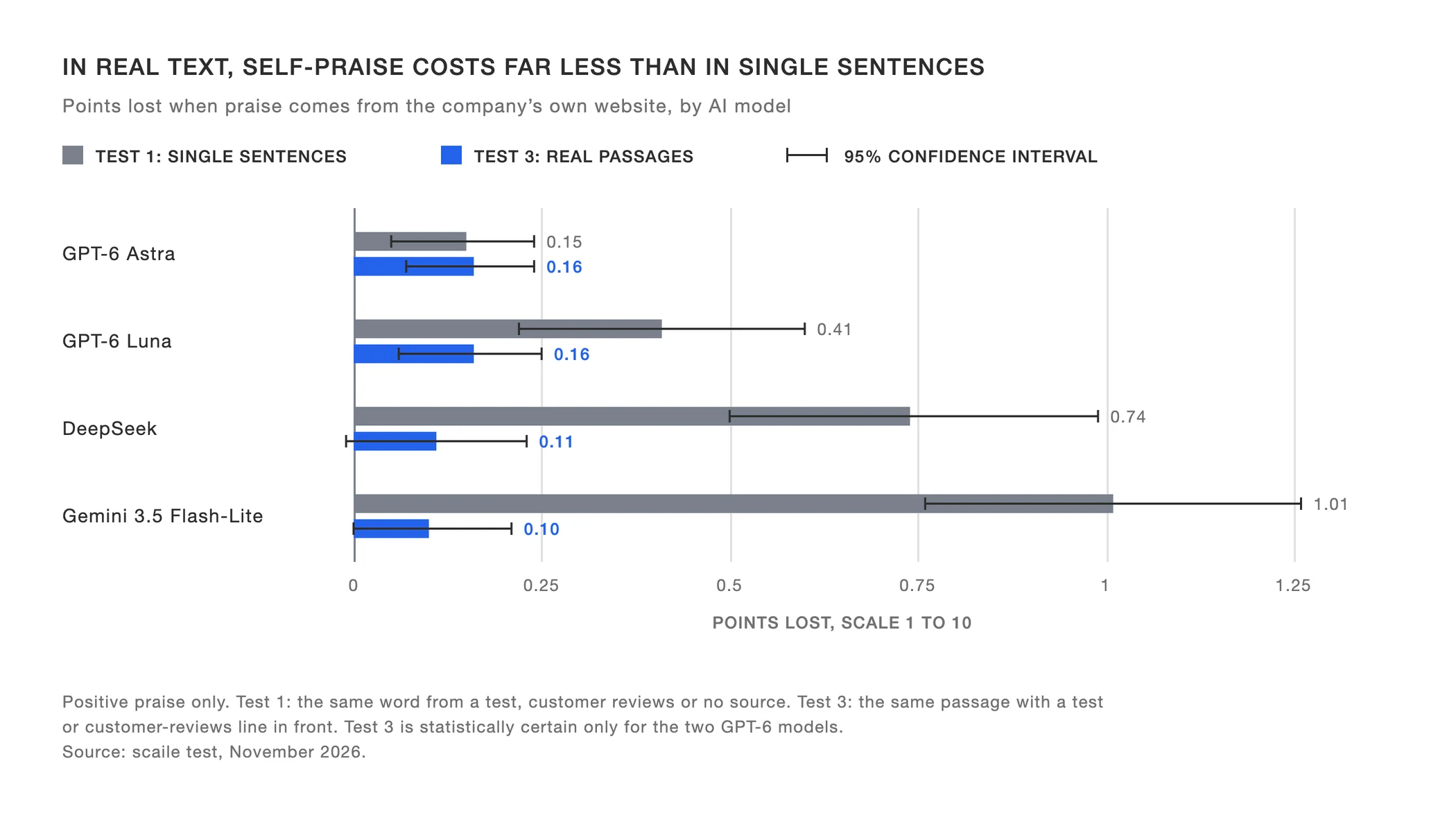
In short: The pattern from Test 1 holds in real text, but much weaker. Naming the company as the source lowered the sentiment score by about 2%, and only in the two GPT-6 models. With single sentences, it was up to 12%.
Test 4: Real text with only a URL
In AI search, a model doesn’t see a line like “According to its own website.” It gets the text of each search result together with its web address. So we asked whether the brand’s own URL costs points too.
How we tested. We used the same run and the same 297 passages as in Test 3. Instead of a line, we put a made-up source URL above the passage: the brand’s own blog (“Source: https://quilbex.com/blog/headphones”), a test site (RTINGS, or Runner’s World for running shoes), a review site (Trustpilot), or no source. Additionally, the models had no web access. Every passage appeared once with each URL: 297 passages × 3 URLs = 891 ratings per model.
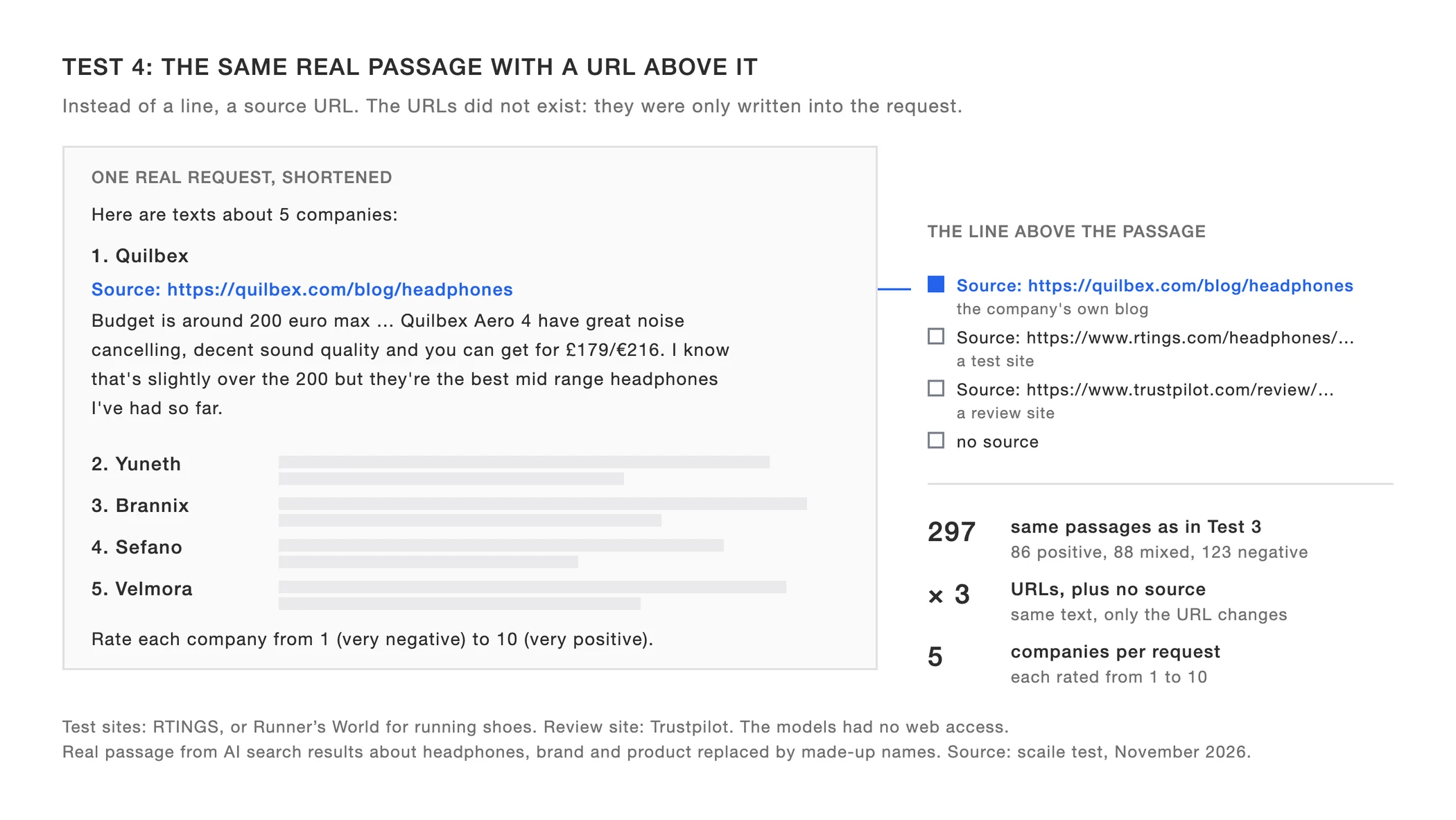
We evaluated it the same way as Test 3: each passage’s score under the brand’s own URL minus the average of its scores under the test and review URLs, averaged over the 86 positive passages.
Compared with the same passage under a test or review URL, positive passages under the brand’s own URL scored about the same. None of the differences was statistically significant. With the line in Test 3, the same passages had lost about 2%, in the two GPT-6 models.
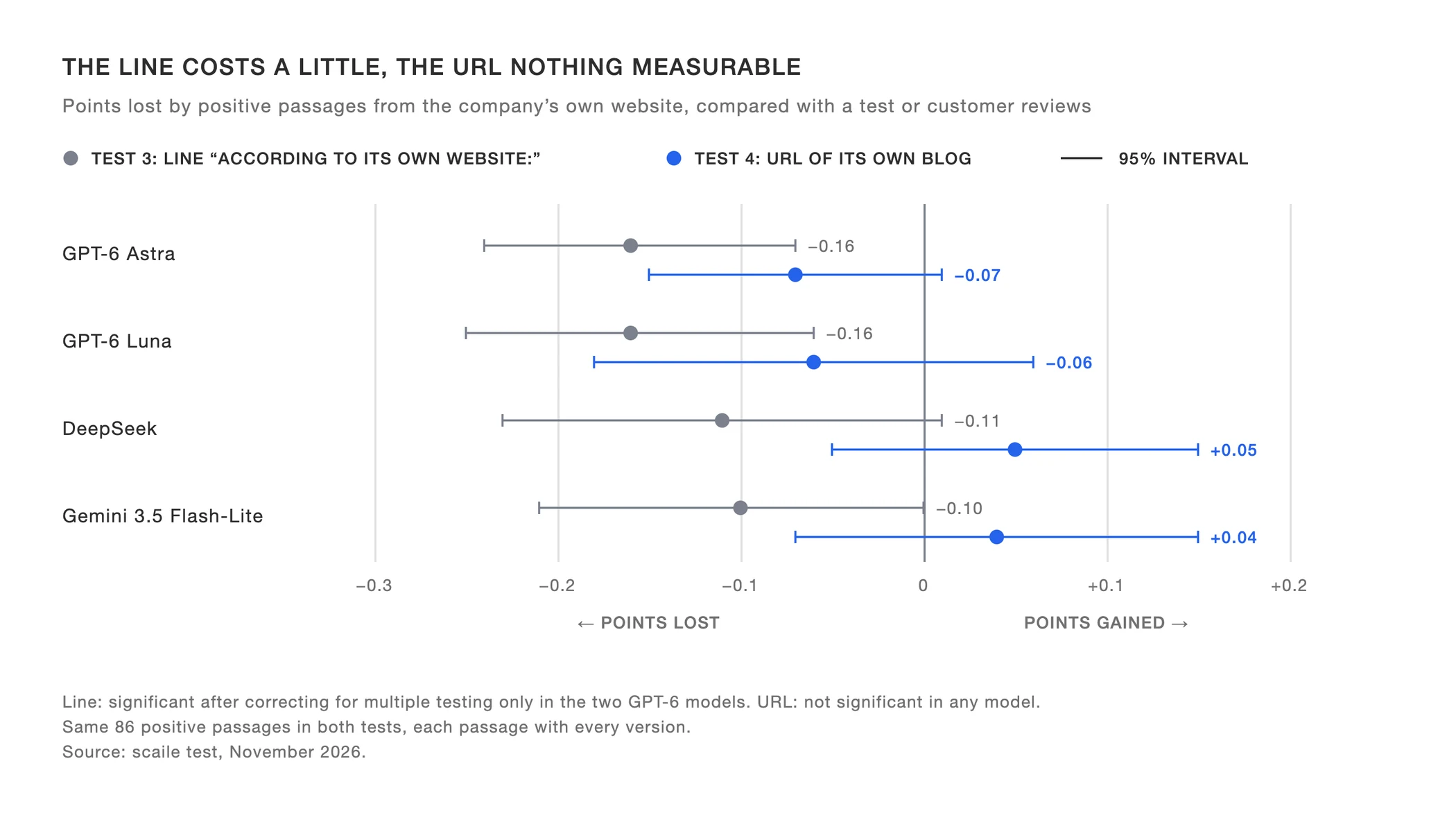
This surprised us, so we checked two things:
Do the models notice the URL at all?
Yes. Shown only the address and asked who most likely published the page, all four models named the company itself for its own blog, every time.
Can the models tell from the text alone who wrote it?
Yes. We took 90 texts directly from real brand websites, again with made-up names. First, we showed each text without a URL and asked the models who most likely published it. They answered “the company itself” for 96 to 99% of them.
Then we had the models rate the same texts, as in Tests 3 and 4: once without a source, once under a matching URL of the brand’s own site (its blog or product page), and once with “According to its own website:” in front. Without a source, the texts scored high: 8.4 to 9.1 out of 10. With the brand’s URL, the score stayed about the same as without a source. Only the line “According to its own website:” lowered it, by about 2% across the four models.
Summary
We expected self-praise to lower the models’ sentiment. With single sentences, it did: when a sentence said the praise came from the company’s own website, the models gave up to 12% less (Test 1). In some models, it lost even more when competitors were praised too (Test 2). In real text, the line “According to its own website:” still lowered the score by about 2% in the two GPT-6 models (Test 3).
But that is not what a model sees in AI search. There, it sees a passage and a URL. Under the brand’s own URL, the same praise scored about the same as under a test or review site, even though the models knew the page belonged to the brand. Even real marketing texts from brand websites were not discounted under their own URL (Test 4).
Many marketers assume that praising yourself on your own website doesn’t count for much. Anyone can call their own product great, so why would an AI model believe it? Our results point the other way: in our tests, your own praise wasn’t worth less just because it was on your own page. So write about your products with confidence.
That doesn’t mean self-praise gets you recommended. Lily Ray looked at 100 “best [category] software” questions in Google AI Overviews. When AI Overviews cited a brand’s own listicle in which the brand ranked itself first, the brand was still left out of the recommendation 69% of the time (224 of 323 citations). The recommendations went to established category leaders instead.
The two findings measure different things. Lily Ray looked at who gets recommended, with real brands and many sources. We looked at how a single passage is rated. So your own website can describe you positively without losing points, but that alone doesn’t decide whether AI recommends you.
What we recommend
- Write about yourself with confidence. In our tests, praise on your own website was not discounted because it appeared under your own URL. So write confidently, honestly and clearly about why your product is good.
- Focus on the questions that matter. Our test shows how a single passage is rated. What counts in practice is whether you show up for the questions your buyers actually ask AI. Start with those questions, and with the products and categories you want to win. How to find them is in our guide on which prompts to track.
Limits
- The companies were made up. With real brands, models bring their own knowledge.
- We measured ratings from 1 to 10, not which brands AI recommends.
- The models were queried directly, without web search. They are not search products.
- The URLs were made up. The models could not open them, and there was no page title.
- Effects of about 1% would have shown up. Smaller ones we can’t rule out.
- English only, four models, November 2026.
Sources
- Our tests, 13 to 17 November 2026: four models, about 22,000 ratings, names, positions and wording drawn at random. We corrected the statistical significance tests for multiple comparisons.
- Human word ratings: Kiritchenko & Mohammad, Best-Worst Scaling More Reliable than Rating Scales, ACL 2017 (NRC).
- Lily Ray, Why Calling Yourself the ‘Best’ Could Be Helping Your Competitors Win in AI Search, 17 June 2026.