GEO vendors and GDPR: data location, DPA and content ownership
In short
Before you sign a GEO vendor, you need its data processing agreement, its subprocessor list and clear exit terms. scaile works under a GDPR-aligned DPA, never trains shared models on your content and exports your data in four formats.

Dora is a founding engineer at scaile. She studied computer science, psychology and neuroscience at TUM, which is the perfect fit for GEO: she has a deep understanding of technology and of the human side, and knows how to write and produce content that leads humans to buy and AI to show you in its answers.
Key takeaways
A GEO vendor that handles your team's logins, analytics access or customer data works with personal data on your behalf. The GDPR then requires a written contract for it, the data processing agreement (DPA).
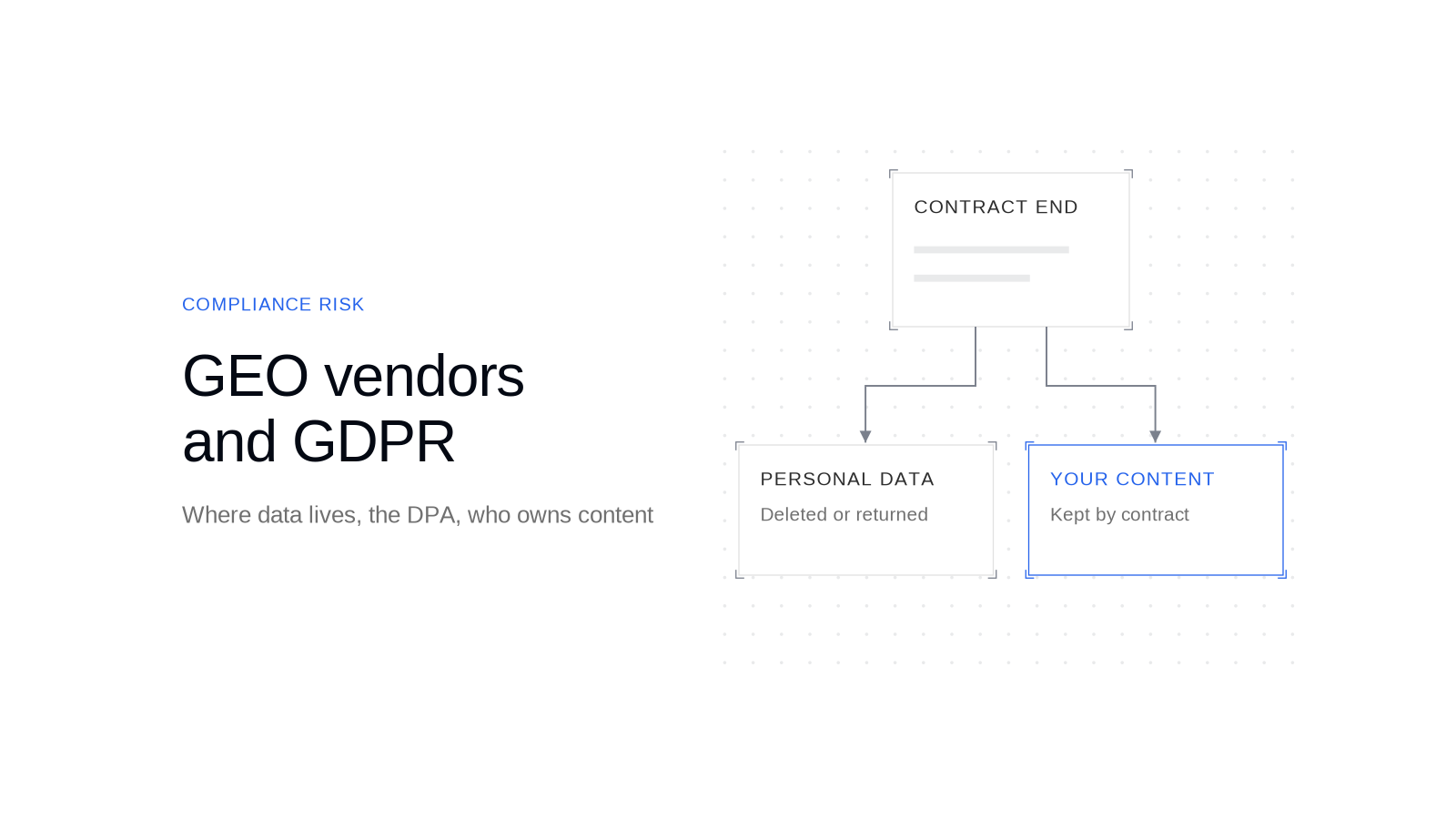
The DPA names which other companies may see your data and lets you object to a new one. At the end, your personal data is deleted or returned, as you choose.
When a service outside the EU receives your data, the transfer needs a legal basis, for example the EU's standard contract clauses. Ask the vendor for each service and its location.
Who owns the articles and the tracking history is not a GDPR question. Put it into the service contract, together with how you get your data out.
With scaile, you are never locked in: your articles go live directly in your own CMS, and you can export your tracking history from day one at any time as CSV, JSON, Excel or Google Sheets. Your content and data belong to you.
Procurement asks three questions before a GEO contract. Where is our data stored? Is there a data processing agreement? What happens to data and content when the contract ends?
Marketing adds a fourth: can we see the results ourselves and keep working with them later?
Where does a GEO vendor store your data, and what happens after the contract?
The vendor’s data processing agreement answers where your data goes, and the service contract answers who owns the work afterwards. A vendor that processes personal data for you needs a binding contract under Article 28 of the GDPR. It sets out the subject, duration and purpose, the type of personal data and whose data it is. [1]
That contract binds the vendor to two points that matter most here:
- Instructions: it processes your data only on your documented instructions, including any transfer to a country outside the EU. [1]
- The end: it deletes or returns all personal data when the service ends, at your choice, and deletes existing copies unless the law requires storage. [1]
Which of your data a GEO vendor actually touches
A GEO vendor touches more personal data than most buyers expect. The GDPR counts any information about an identifiable person as personal data, including an online identifier. [2]
Take a regional tourism board as a hypothetical example, not a real client. Its GEO vendor would handle five kinds of data:
- Team accounts: names and e-mail addresses of the people who log in and approve content. Personal data.
- Search Console and GA4 access: mostly totals of queries, clicks and visits, with online identifiers in the analytics behind them.
- Booking or CRM data: needed only if the vendor connects AI visits to real enquiries. Personal data of customers.
- Brochures, guides and expert interviews: mostly business knowledge, but recordings and author profiles name people.
- Prompt lists and tracking results: the buyer questions and what AI assistants answer about the board. Business data.
The more a vendor measures down to the enquiry, the more personal data it holds. scaile needs only read access to your website, Search Console and analytics on day one. Publishing access to your CMS can wait until the first articles are approved.
What the data processing agreement must say
Article 28(3) lists what the contract must stipulate about the vendor. [1] For a GEO vendor, three clauses carry most of the weight:
- Subprocessors: the vendor engages another company only with your prior specific or general written authorisation. Under a general authorisation it tells you about every change, so you can object. [1]
- Security: the technical and organisational measures of Article 32, which the contract must name.
- Audits: the vendor gives you all information needed to show compliance and allows audits, including inspections. [1]
The European Data Protection Board (EDPB), where the EU’s data protection authorities sit together, sets the bar higher than a copy of the law. A DPA “should not merely restate the provisions of the GDPR”, it should say concretely how each requirement will be met. [3]
A DPA that only repeats Article 28 tells you what the vendor must do, not what it does.
Where your data lives: subprocessors and transfers outside the EU
A GEO vendor’s data lives wherever the vendor and each of its subprocessors process it. A GEO setup usually spans three kinds of service: hosting, language models that write and analyse text, and the AI assistants the vendor asks to measure your visibility. Several of these companies are based in the US.
Each subprocessor carries the same data protection duties as the vendor, by contract, and the vendor stays fully liable to you for it. [1]
Moving data out of the EU adds a second rule. Without an adequacy decision for the country, a transfer needs appropriate safeguards. [4] One of them is the set of standard contractual clauses (SCCs) adopted by the European Commission, modernised on 4 June 2021. [5]

Four questions get you the full picture:
Where do the servers, the database and the backups run?
Which model providers see your content and prompts, and may they train on them?
Which assistants does the vendor query for tracking, and does anything about a person travel with the question?
For every service outside the EU: which adequacy decision or which SCCs cover it?
The subprocessor list is the honest answer to “where does our data live”. A single country on a sales slide is not.
Who owns the content and the data after the contract?
You own what the service contract says you own. The GDPR returns or deletes personal data; articles, briefs, prompt lists and tracking history need their own clause. Three things belong in it:
- Published content: who holds the rights to articles, diagrams and images, also after the end.
- Working material: briefs, the knowledge base and the brand guidelines you supplied.
- Tracking data: the history of your buyer questions, and the formats you receive it in.
AI-written text adds a copyright question. The U.S. Copyright Office concludes that “prompts alone do not provide sufficient human control” to make the user the author of the output. [6] Human authors keep copyright in their own perceptible contributions and in the creative selection, arrangement or editing of the output. [6]

Write down your right to use, change and keep publishing the content, not only who “owns” it. Labels for AI-written text are a separate question, covered in AI content labelling under the EU AI Act. Keeping Search Console, GA4 and the CMS in your own name is covered in GEO contracts: minimum term, notice and what follows the audit.
scaile publishes approved articles into your existing CMS, so they live on your own domain.
Can you see the results yourself and keep working after you leave?
You should have your own login while the contract runs and a full export when it ends. A dashboard you only see through the vendor’s reports leaves you with nothing once the contract stops.
You see what the vendor sends, as long as you pay
You see the results yourself and take the data into your own reporting
scaile combines Bing Webmaster Tools, Google Search Console and GA4 with its own prompt tracking in one report in the scaile platform. Exports come as CSV, JSON, Excel and Google Sheets, with API access, and the tracking history is kept from your project start for the whole engagement.
Export the history before the last day of the contract, not after it.
How to read a vendor’s answers
A vendor’s first answer shows how far its paperwork goes. Five common answers, and what to ask next:
A statement, not a contract. Ask for the DPA itself.
Ask for the annexes: the security measures and the subprocessor list.
The choice between deletion and return is yours. The EDPB says the contract should let you change that choice before the end and set out how. [3]
Your content and prompts then serve the vendor’s own purpose. A processor that decides on purposes and means counts as a controller for that processing. [1]
Add one before you sign: rights to the published content, export formats and the date of the last export.
Your data protection officer makes the call; these answers show where to look first. The wider platform checklist is in how to choose an AI visibility platform.
What scaile delivers
scaile puts the terms in writing before the work starts. Agreements run for a minimum of six months, and the notice period and the exact terms are set in your proposal. Within that, you choose how to work:
Your buyer questions in AI search, found by scaile from data and tracked in app.scaile.to.
You getA tracking history from your first day, ready to exportA scaile strategist builds the GEO strategy from your AI visibility, search and analytics data. scaile executes, with weekly strategy calls.
You getNo article goes live before your team approves it in app.scaile.toscaile takes over GEO completely: strategy, website changes, content, publishing, refreshes and monitoring.
You getReports and what scaile plans next, while you give expertise and approvalsClients held to strict publishing rules describe it in their own words:
”[…] we are held to the highest publishing-house guidelines, and everything we publish has to be factual and correct. scaile saw the problem, understood us, and made us more efficient and more effective without changing the way we work.” Serge Heitmann, CEO, Axel Springer Teaser Ad GmbH / AdUp Technology (case study)
A GEO vendor needs a DPA that names its subprocessors and your choice at the end, and a service contract that settles content and exports. scaile works under a GDPR-aligned DPA, keeps your tracking history exportable and publishes into your own CMS. Book a call with scaile.
FAQ
Does the DPA have to be signed on paper?
No. Article 28 requires the contract in writing and accepts electronic form, so a signed PDF or an accepted online agreement works.
Does a vendor that only tracks AI answers need a DPA?
Yes, as soon as your team logs in to its platform: names and e-mail addresses are personal data. The buyer questions and AI answers themselves usually are not.
Sources
- Art. 28 GDPR – Processor - General Data Protection Regulation (GDPR)
- Art. 4 GDPR – Definitions - General Data Protection Regulation (GDPR)
- EDPB Guidelines 07/2020 on the concepts of controller and processor in the GDPR
- Art. 46 GDPR – Transfers subject to appropriate safeguards - General Data Protection Regulation (GDPR)
- Standard Contractual Clauses (SCC) - European Commission
- U.S. Copyright Office: Copyright and Artificial Intelligence, Part 2: Copyrightability