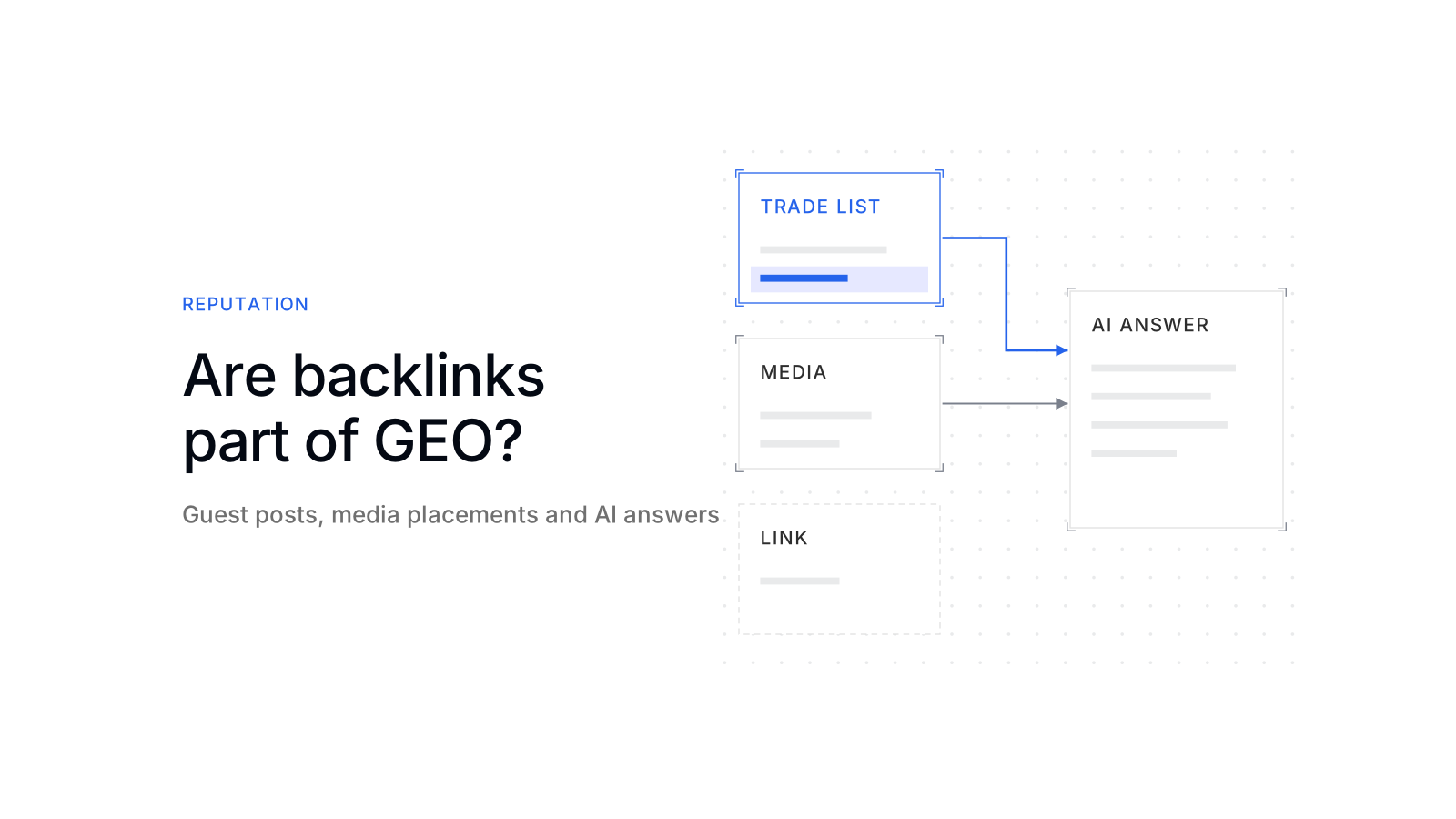
Are backlinks, guest posts and media placements part of GEO?
In short
Yes, as mentions on the pages AI answers are built from, not as a link count. Backlinks get your own pages found. scaile does Managed GEO and shows which outside sources the answers to your buyers' questions cite. scaile makes sure you are named on those pages.

Dora is a founding engineer at scaile. She studied computer science, psychology and neuroscience at TUM, which is the perfect fit for GEO: she has a deep understanding of technology and of the human side, and knows how to write and produce content that leads humans to buy and AI to show you in its answers.
Key takeaways
Being mentioned on other websites is part of GEO. When someone asks an AI assistant about a brand, about half of the sources it cites are other people's pages.
Backlinks still matter for one reason: without them, an AI search engine often has none of your pages stored, so it cannot cite them.
More links do not make AI assistants name you. Being named in the articles they read for your buyers' questions does.
A guest post or a press article is worth it if AI assistants already read that page when your buyers ask, and the page names you.
Buying links, or writing guest posts just to get a keyword link, is against Google's rules and puts your rankings at risk.
scaile makes sure you are named on the right pages: 1) it finds the pages cited in real AI answers, and 2) it contacts those pages and asks whether they can mention you.
Are backlinks, guest posts and media placements part of GEO?
Yes, but in a different form than in a link-building plan. Generative engine optimization (GEO) counts a guest post or a media placement when it puts your name on a page that AI assistants read to answer your buyers’ questions. A backlink still matters, because it helps your own pages get into the indexes AI assistants search. A link that exists only to move a ranking is not GEO, and Google treats it as spam.
Buyers ask it in sales calls almost word for word: is this part of the GEO package? It is a fair question. When a user names a brand in a question to an AI assistant, earned media accounts for 48% of the citations, and 16% come from editorial sites and independent media. [1] The brand’s own content makes up 23%. [1] Omniscient Digital counted this in more than 23,000 citations across hundreds of branded queries. [1]
A comparison of AI search and Google points the same way. AI search showed a systematic bias towards earned media, meaning third-party sources, over brand-owned and social content. Google’s mix was more balanced. [2] The study is a preprint and not peer reviewed.
How many sites link to you, and how strong they are
Whether the pages AI answers use for your buyers’ questions name you
What do backlinks still do for AI answers?
Backlinks still do two things: they get your pages into the index an AI assistant searches, and they raise your authority there. They do not decide whether the assistant names your brand.
scaile tested this in DeepSeek’s search, which shows the scores it gives each result, in a study of 180 buyer questions and 1,000 websites. Of the websites with no backlinks, 2 in 10 had at least one page saved in DeepSeek’s index. With 100 to 999 backlinks it was 9 in 10. Once a site was in the index, more backlinks meant higher authority. Authority 3 or 4 went from 1 in 10 sites without backlinks to 8 in 10 with 1,000 or more.

A page that is not in the index can never be cited. That is why the study’s advice is to get your first 100 or so linking websites. Past that threshold, more links still raise authority, but the share of sites in the index stops rising.
Ahrefs looked at 75,000 brands in ChatGPT, Google AI Mode and AI Overviews. Link metrics, such as the number of backlinks, correlated very weakly with brand mentions in all three. [3] Branded web mentions, by contrast, correlated highly with AI visibility, at 0.66 to 0.71. [3] Ahrefs adds that correlation is not causation, and that improving a metric will not automatically raise AI visibility. [3]
That splits the link budget in two. Links that get your pages indexed and trusted stay part of the job. Links collected to push a domain metric do little for AI answers.
When does a guest post or media placement count for GEO?
A guest post or media placement counts when its page is among the results an AI assistant retrieves for your buyer’s question, and names you where it answers it. Where it sits matters more than who publishes it.
In the same scaile study, ChatGPT named a brand far more often when several pages it read mentioned it and one of them ranked high. With one mentioning page in the top 5 results, the brand was named 37% of the time. With four or more mentioning pages and the best of them in the top 5, it was named 81% of the time. When they all ranked lower, 44%. That is 15,700 cases in ChatGPT, and the authority of the websites doing the mentioning made no difference (full data).

So a trade comparison page that ranks for “best X for Y” is worth more than a famous outlet that never appears for your buyers’ questions. Four tests before you pitch or pay for a placement:
The page already shows up among the pages AI assistants cite for one of your buyers’ questions.
Your brand appears in the passage about the buyer’s question, not only in an author box or a footer link.
The page is near the top for the searches the assistant runs, not just for your brand name.
The description of your offer is accurate, because the assistant repeats what the page says.
Press releases fail the first test for most questions. Across 70,666 AI answers, wire-service URLs were retrieved in about 1.2% of responses and cited inline in 0.6%. [4] When a prompt named a brand, a press release was retrieved 5.0% of the time, against 0.7% for prompts without a brand name. [4] More than half of the releases retrieved were over a year old. [4] A release can reinforce your facts for people who already ask about you by name; it rarely gets you found by people who do not. The authors add that the study does not prove a release creates AI visibility. [4]
Which link-building tactics break Google’s rules?
Google treats any link created mainly to manipulate search rankings as link spam, and buying or selling links for ranking purposes is its first example. [5] The same policy names advertorials whose links pass ranking credit, and links with optimized anchor text in articles, guest posts or press releases distributed on other sites. [5] Text ads and text links that don’t block ranking credit are on the list too. [5]
None of that rules out a paid placement or a guest post. It rules out using either to buy ranking credit. A sponsored article that names you, with a link that passes no ranking credit, still puts your name on a page AI assistants read. Guest posts written around a keyword-rich anchor text put at risk the Google rankings your own pages depend on.
For the GEO package, the rule is simple: the work aims at the mention and the page’s place in the answer, never at ranking credit. An offer that sells link volume or anchor-text placements is link building under a new name.
How do you find the publications AI answers cite?
Ask AI assistants your buyers’ questions, many times, and write down every page they cite. A PR media list tells you who people read. The citations tell you who the assistants read.
- 1Collect the questions
The questions your buyers ask right before they choose a provider, in their words.
Your partSales and support questions from the last quarter - 2Ask the assistants
Put each question to ChatGPT, Gemini, Perplexity and Google AI Mode, several times, and keep every cited page.
ResultA list of the pages behind each answer - 3Sort the sources
Split them into your own pages, trade and media articles, comparison lists, reviews and forums.
ResultThe share of each type for your category - 4Find the gaps
Mark the pages cited often that name your competitors and not you.
ResultA short list of placements that would count - 5Decide per page
Offer data, a quote or a product to test where an outside page is the gap, or write the page yourself where no good answer exists.
Your partExperts and facts for the pitch or the page
Step 5 often ends on your own website: where no good answer exists yet, your own guide can become the source.
In May 2026, AI engines answered Beurer’s 14 core buying questions mainly from test portals, video and retailers, and used beurer.com in 17% of answers. After the magazine was expanded with guide articles, it was 42% in September, more than any other website.
What scaile delivers
scaile treats outside mentions and your own pages as one job, because AI answers draw on both. In its packages, earned third-party coverage is part of the strategy where it matters for AI search. To do that, scaile finds the pages cited in real AI answers, contacts them and asks whether they can mention you. Paid media, publisher placements and specialist third parties are not included by default and are agreed separately.
scaile finds your buyers’ questions with you, from data, and tracks them in its own platform, app.scaile.to, including the sources each answer cites.
You getThe outside pages that shape answers in your category, and whether they name youA dedicated AI search strategist ranks those outside pages against your own, and scaile writes, publishes and refreshes the pages on your site.
You getOne plan for off-site mentions and on-site answers, with a weekly meeting on resultsYour teamReviews and approvesscaile takes over the whole function, from questions and strategy to content and reporting.
You getThe work and the measurement, without extra hours from your teamYour teamProvides context and approvalsNo provider can guarantee rankings, citations, traffic or revenue, and scaile does not either.
Backlinks, guest posts and media placements are part of GEO when they put your name on the pages AI assistants read for your buyers’ questions. Links still get your pages found, but their count does not get you named. Test every placement against the sources the answers already use, keep paid links out of ranking credit, and write your own page where the answer is missing. scaile shows you those sources and plans both sides with your team. To build that plan for your category, talk to scaile about Strategy with you.
FAQ
Should we cut our link-building budget for GEO?
Keep the part that gets your pages indexed and earns links from sites that matter in your field. Move the part that only raises a domain metric to mentions on the pages AI assistants cite for your buyers’ questions.
Do YouTube videos count as off-site work?
Yes. In the Ahrefs study of 75,000 brands, YouTube mentions had the strongest correlation with AI visibility of all factors, at about 0.737. It is a correlation, not proof that a video causes a mention.
Are link exchanges with partners a problem?
Excessive link exchanges, or partner pages that exist only to link to each other, are link spam under Google’s rules. A partner that writes about you because the work is real is a mention, and it counts when AI assistants read that page.
Sources
- How LLMs Source Brand Information: An Analysis of 23,000+ AI Citations Research - Omniscient Digital
- 2509.08919 Generative Engine Optimization: How to Dominate AI Search
- Top Brand Visibility Factors in ChatGPT, AI Mode, and AI Overviews (75k Brands Studied)
- Do Press Releases Show Up in AI Answers? We Analyzed 70,000+ Responses - Omniscient Digital
- Spam Policies for Google Web Search | Google Search Central | Documentation | Google for Developers