White-label GEO pricing: per client, revenue share or co-branding
In short
Your clients ask for GEO, and you need a partner and a pricing model that keeps them yours. scaile prices per active client and runs research, content and tracking behind your name, with one workspace and client-ready reports per client.

Dora is a founding engineer at scaile. She studied computer science, psychology and neuroscience at TUM, which is the perfect fit for GEO: she has a deep understanding of technology and of the human side, and knows how to write and produce content that leads humans to buy and AI to show you in its answers.
Key takeaways
Agencies buy GEO from a partner in three ways: per client, through a revenue share, or co-branded.
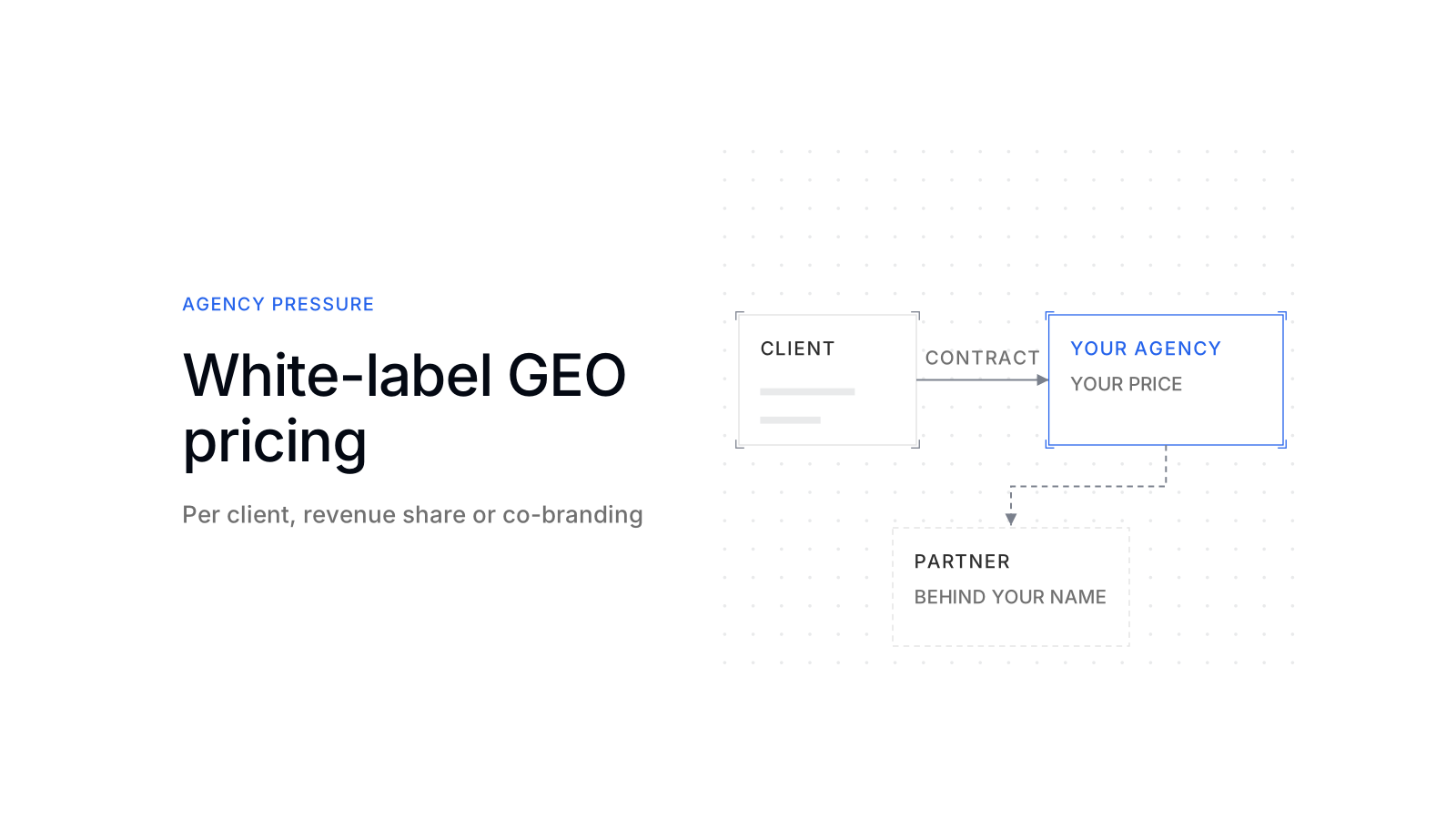
Per client keeps the client contract, your price and the margin with you.
A revenue share pays a commission for the introduction; the partner signs and serves the client.
scaile prices per active client and month, with volume pricing as your portfolio grows.
What scaile does especially well for agencies: every client gets its own workspace with 50 tracked prompts and up to 50 articles a month, and you send the reports as your own.
How can a marketing agency add GEO services for its clients?
Clients now ask their agency whether ChatGPT, Gemini and Google’s AI answers name them, and what the agency does about it. Generative engine optimization (GEO), a term introduced in a 2023 research paper, means improving how visible content is in AI-generated answers. [1] For a company, that means being named and cited when buyers ask.
Building that in-house takes researchers, writers and tracking. The fastest route is a partner who delivers GEO behind your name, at a price per client that leaves you a margin.
How is white-label GEO priced: per client, revenue share or co-branding?
White-label GEO is priced in one of three ways. Each one answers a different question: who signs the client, and who keeps the margin.
You pay the partner a price per active client and month and bill your client your own retainer.
You keepThe client contract, your price and the marginThe partner signs and bills the client. You get a cut for the introduction.
You keepA percentage, without the delivery workYour name and the partner’s appear on the work. Who bills and how the money splits is negotiated.
You keepWhat the deal says, often a shared client
Per client: you buy the work and set your own price
Per client means you buy the delivery at a set price for each active client and resell it at your own. Your margin is the retainer minus three costs:
- Partner price: what you pay for that client’s workspace and the work inside it.
- Your own hours: account management, client calls, approvals and reporting.
- Unused capacity: a client you pay for while the retainer is paused.
A worked example with invented numbers, not a price list of scaile or anyone else. Your client pays a retainer of 3,000 a month, and the partner charges 1,200 for that client.
Your account manager spends 8 hours at 90 an hour, so 720. You keep 1,080 a month, 36% of the retainer, and you set every one of those numbers yourself.

scaile fits this model well: it prices per active client and month, with volume pricing as your portfolio grows, so each new client adds a known cost. How GEO is priced to the brand itself is covered in how GEO is priced.
Revenue share: the partner bills, you earn a cut
In a revenue share the partner signs the client, bills them and pays you a commission for bringing the deal. HubSpot, for example, pays its Solutions Partners 20% commission for 3 years on deals they bring. [2] Its affiliate program pays 30% monthly recurring commission for up to one year. [3]
In the example above, a 20% share of the 3,000 retainer pays you 600 a month, with no delivery work. The partner sets the price, runs the work and keeps the client after the commission ends.
You want to recommend GEO without selling or running it, and the client is not one of your core accounts.
Control: the partner holds the client’s contract, price and contact.
How long the commission runs, whether it pays on renewals, and what happens when the client upgrades.
Co-branding: both names on the work
Co-branding means the partner’s name stays visible next to yours: on reports, in the platform or in the pitch. It is the middle ground between a full white label and a referral.
Co-branding helps when the partner’s name wins the deal; in delivery, one name on the work keeps the relationship with you. A practical split is the specialist’s name in the pitch and your own name in delivery once the client signs.
Which model fits your agency
Per client fits an agency that wants GEO as its own service line; revenue share fits one that wants to refer. Co-branding sits between the two:
| Model | Client signs with | Whose name the client sees | Who sets the price | Your delivery work |
|---|---|---|---|---|
| Per client | You | Yours | You | Account management and approvals |
| Revenue share | The partner | The partner’s | The partner | None |
| Co-branding | Negotiated | Both | Negotiated | Shared, by agreement |
What to check before you sign a white-label GEO deal
Check what one client gets for the price and who talks to that client. Five points cover most deals:
- Scope per client: tracked prompts, AI assistants, markets, content volume and reporting, in numbers.
- Client contact: that the partner talks to your clients only when you ask, in writing.
- Your brand: reports, the login and the domain under your name.
- Pitch workspaces: whether you can show a prospect their own data before they sign.
- Exit: what happens to each client’s data, prompt history and content when a client leaves.
Contract terms are covered in GEO contracts. scaile’s partner terms set the scope per client workspace and the trial workspaces for prospects, scaile’s account manager works with your team rather than your clients, and reports go out under your name.
How do agencies report AI visibility to clients with scaile?
With scaile, your team picks the data that matters to each client and exports a client-ready PDF report that you send as your own. Clients can also get their own workspace login with their own team and permissions, and larger partnerships can put that login on your own domain.
Brands that work with scaile directly describe the results like this:
“scaile helped us increase inbound leads by 100%. We now have constant qualified lead inflow.” Heinrich Rusche, Chief Revenue Officer, Building Radar
“scaile helped us identify customer questions, understand AI systems and build high-quality blog content with human checks in the right places.” Kerstin Glanzer, Director Marketing, Beurer
What scaile delivers
scaile delivers the GEO work for your clients, from research to the report. Each client workspace includes 50 tracked prompts, research, five content clusters and up to 50 articles a month, and a dedicated scaile account manager supports your team with onboarding, training and weekly check-ins.
Tracking per client workspace, with the buyer questions scaile researches for each client.
You getTracking for every client, plus trial workspaces for prospectsYour strategists and writers work in scaile; a scaile strategist plans with them and scaile runs research and content.
You getYour team keeps the client work, scaile adds the capacityscaile researches, structures, publishes, refreshes and reports for the client, with weekly strategy meetings.
You getA GEO service line without new hires, sold at your priceWhite-label GEO comes in three forms: per client, revenue share and co-branding. Per client keeps the contract, the price and the client with you, and scaile is built for exactly that.
If your clients ask about AI search and you want to answer under your own name, book a call with scaile and see what one client workspace holds.
FAQ
Do my clients need to know that a partner does the work?
That depends on your contract with the client. What matters is that you stay accountable for the result and keep the client relationship.
Can I start with a revenue share and switch to per client later?
Only if the partner agrees, because under a revenue share the client has signed with the partner. Agree the switch before the first referral.
Is white-label GEO worth it for an agency with only two or three clients?
Yes, when the partner prices per active client: a small portfolio costs little, and a trial workspace helps you win the next client.