AI competitor gap analysis: find every prompt where a competitor is named and you are not
In short
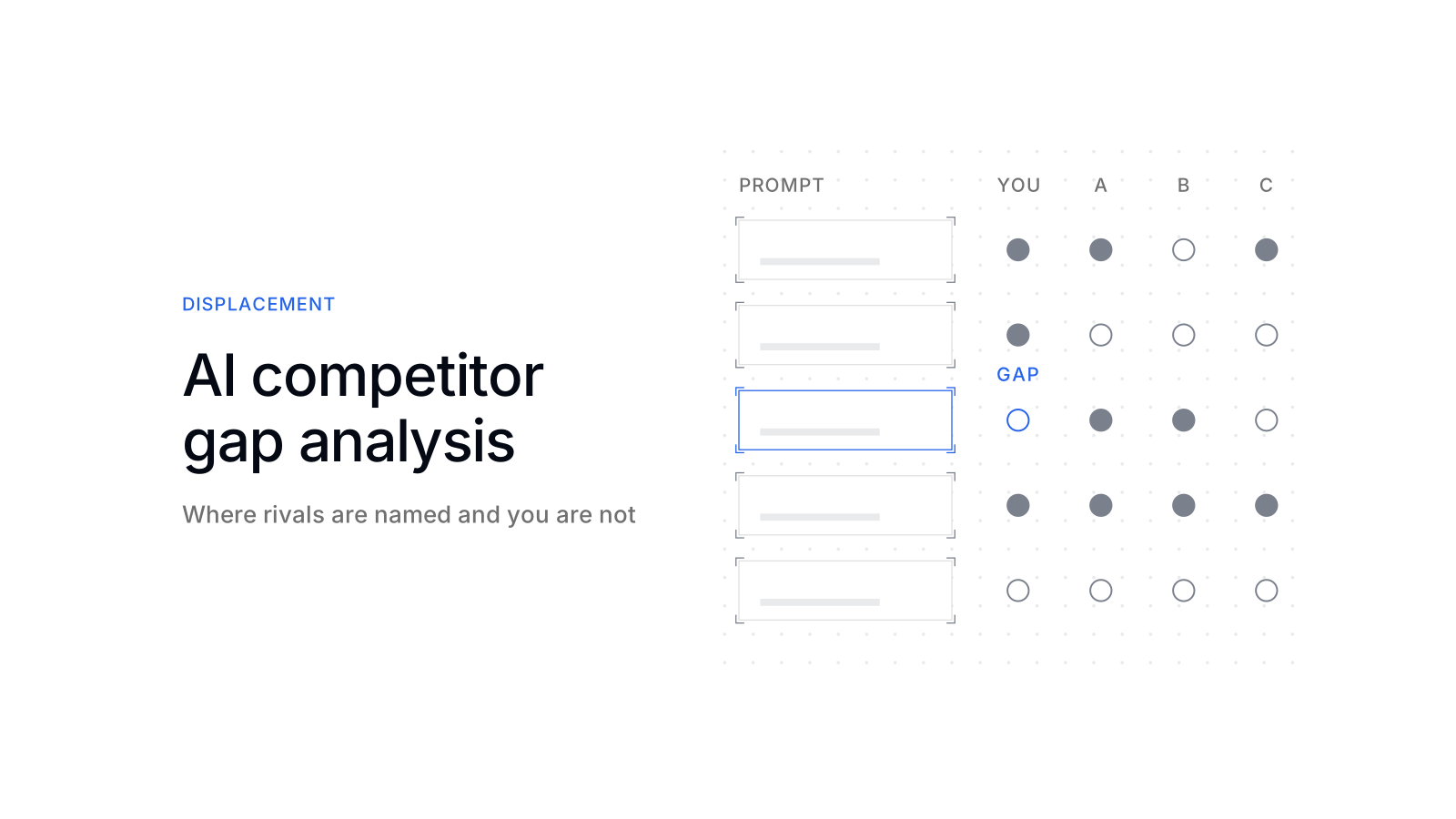
An AI competitor gap analysis lists every buyer question where, over repeated runs, AI assistants name a competitor and never you. scaile tracks your buyer questions and competitors, shows the cited sources per gap and closes the biggest with pages on your site.

Dora is a founding engineer at scaile. She studied computer science, psychology and neuroscience at TUM, which is the perfect fit for GEO: she has a deep understanding of technology and of the human side, and knows how to write and produce content that leads humans to buy and AI to show you in its answers.
Key takeaways
A gap is a buyer question where AI assistants keep naming a competitor and never name you.
Ask each question many times in every AI assistant your buyers use. One answer proves nothing.
For every lost answer, note which websites the assistant used as sources. They tell you what to fix.
Work on the gaps in the order of the money behind them, not in the order you found them.
Each gap becomes one task: a page on your own site, or a mention on a site the assistant already reads.
scaile shows which pages each AI answer relied on and closes the gaps in order of revenue with pages on your site. It measures against the same questions, so you can see whether a gap has really closed.
What is an AI competitor gap analysis?
An AI competitor gap analysis is a list of every buyer question where ChatGPT, Gemini, Perplexity or Google’s AI answers name a competitor and do not name you. It is part of generative engine optimization (GEO), the work that gets a company named and cited in AI answers.
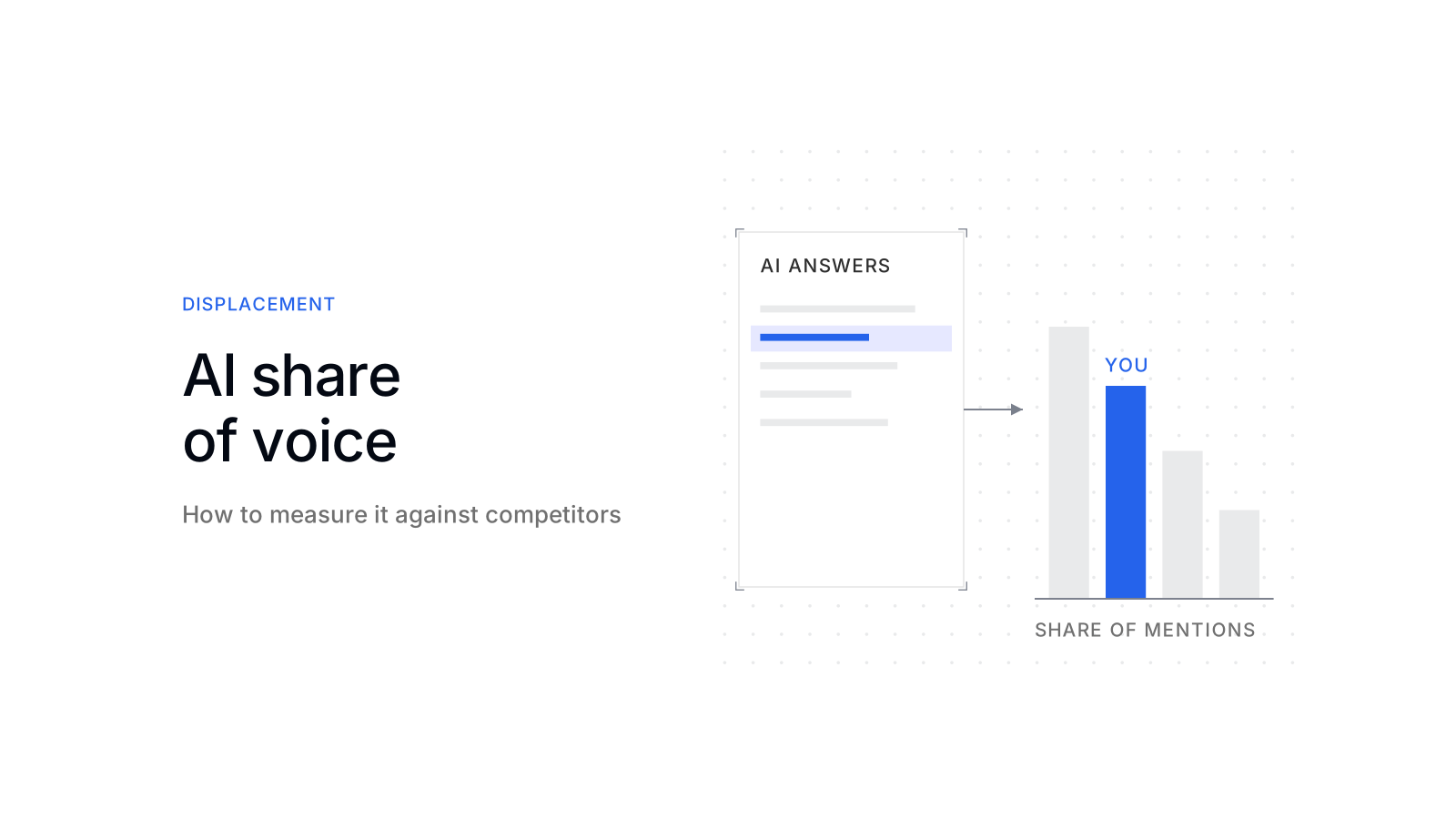
A gap is one question, repeated: a competitor is named again and again, and you never are. That makes it a to-do list, not a score. AI share of voice gives one number for the market; the gap list says which questions to win back.
The analysis has five steps: build the prompt set, run it, code the answers, rank the gaps and plan the work. Why assistants prefer a rival at all is covered in why ChatGPT recommends your competitor.
How to build the prompt set for a gap analysis
Build the prompt set from the questions buyers ask before they choose, without your brand name in them. Questions that name you show how assistants describe you, not who they recommend instead (branded or unbranded prompts).
Cover four types of question, because competitors win different types:
- Category: “best project management software”
- Use case: “project management tool for a 50-person agency”
- Comparison: “dedicated tool or a spreadsheet template?”
- Problem: “how do I stop projects running over budget?”
Tag every prompt with the offer it leads to and its type when you write it. The revenue ranking needs both.
The questions themselves come from building blocks, not brainstorming. scaile splits a brand into its offerings and describes each offering with six building blocks: variants, product types, attributes, needs, buyers and buying situation.
With every combination, scaile searches for real questions in forums, on Reddit, in Search Console and in sales calls, and keeps only the buying questions. Every question it finds gives new keywords for the next round:
- Starting keywords: found about half of the buying questions in a test on 10 offerings.
- After two rounds: 85% of the buying questions.
- Against free search: nearly 10% more prompts for the same budget.
How many questions you need depends on how precise the result has to be. For a margin of error of plus or minus 10 percentage points, scaile works with about 25 real questions per offering; for plus or minus 5, about 100. More on choosing them is in which prompts to track.
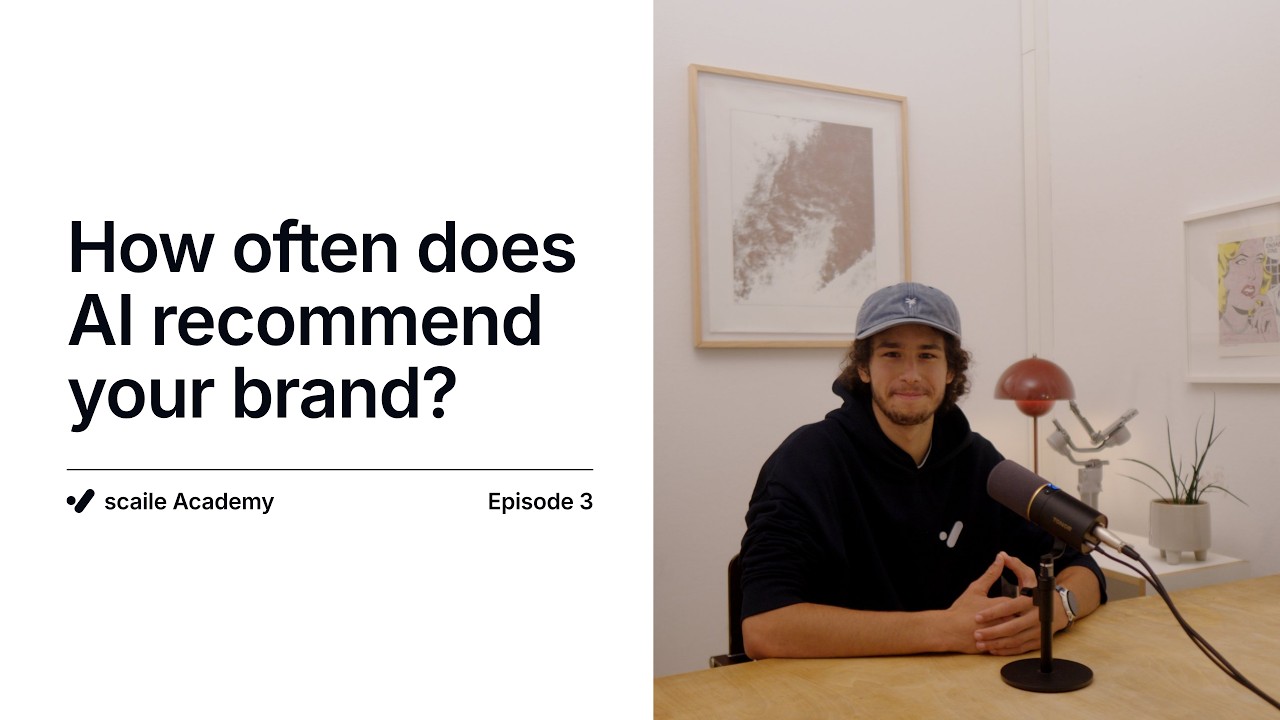
Noah Ahadid shows what that looks like for Porsche in six minutes:
How to run the prompts across AI assistants and markets
Run every prompt many times, in each assistant your buyers use and from each market you sell in. A single answer is a sample of one. SparkToro tested how stable AI recommendations are: [1]
- The test: 600 volunteers ran 12 prompts through ChatGPT, Claude and Google’s AI 2,961 times.
- The lists: there is a less than 1 in 100 chance that ChatGPT or Google’s AI gives the same list of brands in any two of 100 answers.
- The pattern: Google’s AI still named one agency, Smartsites, in 85 of 95 answers to the same prompt.
The list changes from run to run, but how often a brand appears holds. SparkToro calls that share of runs probably a reasonable measure of a brand’s prominence. [1] So a gap analysis counts appearances over many runs.
The result is a share with a margin of error, not a yes or no. In the video’s example, Porsche appears in 34% of ChatGPT answers, give or take five points: strong on questions about a daily driver, weak with buyers of used cars. That is where the gap is.
Keep the assistants apart. In an Ahrefs study of 75,000 brands, ChatGPT, AI Mode and AI Overviews largely named the same brands, with an overlap correlation of 0.779. [2]
That still leaves gaps in one assistant only, so check each platform on its own before you combine them. [3] Do the same per market and language: a gap in German answers is a different task from one in English.
How to code the answers: who is named and which sources are cited
Code every answer in two columns, and mark whose site each cited page is:
- Named brands: every brand in the answer, with its position.
- Cited pages: every source the answer links, marked as yours, a competitor’s or a third party’s.
Count a gap only when a competitor appears in at least two answers to the prompt and you appear in none. A competitor named once is noise. Then give each gap a code from its sources, because the code decides the fix:
The answer relies on the competitor’s page. Your site has no page that answers the question as directly.
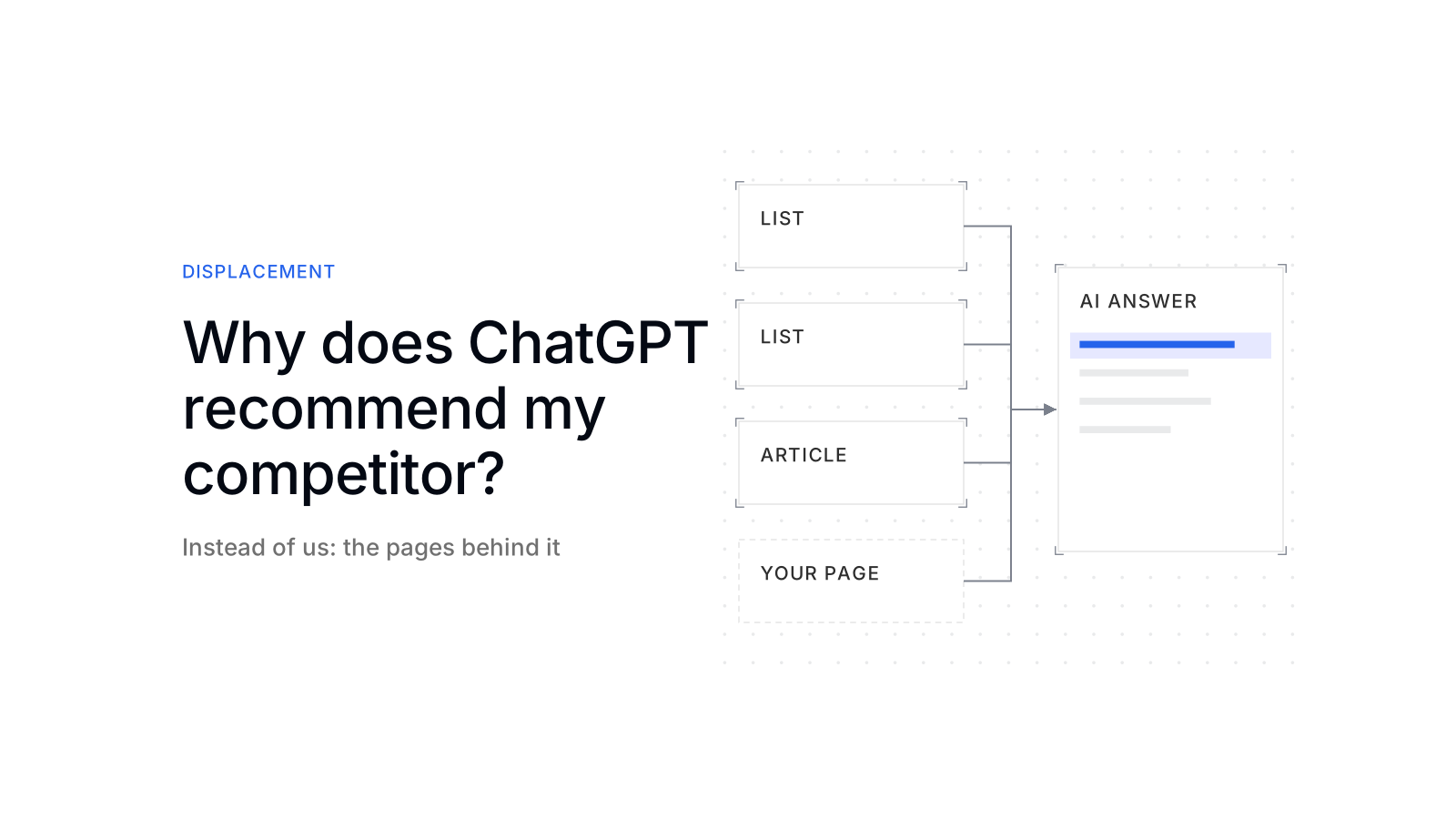
Lists, reviews, forums and guides name the competitor. You are missing from pages the assistant already reads.
Your page informs the answer but does not make your case.
No competitor holds the question yet. It is not a gap but an open question.
A sample gap matrix
A hypothetical example, not measured data: a company selling HR software, with a core suite, a time-tracking add-on and a starter plan. It runs 200 buyer questions without its name on six days in ChatGPT, Gemini, Google AI Mode and Perplexity, so 24 answers per question and 4,800 answers in all. It tracks five competitors, A to E.
Seven rows of the matrix, answers naming each brand out of 24 per prompt:
| Prompt (hypothetical) | Type | You | A | B | C | D | E |
|---|---|---|---|---|---|---|---|
| Best HR software for a 500-employee company | Category | 0 | 18 | 14 | 9 | 3 | 0 |
| Alternatives to vendor A for payroll in Germany | Comparison | 0 | 4 | 9 | 7 | 2 | 0 |
| Best time-tracking app for shift work | Use case | 0 | 2 | 0 | 1 | 0 | 16 |
| How to avoid payroll errors | Problem | 0 | 7 | 3 | 1 | 0 | 0 |
| HR software for a 20-person startup | Use case | 0 | 2 | 4 | 3 | 1 | 0 |
| HR software hosted in the EU | Use case | 9 | 5 | 6 | 2 | 0 | 0 |
| How do I introduce digital personnel files? | Problem | 0 | 0 | 0 | 1 | 0 | 0 |
The company is named for 22 of the 200 questions, such as the one about EU hosting. The rest sorts like this:
- 18 strong gaps: the leading competitor holds half the answers or more, like A on HR software for 500 employees.
- 26 medium gaps: the leader holds 25 to 50 percent, like B on payroll alternatives.
- 38 weak gaps: the leader holds under 25 percent, like B on the startup prompt.
- 30 one-offs: a competitor in a single answer, like on digital personnel files, not counted.
- 66 open questions: no tracked brand named at all.

Coding changes what the matrix means:
- Two competitor groups: suite vendors A to D hold the HR software and payroll questions, specialist E holds time tracking. Each needs different pages.
- Competitors’ own sites: on the 500-employee question, most lost answers rely on A’s comparison page. That is the “competitor’s page” code.
- Cited, not named: on payroll errors, the assistants cite the company’s guide but name A. The guide explains the problem without naming its own product as the fix.
The third-party sites cited in the lost answers, such as software comparison portals, review platforms and payroll forums, are the list the PR plan starts from.
How to prioritise competitor gaps by revenue
Rank each gap by the revenue behind the question, not by the number of gaps. Volume misleads: in Precis’s analysis of banking, AI Overviews appear for 8% of searches but carry 13% of the financial value. [4]
Weighting changes the picture too. In an Ahrefs example, a brand’s share fell to 31% because its mentions came from the questions people ask least. [3]
Score each gap on three ratings from 1 to 3 and multiply them:
- Revenue: the deal value of the offer the prompt leads to.
- Buying stage: category and comparison questions sit closer to a purchase than problem questions.
- Gap strength: the strong, medium and weak bands above score 3, 2 and 1.
The five gaps from the HR example, scored:
| Gap from the matrix | Offer | Revenue | Stage | Gap strength | Score |
|---|---|---|---|---|---|
| HR software, 500 employees | Core suite | 3 | 3 | 3 | 27 |
| Payroll alternatives | Core suite | 3 | 3 | 2 | 18 |
| Time tracking, shift work | Add-on | 1 | 2 | 3 | 6 |
| Payroll errors | Core suite | 3 | 1 | 2 | 6 |
| Startup, 20 people | Starter plan | 1 | 3 | 1 | 3 |

The strongest gap is not always the first one to close. The time-tracking question is lost in most answers, yet it ranks third because the add-on earns little. On a tie, start where your page is already cited: the assistant reads it, the page only has to make your case.
How to turn the gaps into a content and PR plan
Turn each coded gap into one task with an owner, in score order. The code says which kind of task it is:
| Gap code | Task | Owner |
|---|---|---|
| Competitor’s page | A page on your site that answers the prompt as directly: comparison, use-case or alternatives page | Content |
| Third-party pages | The cited lists, reviews and forums to get onto, through PR, reviews or shared data | PR |
| Cited, not named | A rewrite that says what you offer and for whom, on the page the assistant reads | Content |
| Open question | The first clear answer on your site, before a competitor gives one | Content |
Ahrefs gives the same order in its example: the topic you lose is where new content, comparison pages and third-party mentions should go first. [3]
Mentions on other sites belong in the plan, not only pages on your own. Across 75,000 brands, Ahrefs measured these correlations with AI visibility: [2]
- Branded web mentions: 0.66 to 0.71
- YouTube mentions: about 0.737
Correlation is not causation, as Ahrefs notes. [2]
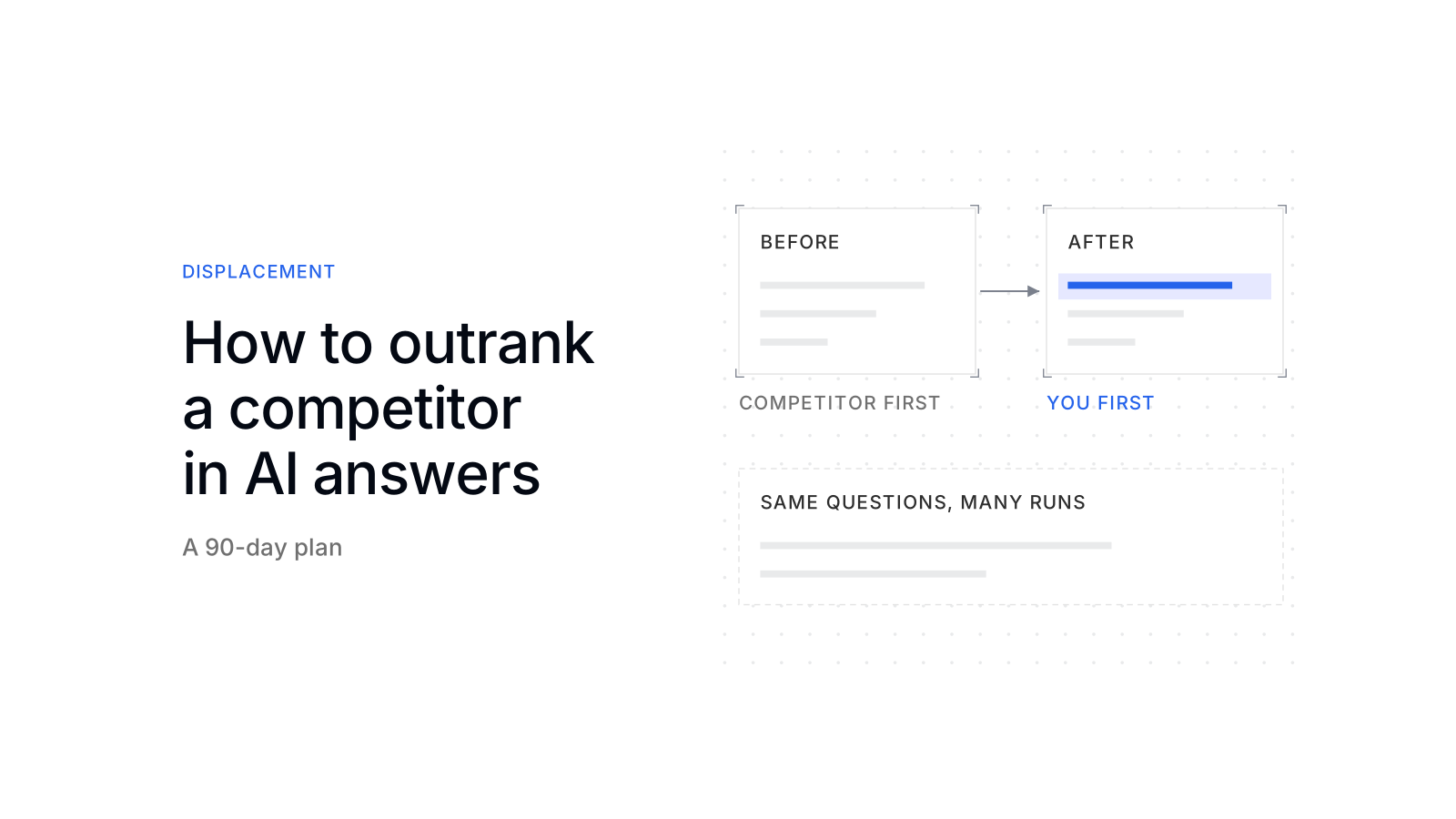
Re-run the same prompts in the same assistants on a fixed rhythm. A gap is closed when you are named in repeated answers, not in one. The fixes per code and a 30/60/90-day sequence are in how to outrank a competitor in AI answers.
What scaile delivers
scaile reports which competitors AI answers name instead of you, which sources they cite and where a citation is winnable. It tracks your domains and the competitors you benchmark against on up to nine answer engines, without guaranteeing rankings, citations, traffic or revenue.
Tracking only: your buyer questions asked in AI assistants on a fixed rhythm, in scaile’s own platform. It can be extended to a full programme at any time.
You getThe gap matrix, coded by source, for your brand and competitorsA strategist turns the scores into a plan with you, scaile writes and changes the pages, and your team approves every step.
You getA ranked plan and the pages that close the top gapsscaile takes over GEO completely, from strategy to published pages, and reports what it plans next.
You getGaps closed in score order, measured on the same questionsA gap analysis turns “a competitor is always recommended” into a ranked list of questions, each with the sources that decide it and one task to close it.
Start with the questions buyers ask before they choose, run them often enough to trust the count and work down the list by revenue. If you want the matrix built and kept current for your brand, talk to scaile about Track.
FAQ
What are the best platforms for monitoring visibility in AI answers?
Choose one that asks your questions in all the assistants you care about, repeats them on a fixed rhythm, records the cited pages and exports the raw answers. A tool shows the gaps; closing them takes content and outreach. The guide to choosing an AI visibility platform on the scaile blog compares the options.
How many competitors should a gap matrix include?
The ones your buyers compare you with, plus any brand that keeps appearing in the answers. A brand you do not track never shows up as a gap, so review the list every quarter.
Sources
- NEW Research: AIs are highly inconsistent when recommending brands or products; marketers should take care whe
- Top Brand Visibility Factors in ChatGPT, AI Mode, and AI Overviews (75k Brands Studied)
- AI Share of Voice: What It Is, How to Measure It, and What It Actually Tells You
- Precis | AI search strategy: How to win LLM visibility and the zero-click battle
Plays from YouTube · Privacy policy