Comparison pages for AI search: your site or independent sites?
In short
Both, for different questions. AI search leans on independent review and comparison sites, yet cites a brand's own pages too. scaile shows which comparison pages the assistants cite for each question and writes both: the ones for your site and the ones for other sites.

Dora is a founding engineer at scaile. She studied computer science, psychology and neuroscience at TUM, which is the perfect fit for GEO: she has a deep understanding of technology and of the human side, and knows how to write and produce content that leads humans to buy and AI to show you in its answers.
Key takeaways
Most companies need both kinds of comparison page, because your own site and independent sites answer different buyer questions.
AI assistants lean on independent sources: for electric-car questions in one study, 80% of ChatGPT's sources were independent media, review and comparison sites.
A "you vs competitor" page on your own site still gets cited when it compares fairly, shows evidence and links to the alternatives.
A paid listing dressed up as neutral, or a review site you control posing as independent, breaks Google's spam rules and, in the US, an FTC rule.
scaile is especially good at showing which pages the assistants cite for each comparison question, yours or someone else's. It then produces both kinds: the comparison pages for your site and the pieces for third-party domains where a mention pays off.
“Do we need comparison pages against competitors, and should they live on our own site or on independent sites?” Heads of SEO ask this in sales calls once a competitor shows up in the AI answers their buyers read.
Should comparison pages live on your site or on independent sites?
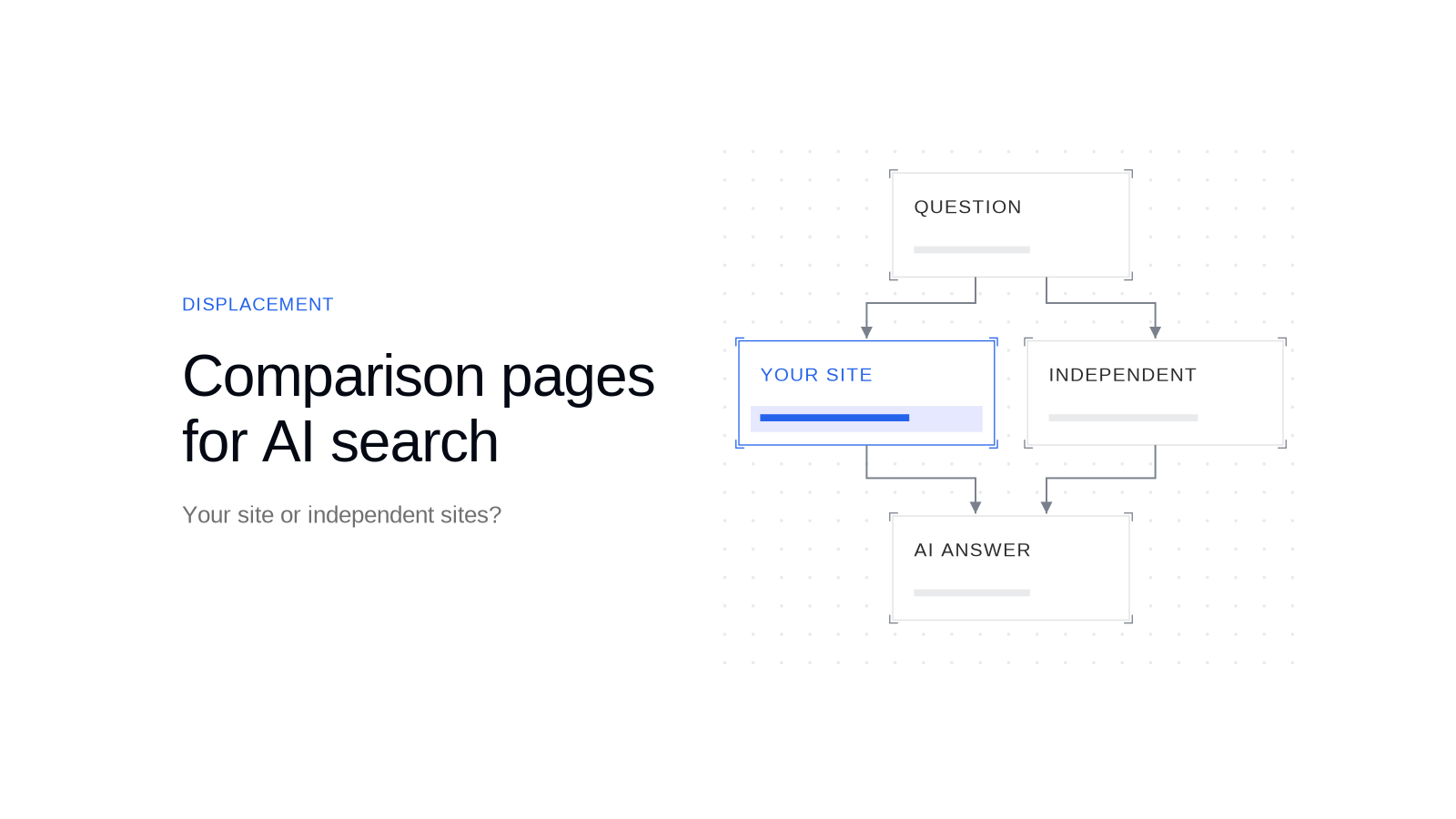
Both, because AI assistants answer different comparison questions from different pages. A one-to-one question such as “your product vs competitor” can be answered from the two vendors’ own pages. A broad question such as “best HR software for 200 employees” is mostly answered from independent lists and review sites.
The one-to-one “you vs competitor” and “alternatives to competitor” pages, where you decide what the comparison says
The “best X for Y” lists and review sites, where you earn a place instead of writing it
Which comparison pages AI assistants actually cite
A study comparing AI search with Google found a “systematic and overwhelming bias towards Earned media (third-party, authoritative sources) over Brand-owned and Social content”. [1] Earned means independent media, review or comparison sites; brand means the company’s own site. [2]
For electric cars, the researchers counted this source mix: [2]
- Google: 56% earned, 26% brand, 18% social, the most balanced mix.
- ChatGPT: 80% earned and 19% brand, with social under 1%.
- Perplexity: 67% earned, 29% brand and 4% social.

The study is a preprint from September 2025 and not peer reviewed. [1] Ahrefs looked at the same question from the page side, in ChatGPT answers to 750 top-of-the-funnel prompts on software, products and agencies: [3]
- “Best X” lists: 43.8% of all cited page types were blog lists of this kind.
- List position: brands placed higher on a cited list were recommended more often.
- Own lists: a brand’s self-promotional best list showed up in more than a third of the software answers that recommended that brand.
- Own landing pages: when a brand’s own site was the first recommendation, an internal landing page appeared more often than its homepage or its best list.
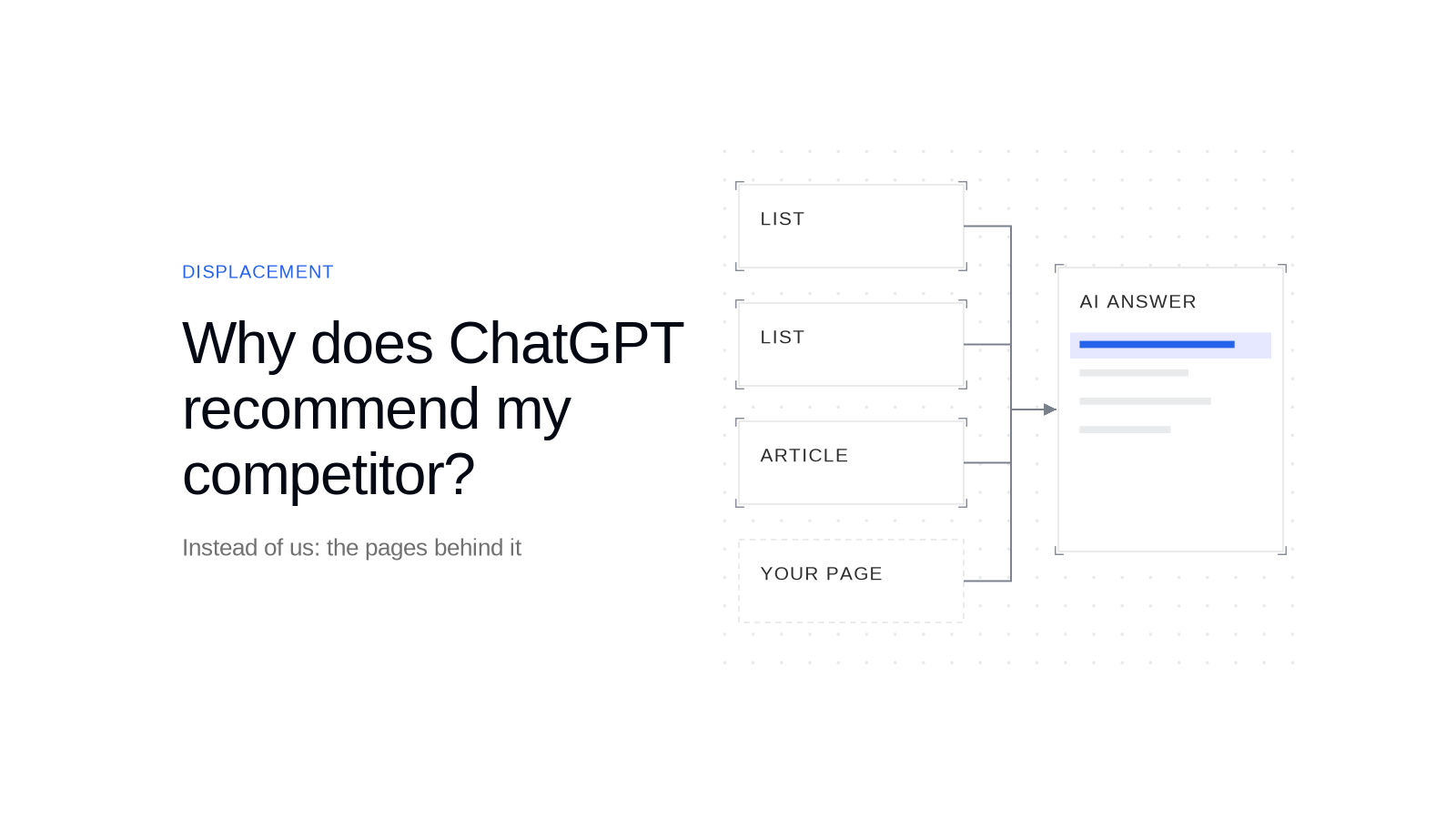
Independent lists carry most comparison answers, but a brand’s own comparison and product pages are cited too. Why one competitor gets named instead of you is covered in why ChatGPT recommends your competitor.
What a ‘you vs competitor’ page on your own site needs
A “you vs competitor” page needs evidence a buyer can check and a comparison the competitor cannot fairly object to. Google’s guidance on reviews and ranked lists sets out what such a page should carry:
- Real differences: explain what sets each product apart, cover comparable options, and discuss benefits and drawbacks based on your own research. [4]
- Evidence for “best”: when you call something the best for a purpose, say why, with first-hand supporting evidence. [4]
- Links out: include links to other useful resources, your own or on other sites, so the reader can decide. [4]
- Verifiable features: compare material, relevant and verifiable features or the price, never vague claims. [5]
The fourth point is law in Germany. A page that names a competitor is comparative advertising. Such a comparison is deemed unfair when it does not relate objectively to verifiable features or price, or when it denigrates the competitor. [5] Have your legal team check the page before it goes live.
Take a hypothetical HR software company with 200-employee customers. Its page against a larger HR suite puts price model, payroll countries, integrations and setup time side by side. It says which buyer each product fits and links to the suite’s own pricing page. A comparison an AI assistant can quote has to be one the competitor’s buyers would also accept.
What independent comparison sites do that your page cannot
They give the outside judgment that AI search weighs most, and you can only earn a place on them, never write it. On such a list the publisher decides who appears and in which position.
Two things follow for your team:
- Start from the lists the assistants cite. The independent pages that appear in the answers to your comparison questions are the ones worth an entry, whatever their fame.
- Keep the entry current. Publishers update their lists, and your product facts change too. A stale entry with an old price model or a missing feature works against you in every answer that cites it.
How to get onto those pages, from review requests to data publishers can quote, is covered in whether backlinks and media placements are part of GEO.
Paid placements and sites you control: where the line is
Paying for visibility is allowed when the reader can see it is paid; posing as independent is not. The common setups, and what the rules say about each:
Google counts paid advertorials whose links pass ranking credit as link spam. [6] Label it and keep its links from passing ranking credit.
Google’s site reputation policy covers third-party content published on a host site mainly for that host’s ranking signals. [6]
In the US, a business may not misrepresent that a site it controls, owns or operates gives independent reviews of a category that includes its own products. [7]
If a reader would assume a page is neutral, it has to be neutral, or it has to say who is behind it. This is general information, not legal advice.
How to decide per question
Sort your comparison questions by type and give each type its home. For the hypothetical HR software company, the four types look like this:
Your own comparison page. Buyers who ask this already know both names, and your page is the most direct answer.
Your own alternatives page, plus an entry on the independent lists the assistants cite for this question.
Independent lists and review sites first. Your own list is an option if it is honest and links to the alternatives.
Look up the sources behind those answers, then fix the page or the listing that is missing.

Google’s AI Overviews and AI Mode may run several related searches across subtopics and data sources for one answer. [8] One comparison question can therefore pull in your page and an independent list at once, which is why the two work together. Finding every question you lose is the job of an AI competitor gap analysis.
What scaile delivers
Most comparison questions in a category are answered by someone other than the vendors, which is why scaile maps the whole comparison surface of a category before it writes a page. scaile produces both kinds of pages, onsite and offsite. From what the assistants cite, scaile sees on which domains an offsite piece pays off and whom to contact there to get mentioned. You choose how much of the work scaile takes:
scaile finds those questions from data and tracks mentions, positions, sentiment and which sources get cited in app.scaile.to.
You getPer question, the comparison pages the assistants cite and whether one of them is yoursA scaile strategist decides with your team which comparisons go on your site and which independent lists to earn. scaile writes the pages, your team approves them.
You getA list of comparison questions, each with the page or listing that should answer itscaile takes over: your comparison pages, earned third-party coverage where it matters for AI search, and a refresh when a page stops being cited.
You getReports and the next steps, while you give expertise and approvals“scaile helped us increase inbound leads by 100%. We now have constant qualified lead inflow.” Heinrich Rusche, Chief Revenue Officer, Building Radar.
At BILD Reisen, mentions in AI answers to travel booking questions tripled.
Comparison pages belong in both places: your own site for the one-to-one questions, independent lists for the broad ones, and nothing in between that pretends to be neutral. Talk to scaile about which comparison questions your company should answer first.
FAQ
How many comparison pages should we build?
One for each competitor your buyers actually compare you with, not one for every name in the market. Ahrefs keeps its own comparison posts under half a percent of its blog content and does not always put itself in the top spot.
Do comparison pages need special markup for AI search?
No. Google says there are no additional requirements and no special optimizations needed to appear in AI Overviews or AI Mode. The page has to be indexed and eligible to show in Google Search with a snippet, the same as for normal search.
How often should a comparison page be updated?
Whenever a price, feature or integration on either side changes, and at least on a fixed review date. Of 1,100 best lists Ahrefs found cited as sources, 79.1% had been updated in 2025.
Sources
- 2509.08919 Generative Engine Optimization: How to Dominate AI Search
- Generative Engine Optimization: How to Dominate AI Search
- Do Self-Promotional “Best” Lists Boost ChatGPT Visibility? Study of 26,283 Source URLs
- How To Write Reviews | Google Search Central | Documentation | Google for Developers
- Act against Unfair Competition (Gesetz gegen den unlauteren Wettbewerb – UWG)
- Spam Policies for Google Web Search | Google Search Central | Documentation | Google for Developers
- eCFR :: 16 CFR Part 465 — Rule on the Use of Consumer Reviews and Testimonials
- AI Features and Your Website | Google Search Central | Documentation | Google for Developers