Low domain authority in AI search: can you win, and does it last?
In short
Even with low domain authority, you can appear in AI answers, especially for specific buyer questions that your own data and product facts answer. There is no fixed timeline for how long an advantage lasts: it can shrink when competitors publish equally good answers. Original data, up-to-date content and mentions in relevant sources can help sustain it.

Dora is a founding engineer at scaile. She studied computer science, psychology and neuroscience at TUM, which is the perfect fit for GEO: she has a deep understanding of technology and of the human side, and knows how to write and produce content that leads humans to buy and AI to show you in its answers.
Key takeaways
Even with low domain authority, you can gain visibility for specific buyer questions that your own product facts and data answer.
How often other websites mention your brand goes together with AI visibility far more than the number of links pointing to you.
When competitors also invest in GEO, the advantage can shrink. Original data and up-to-date content help you keep standing out.
Can you win AI search with low domain authority?
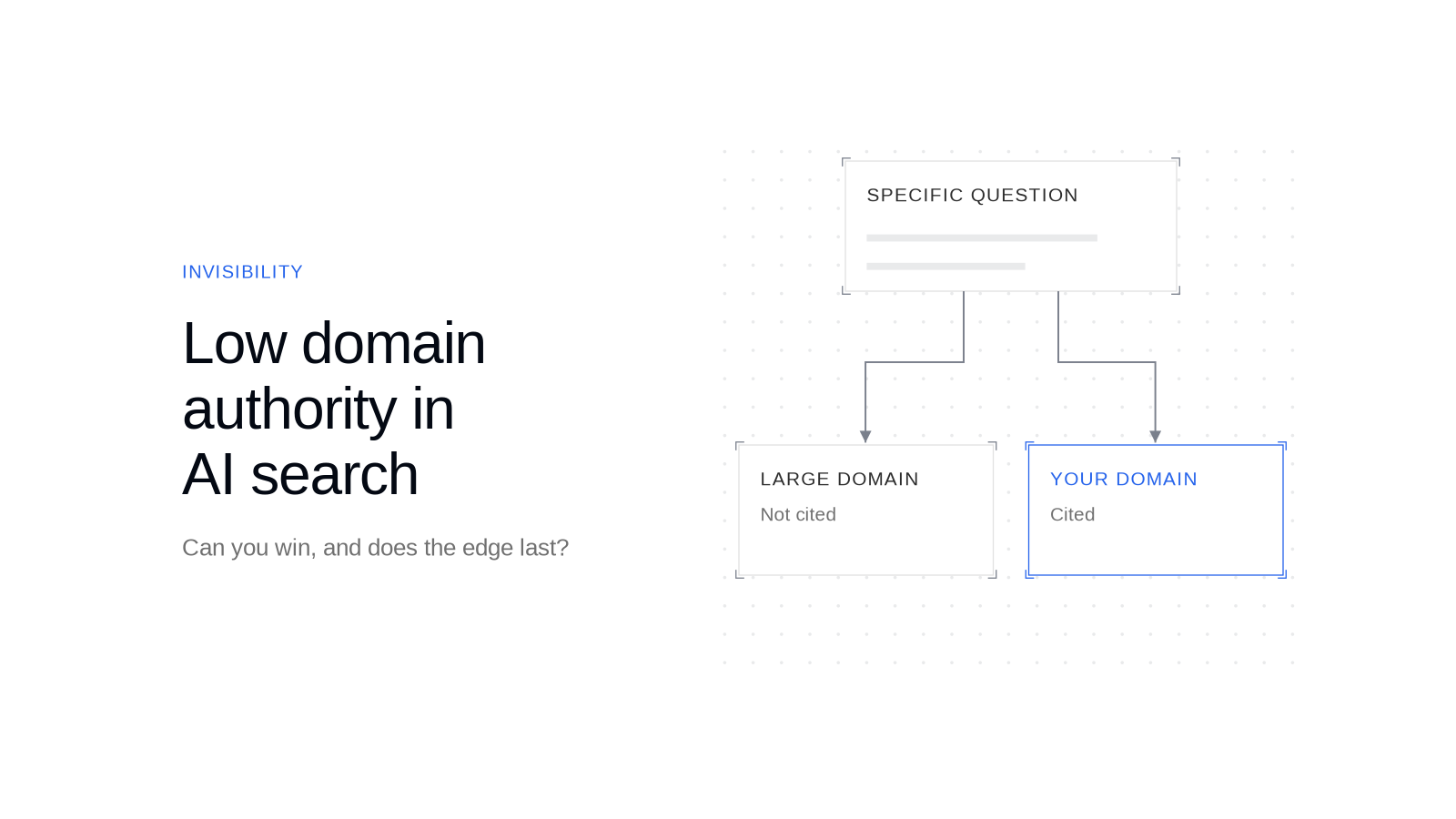
Yes, on the questions where your page is the best answer.
Domain Authority is a score from the SEO tool vendor Moz, and Moz itself states that it “is not a Google ranking factor and has no effect on the SERPs”. [1] Google adds that there are no additional requirements and no special optimizations needed to appear in AI Overviews or AI Mode. [2]
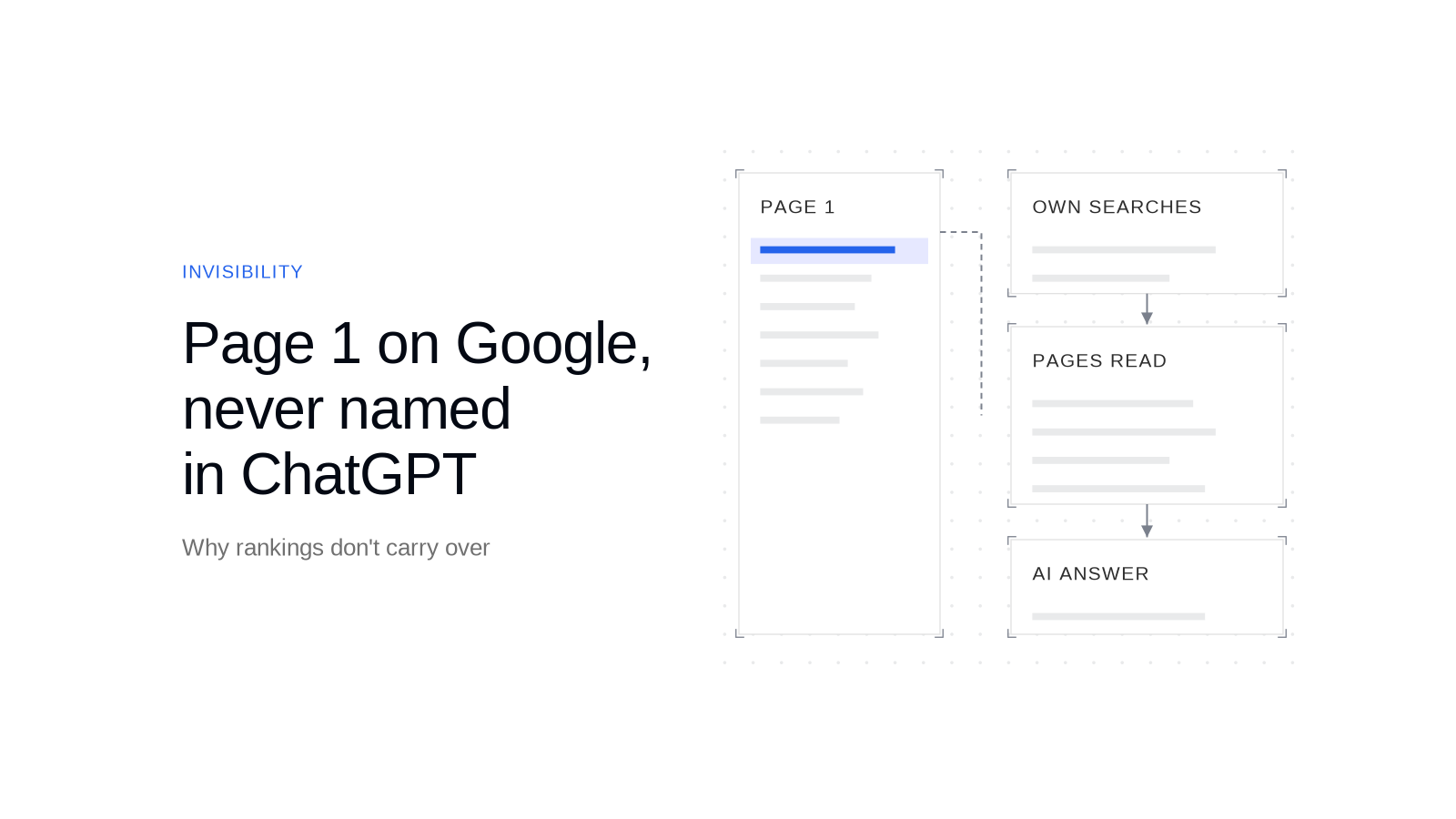
AI assistants also do not simply reuse the strongest domains from Google. In 80 ChatGPT answers scaile analysed, only 3.5% of the cited pages (18 of 517) ranked on Google’s page 1 for the searches ChatGPT itself ran.
An assistant decides per question which pages answer it, so a small domain competes question by question, not score against score.

What domain authority measures, and what AI answers weigh instead
Domain authority measures your link profile; AI answers lean more on how often the web talks about you. Moz designed the score “to reflect the overall strength of your domain’s link profile compared to others”. [1]
Ahrefs compared 75,000 brands with how often Google’s AI Overviews mention them. The strongest correlations were all off-site factors: [3]
- Brand web mentions: 0.664, the strongest link to AI Overview visibility.
- Branded anchors: 0.527, links whose text is your brand name.
- Branded search volume: 0.392, how often people search for your name.
- Domain Rating: 0.326, Ahrefs’ own counterpart to domain authority.
- Backlinks: 0.218, the weakest of the link metrics.
Ahrefs stresses that correlation is not causation. [3] Read the figures as a direction: being named on other sites matters more than collecting links. Which links and placements still help is covered in whether backlinks and media placements are part of GEO.
Where a small brand wins first
A small brand wins first where a large one has no specific answer. Take a hypothetical 15-person software company that sells permit management to municipalities. It will not win “best software for local government”, but it can win four kinds of question:
- Narrow buyer questions: “How long does a building permit take with digital processing?” asks for detail a generalist page rarely holds.
- Questions only your data answers: your own processing times, error rates or rollout steps are first-hand facts no competitor can cite.
- Exact product questions: which standards, integrations and data locations you support, stated in full on one page.
- The pages that are already cited: if AI answers for your category quote one trade portal, being named there puts you into the answer.
The month-by-month plan for taking a question from a named competitor is in how to outrank a competitor in AI answers.
Does the edge vanish once competitors do GEO?
Partly. The head start on generic questions shrinks, but the GEO study suggests that optimizing helps lower-ranked pages most even when every page does it. The researchers from Princeton and IIT Delhi optimized all competing sources at the same time, and “lower-ranked websites, which typically struggle for visibility, benefit significantly more from GEO”. [4]
- Fifth-ranked page: visibility rose by 115.1% when its content cited sources. [4]
- Top-ranked page: visibility fell by 30.3% on average in the same test.

The test ran on the researchers’ own benchmark, not on a live assistant, so treat it as evidence of the mechanism, not a forecast. What it shows is why the work never ends in one round: when everyone optimizes, the advantage moves to what others cannot copy.
Being early on generic questions, formatting tricks, one well-structured page per topic
First-hand data, exact product facts, mentions on the pages AI answers cite, pages kept current
How to tell whether you are winning
You are winning when AI answers name you in a growing share of many runs, not when you hit “position one”.
AI recommendation lists barely repeat. In a SparkToro study, 600 volunteers ran 12 prompts through ChatGPT, Claude and Google’s AI 2,961 times. [5] There is a less than 1 in 100 chance that ChatGPT or Google’s AI gives the same list of brands twice in 100 answers. [5]
The study’s author concludes that visibility percentage across dozens to hundreds of prompts, run several times, is a reasonable metric. [5] Read your share per question like this:
The answer to that question does not exist on your site yet. Write it first.
The page is found but the answer leans on others. Add the facts only you have.
You are in the pool. Get mentioned on the outside pages the answers cite.
Keep the page current and watch for new competitors in the same answers.
Count runs per question over weeks; one screenshot of one answer proves nothing.
What scaile delivers
scaile turns a small domain’s facts into pages that search engines and AI assistants pick up. You choose how much of the work scaile takes:
scaile finds the buyer questions from data and tracks how often AI assistants name you in app.scaile.to.
You getYour share of runs per question, and the pages cited instead of youA scaile strategist ranks the winnable questions using your tracking, search and analytics data. scaile writes the pages, your team approves them.
You getA ranked list of winnable questions and the pages that answer themscaile takes over GEO completely: strategy, website changes, content, outside mentions, refreshes and reporting.
You getReports and the next steps, while you give expertise and approvalsImpossible Cloud grew from 300 to 2 million organic impressions a month.
LipoCheck became the first answer in its category in ChatGPT.
Talk to scaile about the questions your company can win first.
FAQ
Does domain authority matter at all for GEO?
Indirectly. Links still help search engines discover your pages, and an AI answer can only cite a page that is found. The score itself is a vendor metric, not an input to the assistants.
How long does a small brand need before AI answers name it?
It depends on the question and the competition in it. Narrow questions with few good answers move first; broad category questions take longer and need mentions on outside pages.
Should we wait until our domain authority is higher?
No. Building pages that answer specific buyer questions is also what earns mentions and links over time, so waiting only delays both.
Sources
- Domain Authority: What is it and how is it calculated - Moz
- AI Features and Your Website | Google Search Central | Documentation | Google for Developers
- An Analysis of AI Overview Brand Visibility Factors (75K Brands Studied)
- GEO: Generative Engine Optimization
- NEW Research: AIs are highly inconsistent when recommending brands or products; marketers should take care whe