How to make your company more visible in AI search: 4 steps
In short
Let AI crawlers read your site, answer your buyers' questions on your own pages, get named on the sites each AI engine cites, and measure every engine. scaile does this for you as Managed GEO.

Dora is a founding engineer at scaile. She studied computer science, psychology and neuroscience at TUM, which is the perfect fit for GEO: she has a deep understanding of technology and of the human side, and knows how to write and produce content that leads humans to buy and AI to show you in its answers.
Key takeaways
For your company to show up in AI search, it needs four things: AI engines can access your website, your pages answer your buyers' questions, other websites mention your company, and you measure the result in every AI engine.
ChatGPT, Perplexity, Gemini and Google's AI mostly cite different websites, so what works in one does not automatically work in the others.
Mentions on YouTube, in forums like Reddit and on other websites count alongside your own site. More pages on your own site barely help.
scaile finds the questions your buyers ask AI, with how often they are asked and how close to a purchase they are, and tracks how each AI engine answers them.
scaile then improves your pages for exactly those questions and works to get your company named on the websites the AI engines cite for them.
How do you make your company more visible in AI search?
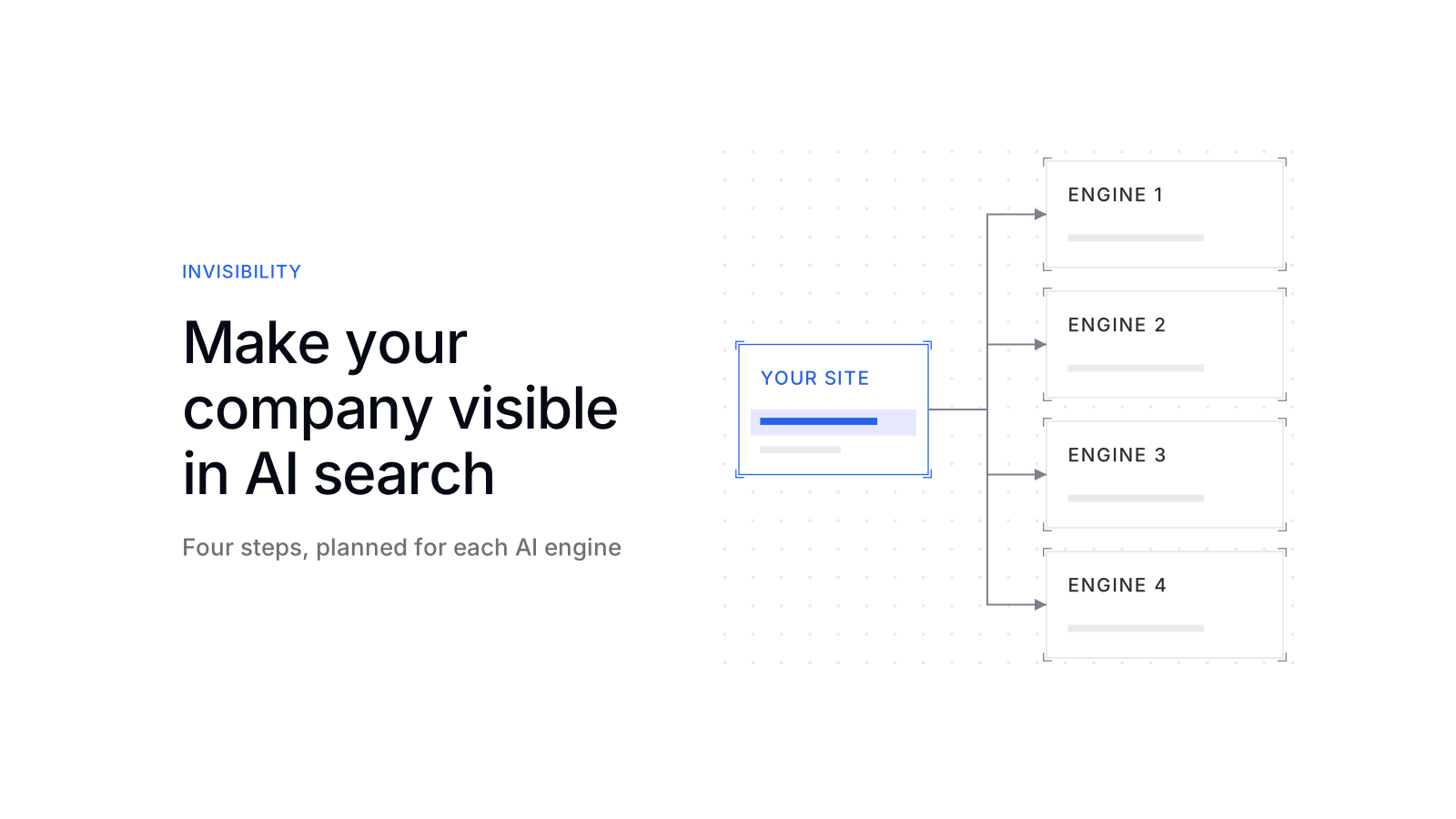
You make your company more visible in AI search with four pieces of work, in this order:
- Crawler access: let every AI search crawler read your site.
- Answers: put clear answers to your buyers’ real questions on your own pages.
- Mentions: get named on the other websites each AI engine reads.
- Measurement: measure across all engines instead of checking one answer.
The order matters. A page the crawler cannot read never reaches an answer, however good it is. An answer on your own site helps most when other sites confirm it.
This work is called generative engine optimization (GEO). It matters now because buyers research differently. In G2’s 2026 research, 51% of B2B software buyers start their research with an AI chatbot more often than with Google, up from 29% in G2’s 2025 report. [1]
Each AI engine reads different sources
Each AI engine builds its answers from a different set of websites, so visibility in one does not carry over to the others.
scaile measured 5,504 AI answers to 276 buyer questions about AI search, in English for Germany, on five days between 2 and 16 November 2026, across ChatGPT, Perplexity, Google AI Mode and Gemini.
Of the 8,330 websites the four engines cited, only 236 (2.8%) were cited by all four. 76% were cited by just one engine.

The engines also differ in how many sources they show. ChatGPT cited 18.8 sources per answer on average, Google AI Mode 2.2. A page that ChatGPT lists as one of nineteen sources may never make Google’s short list of two.

The measurement covers one topic, one market and two weeks. In a different industry the cited websites will be different ones. The pattern is the point: plan for each engine your buyers use, not for “AI search” as one thing.
Let every AI search crawler read your site
An AI engine can only show your site in its answers if its search crawler may read it. ChatGPT, Perplexity and Claude each run their own search crawler, and a block in your robots.txt file shuts out that engine alone. Google uses its normal search crawler:
Sites that opt out of OAI-SearchBot are not shown in ChatGPT search answers, though they can still appear as navigational links. [2]
Perplexity recommends allowing PerplexityBot in robots.txt so your site appears in its search results. [3]
Anthropic says that disabling Claude-SearchBot stops it from indexing your content for search. [4]
No extra crawler. A page must be indexed and eligible for a snippet in Google Search; there are no additional technical requirements. [5]
Search and training are separate settings. You can allow OAI-SearchBot so you appear in ChatGPT search and still block GPTBot, OpenAI’s crawler for model training. [2]
OpenAI also recommends allowing requests from its published IP ranges, so check your firewall as well as robots.txt. [2]
For Google, the work is ordinary SEO. Google says the best practices for SEO remain relevant for AI Overviews and AI Mode, with no special optimizations needed. [5] The full list of crawlers, and what blocking each one costs, is in which AI crawlers can read your site.
Answer your buyers’ questions on your own pages
Each question your buyers ask an AI assistant needs a clear answer on your own pages, in the words buyers use. Give AI engines a passage they can quote. A product page that lists features but never answers “which tool fits a 20-person team?” gives them nothing to quote.
In the research paper that named generative engine optimization, optimizing content raised visibility in generative engine responses by up to 40%. [6] Start with three changes:
- 1Find the real questions
Collect the questions buyers ask before they choose a supplier, from sales calls, search data and live AI answers. See which prompts to track.
- 2Answer each one in the first sentence
Put the direct answer under a heading that matches the question, then the evidence. Each section should make sense if it is quoted alone.
- 3Give your company facts one home
State what you offer, for whom, where and since when on one page, the same way everywhere. See grounding pages.
Which signals make an engine pick one source over another is covered in how to get cited in AI answers.
Get named on the pages AI engines read
AI engines name the brands that other websites talk about, so mentions elsewhere matter alongside your own site. Ahrefs compared 75,000 brands across ChatGPT, AI Mode and AI Overviews and found these correlations with AI visibility: [7]
- YouTube mentions: about 0.737, the strongest of all factors
- Branded web mentions: 0.66 to 0.71
- Number of pages on the site: about 0.194, almost no relationship [7]
These are correlations, not proof of cause, but they point in one direction.
Which pages count depends on the engine. In scaile’s measurement, Reddit was among the sources of 16% of Gemini answers and 14% of Google AI Mode answers, but of 0% of ChatGPT answers.
Pick the channels from the engines your buyers use. For ChatGPT alone, see how to get your business mentioned in ChatGPT.
Reddit threads and forums where buyers ask each other for recommendations.
YouTube videos that name your company: your own channel, reviews and interviews.
Comparison articles, industry rankings and review sites that buyers read before a shortlist.
LinkedIn posts by your people, trade press and interviews.
The aim is honest mentions in the right places, not volume. How links, guest posts and media placements fit in is covered in are backlinks part of GEO?.
Measure across engines, not one answer
Measure your visibility as a share of many answers across every engine, because a single answer tells you almost nothing. In SparkToro’s study, there was less than a 1 in 100 chance that ChatGPT or Google’s AI, asked 100 times, gives the same list of brands in any two responses. [8]
So fix a set of buyer questions, run each one repeatedly on each engine, and record how often you are named and which sources are cited. The pattern shows which of the first three pieces of work is holding you back:
Check its crawler access first.
Your answers or your mentions elsewhere are too thin.
Some engines also report it themselves. Bing Webmaster Tools’ AI Performance report shows how often Microsoft Copilot and Bing’s AI summaries cite your content, which URLs, and how that changes over time. [9] A quick first look is in how to check your AI visibility for free.
What scaile delivers
scaile runs SEO and GEO as one job, with your team or for it. The prompts come from social listening, keyword mining, prompt tests and volume checks (find customer intent).
Tracking covers ChatGPT, Claude, Gemini, Perplexity and Google AI Overviews and records mentions, positions, sentiment and every cited source (report and improve). BILD Reisen went from unnamed in AI answers to 3× the mentions for travel booking questions (BILD Reisen case study).
Your prompts, tracked in app.scaile.to. Tracking only, no strategy or content.
You getHow often each engine names you, and which sources it cites insteadA strategist builds the plan from your AI visibility, search and analytics data, and scaile executes it on your site and on the pages the engines cite (for content teams).
You getOne weekly report and a strategist who goes through it with youYour teamReviews and approves every stepscaile takes over GEO completely: strategy, website changes, content, publishing, refreshes and monitoring (for teams without one).
You getReports and what scaile plans nextYour teamProvides expertise and approvalsMaking your company visible in AI search takes four pieces of work: crawler access, answer pages, mentions elsewhere and measurement, matched to the engines your buyers actually use. Do them in that order and the measurement shows you where the gap is. To do this for your company with a strategist, talk to scaile about Strategy with you.
FAQ
How long does it take to become visible in AI search?
It depends on the engine and on how much work is missing. A crawler fix is fast: OpenAI and Perplexity say a robots.txt change reaches their systems within about 24 hours. New answer pages and mentions on other sites take longer, often months.
Which AI engine should we start with?
The one your buyers use. Ask new customers which assistant they use, and look at which AI assistants already send visits in your analytics.
Sources
- In the Answer Economy, Don’t Win the Click — Win the Answer
- Overview of OpenAI Crawlers
- Perplexity Crawlers - Perplexity
- Does Anthropic crawl data from the web, and how can site owners block the crawler? | Claude Help Center
- AI Features and Your Website | Google Search Central | Documentation | Google for Developers
- 2311.09735 GEO: Generative Engine Optimization
- Top Brand Visibility Factors in ChatGPT, AI Mode, and AI Overviews (75k Brands Studied)
- NEW Research: AIs are highly inconsistent when recommending brands or products; marketers should take care whe
- Introducing AI Performance in Bing Webmaster Tools Public Preview |…