Can ChatGPT replace your SEO agency?
In short
If you are an SEO or GEO expert yourself, you can use ChatGPT as a tool and will certainly get a lot done with it. If not, the output gets too generic and misses your customers' questions. scaile does Managed GEO: a system that finds customer questions, tracks them, answers them GEO-optimized and keeps iterating.

Dora is a founding engineer at scaile. She studied computer science, psychology and neuroscience at TUM, which is the perfect fit for GEO: she has a deep understanding of technology and of the human side, and knows how to write and produce content that leads humans to buy and AI to show you in its answers.
Key takeaways
If you are an SEO or GEO expert, you can do a lot yourself with ChatGPT. If not, the output gets too generic and misses your customers' questions.
ChatGPT can take over first drafts, outlines and rewrites that an SEO agency would otherwise bill for.
It does not know how often people search for a term or how your pages perform in Google. That data sits with Google, other search engines and LLM providers themselves.
In a test with six keywords, an AI model without web search got the monthly search volume roughly right in 5 of 18 answers.
Pages that AI answers quote carry real numbers, quotes and sources. Those have to come from your company, not from the model.
Can ChatGPT replace your SEO agency?
If you are an SEO or GEO expert yourself, you can use ChatGPT as a tool and will certainly get a lot done with it. You know which questions your customers ask, give the model the right brief and notice when a result is off. If not, we keep seeing the same thing: the output is far too generic and misses the questions your customers actually ask.
The writing is not the problem. ChatGPT writes first drafts, outlines, meta descriptions and rewrites quickly and well. But ChatGPT alone does not find the right customer questions. For that you need a more sophisticated system: your search data, the questions your customers ask AI, a check of every fact against a source, and someone who answers for the changes on your site.
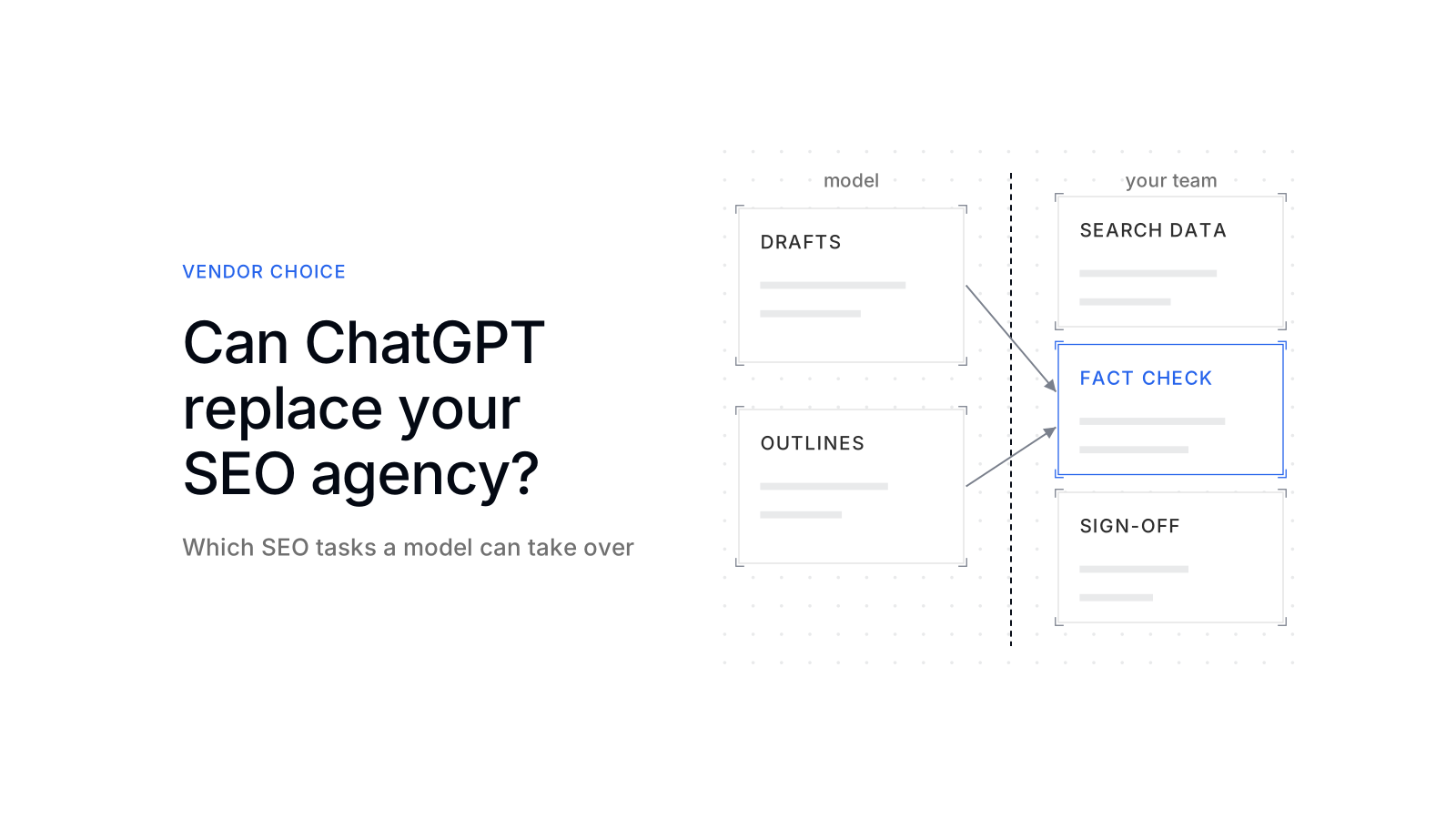
So the useful question is not “agency or ChatGPT”. It is which tasks you hand to the model, and who checks each result. Split that way, many teams can do more in-house. Few can drop the checking and the measurement.
Which SEO agency tasks can ChatGPT take over?
ChatGPT can take over the writing parts of most SEO tasks and none of the parts that need your data or your judgement. Google’s own guide to hiring an SEO lists what agencies provide. The list includes a review of your site content or structure, technical advice, content development, keyword research, expertise in specific markets and optimizing for generative AI. [1] Task by task, the split looks like this.
ChatGPT drafts articles, FAQs and meta descriptions in minutes. Your team still adds the facts, the cases and the final check of every claim.
ChatGPT suggests topics, phrasings and question variants. It does not know how many people search for them; that number comes from several other tools.
ChatGPT explains a finding from a crawler or a Search Console export and suggests a fix. It does not run a full crawl of your site, and every fix still needs testing.
ChatGPT knows what is written about your market. It does not know what your sales team hears in calls or why customers choose you.
ChatGPT can restructure a page so the answer comes first. Whether AI answers then name you has to be measured, not asked once.
A good SEO, Google adds, asks what makes your business unique, who your competitors are and how your customers find you. [1] ChatGPT answers questions. It does not ask these on its own, and it cannot verify your answers.

Why can’t ChatGPT tell you your search volumes?
ChatGPT cannot tell you your search volumes because it has no access to the search volume data of Google, other search engines or other LLMs. Those numbers sit with the providers themselves. Keyword Planner in Google Ads, for example, shows estimates of how many searches a keyword gets each month. [2] How your own pages perform sits in Search Console, and only verified site owners get it. Google explains why: owners “have access to sensitive Google Search information about a site”. [3] A language model sees neither unless you give it an export.
To see what a model does without that data, scaile asked Google’s Gemini 2.5 Flash model for the monthly US search volume of six SEO keywords. Each question ran three times with web search off and three times with it on. The reference was the Google Ads figure for the same day.
- With search off, the model gave a number in all 18 runs. 5 of the 18 were within 25% of the Google Ads figure, all three for “local seo” among them.
- For “generative engine optimization”, Google Ads shows 4,400 searches a month. The model’s three answers were 260, 800 and 5.
- With search on, the model declined to give a number in 14 of 18 runs. Two of the four numbers it did give were 40,000 and 33,100 for “keyword research tool”, where Google Ads shows 3,600.

The test used one model, six keywords and three runs each. ChatGPT itself was not part of it, and Google Ads volumes are estimates too. It shows the behaviour. Without a data source, a model answers with a confident number that can be off by a factor of ten. With search on, it mostly says it cannot know. Paste a Search Console export into ChatGPT and it summarises it well. The data has to come first.
Can ChatGPT write content that wins AI answers?
ChatGPT can write the form of content that wins AI answers, not its substance. The study that named generative engine optimization (GEO) tested which changes make a page more visible in AI-generated answers. Its top methods added relevant statistics, credible quotes and citations from reliable sources. They improved one of its visibility measures by 30 to 40% in relative terms. [4] Keyword stuffing, a classic SEO habit, offered “little to no improvement”. [4]
Every method that worked depends on facts. A model can insert a statistic in seconds. Whether it is true, current and yours, the model cannot settle on its own. The paper that introduced retrieval-augmented generation, which lets models look things up, lists “providing provenance for their decisions and updating their world knowledge” as open research problems. [5] Retrieval helps: the same paper found models with it write more specific and factual language than models without it. [5] It does not replace a person who checks each claim against its source.
The numbers that make a page worth citing are often your own: results, test data, the questions customers ask. A model has none of them until you supply them. How to split drafting and review is covered in AI content vs human content, and what GEO adds to SEO in GEO vs SEO.
Can AI agents do SEO end to end?
AI agents can carry out more of the steps, but they do not take over the responsibility. An agent that logs into your content management system (CMS) and Search Console acts with the rights you give it. In Search Console, owners can “perform actions that can affect a site’s presence and behavior on Google Search”. [3] Handing those rights to software is a decision about risk, not about convenience.
Google’s guidance on hiring help applies to software as much as to people. Hiring for SEO “can potentially improve your site’s visibility and save you time, but you can also risk damage to your site and reputation”. [1] And: “Ultimately, you are responsible for the actions of any companies you hire.” [1] An agent does not change who carries that responsibility. It is still you.
What works is a model inside a process with a human gate. The model drafts and proposes, a person checks the sources and approves, and only approved changes go live. A wrong fact on a product page, or a broken redirect, costs more than the hours saved.
When ChatGPT plus your own team is enough
ChatGPT plus your own team is enough when the team has the SEO and GEO knowledge, the data access and the time to check what the model writes. It is not enough when the model would stand in for the expertise itself. ChatGPT then writes fast, but generic, and misses your customers’ questions.
Someone in-house knows SEO, reads Search Console and GA4 every week and checks facts before anything goes live. ChatGPT speeds up their drafting, and the site has a few dozen pages to look after.
Nobody on the team owns search, facts need sign-off from product or legal, or you serve several markets. Or you need to know whether AI answers name you. ChatGPT then writes faster, but nobody checks or measures.
Most teams sit between the two: writing and approval in-house, strategy, data and measurement from outside. The full sourcing decision is in GEO agency vs tool vs in-house vs DIY. Running the AI-search part yourself with ChatGPT and Claude is covered in can you do GEO yourself.
What scaile delivers
scaile delivers the system ChatGPT alone does not have. scaile has spun a whole web that finds your customers’ questions, tracks them, answers them GEO-optimized, keeps iterating on the answers and picks up the latest trends in your market right away. SEO and GEO run as one job, and your team approves every step.
scaile finds the buying questions your customers ask AI, based on data, and tracks them in its own platform, app.scaile.to.
You getWhether AI answers name your brand, and who they name insteadA dedicated strategist builds the SEO and GEO strategy from your Search Console, GA4 and AI-visibility data. scaile researches, writes, publishes and refreshes.
You getContent where every fact shows its source in the editor, published into your CMSYour teamReviews and approves, and keeps using ChatGPT where it helpsscaile takes over the whole function, from strategy to reporting.
You getThe work and the measurement, without extra hours from your teamYour teamProvides context and approvalsChatGPT can replace the drafting in an SEO agency’s work, not the data, the fact check or the accountability behind it. Hand the model the words, and keep the data, the sources and the approval with people who answer for them. If you want a strategist to build that split with your team, talk to scaile about Strategy with you.
FAQ
Can ChatGPT do a technical SEO audit?
Not on its own. It can explain the findings of a crawler or a Search Console export and suggest fixes. The crawl, the testing of each fix and the decision what to change first stay with your team or your agency.
Should my SEO agency use ChatGPT?
Yes, for drafts, outlines and first analyses. Ask how the agency checks facts before publishing, who approves changes on your site and how it measures results. Those answers matter more than whether it uses AI.
Is ChatGPT cheaper than an SEO agency?
The subscription is cheaper. The cost moves to your team: someone has to supply the data, check every claim, approve changes and measure the result. Compare the hours, not only the invoices.
Does a GEO agency replace an SEO agency?
Not necessarily. GEO works on the same pages SEO works on, so the SEO work stays. A GEO agency adds the AI-search part on top, and some, like scaile, do both as one job.
Sources
- Do You Need an SEO? Tips for Hiring an SEO | Google Search Central | Documentation | Google for Developers
- Use Keyword Planner - Google Ads Help
- Verify your site ownership - Search Console Help
- GEO: Generative Engine Optimization
- 2005.11401 Retrieval-Augmented Generation for Knowledge-Intensive NLP Tasks