Website relaunch and GEO: relaunch first or start GEO now?
In short
Start GEO now and plan it into the relaunch. Buyer questions, measurements and content carry over to the new site; redirects and crawler access decide the rest. scaile runs Managed GEO alongside your web team.

Dora is a founding engineer at scaile. She studied computer science, psychology and neuroscience at TUM, which is the perfect fit for GEO: she has a deep understanding of technology and of the human side, and knows how to write and produce content that leads humans to buy and AI to show you in its answers.
Key takeaways
You do not have to wait for the new website. The research into what buyers ask AI, the first measurements and your content all move to the new site.
Most of the risk sits in the switch itself: every old page address needs a permanent redirect to its new page, generally kept for at least a year.
Write AI search into the relaunch brief: AI crawlers allowed, text readable without scripts, every page in the sitemap.
Expect Google rankings to move for a few weeks after the switch, and compare AI mentions on the same buyer questions before and after.
A GEO agency usually does not design your website. scaile works with your web team or agency and publishes into your CMS.
Should you relaunch the website first, before you start GEO?
In most cases, no: start generative engine optimization (GEO) now and plan it into the relaunch. GEO is the work that gets your company named and cited in AI answers such as ChatGPT or Google’s AI Overviews. Most of it does not depend on templates or design.
Buyers ask it in sales calls in almost these words: “Should we relaunch or rebuild the website first, before we start GEO?” A second question follows: “Is a website relaunch or web design included in the GEO package?”
Start the parts of GEO that do not depend on the website now, and write the parts that do into the relaunch spec. Waiting for the new site means months without knowing which buyer questions you lose today, and a relaunch planned without that knowledge.

What carries over a relaunch and what gets rebuilt
Everything that lives in your knowledge carries over a relaunch; everything that lives in the website’s code gets rebuilt. That split decides what is safe to start now.
The buyer questions you track, the measurement history, your company facts and approved claims, and the text of pages that answer those questions.
Page addresses, templates, internal links, robots.txt, the sitemap, structured data and the way pages render.
Content you write now is not wasted: the text moves to the new site, only its address changes. The rebuilt half is where AI visibility is lost or won.
Google says there are no extra requirements to appear in AI Overviews or AI Mode. [1] To be shown as a supporting link, a page must be indexed and eligible for a snippet. [1] Anything that breaks indexing on the new site breaks AI visibility in Google too.
ChatGPT works the same way through its own crawler. OpenAI says sites that opt out of OAI-SearchBot are not shown in ChatGPT search answers. [2] A robots.txt carried over from a staging server can do exactly that on launch day. Which crawler does what is covered in which AI crawlers can read your site.
Three relaunch timelines and what to do in each
What to do now depends on how far away the switch is. Three cases cover most relaunches:
The new templates are nearly done.
Do nowFind the buyer questions, measure the current site, prepare new content for the new templates and publish it there firstThe relaunch is planned but not built.
Do nowRun GEO on the current site and add every new page to the redirect planA relaunch is discussed, nothing is decided.
Do nowTreat the current site as the site, and keep what AI cannot read as input for a later relaunch briefIn none of the three cases does GEO wait for the new design. The work changes only in where new pages are published and how much goes into the redirect plan.
GEO requirements for your relaunch spec
The relaunch spec should name seven GEO requirements, so the new site launches readable for search engines and AI systems:
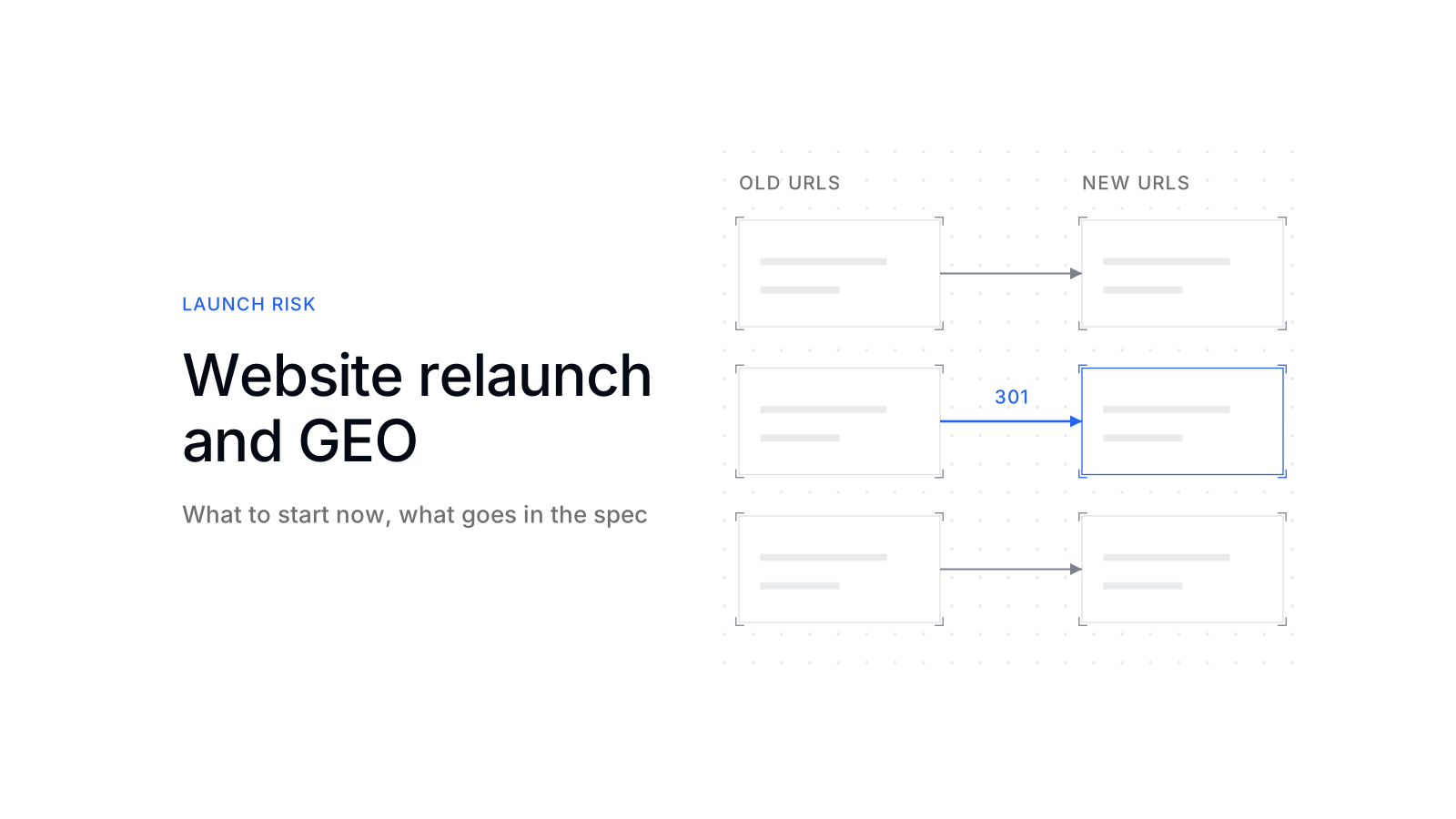
- URL map: Google advises preparing a mapping from every current URL to its new address before the move. [3]
- Permanent redirects: Server-side 301 or 308 redirects, as Google recommends, [3] each straight to the final page, not through a chain. Google advises keeping them generally at least one year, so all signals move to the new URLs. [3]
- Crawler access: The new robots.txt allows Googlebot and the AI search crawlers you want to be cited by, OAI-SearchBot included.
- Readable text: The main content is in the page’s HTML, not only loaded later by scripts.
- Structured data: Schema on the new templates says the same as the visible text. How to check it is in schema markup for GEO.
- Content parity: Pages that answer buyer questions keep their answers, facts and sources on the new template.
- Measurement: Search Console and analytics, including AI traffic, run on the new site from the first day.
The URL map and the redirects carry most of the risk. Google says permanent redirects cause no loss in PageRank. [3] With a permanent redirect, Google shows the new address in search results. [4] A missing redirect turns a cited page into an error page.

The full list of what a technical check covers is in what a technical GEO audit delivers.
What to expect at the switch, and how to measure it
Expect rankings to move for a while after the switch, and plan the measurement before it. Google tells site owners to expect temporary fluctuation in rankings during a move. [3]
For medium-sized websites it can take a few weeks or more until Google shows the new URLs instead of the old ones, and longer for large sites. [3] For small and medium sites, Google recommends moving all URLs at once rather than section by section. [3]
- 1Before the switch
Measure the buyer questions you track in each AI assistant, and test the redirect map against the old URLs.
CheckEvery old URL answers with one redirect to its new page - 2Switch day
Go live with all URLs, the new sitemap and the new robots.txt together.
CheckAI crawlers reach the new pages - 3First weeks
Watch Search Console for errors and pages that drop out of the index.
CheckFix broken redirects the same week - 4After a few months
Ask the same buyer questions again and compare.
CheckAI answers cite the new URLs
OpenAI says a change to robots.txt takes about 24 hours to reach ChatGPT search. [2] No AI provider publishes how quickly it replaces old URLs in answers, so the comparison on the same questions is the only reliable reading. How long GEO work takes to show in general is in how long GEO takes.
Is a website relaunch part of a GEO package?
Usually not, and at scaile not for companies with their own web team. scaile publishes into your existing CMS and works alongside your current agencies; who owns which step is agreed before the work starts. The relaunch itself stays with your web team or agency.
What scaile brings to a relaunch is the GEO side. Its Website GEO Audit & Setup checks access for AI crawlers, indexing, structured data and content structure, says exactly what to change and implements it with your team. It also sets up Google Search Console, GA4 and Rybbit for AI traffic and AI crawlers.
Your web team or agency.
scaile, together with your web team.
scaile writes and moves it, your team approves.
scaile, on the same buyer questions.
For sites on Framer, Webflow or a custom setup, the publishing route is confirmed during technical setup. How GEO content reaches a CMS is explained in how GEO content gets into your CMS.
Small businesses without a marketing team are the exception. There scaile takes over the marketing role, and the scope can reach from positioning and the website to content and reporting.
What scaile delivers
scaile keeps tracking history from your project start for the whole engagement, so a relaunch shows up as a before and after in one series. It also reports AI crawler activity, referrals and conversions.
Tracking only: your buyer questions asked in AI assistants week after week. It can be extended to a full programme at any time.
You getA measurement of the old site to hold the new one againstA strategist builds the GEO plan from your data, scaile makes the changes and your team approves every step.
You getGEO requirements in the relaunch spec, and content ready for the new templatesscaile takes over GEO completely and sends reports and what it plans next. You provide expertise and approvals.
You getA switch handled on the GEO side, from the URL map to the check afterwardsA relaunch does not have to stop GEO: the research, the measurement and the content carry over, and the URL map, the redirects and crawler access decide whether visibility survives the switch.
Start on the current site, put the GEO requirements in the spec and measure the same buyer questions before and after. If you want that planned into your relaunch, talk to scaile about Strategy with you.
FAQ
Do we need to submit anything to Google if the domain changes?
Yes. When you move to a new domain or subdomain, Google asks you to submit a Change of Address in Search Console for the old site. It is not needed for a move from HTTP to HTTPS, between www and non-www, or for new paths on the same domain.
Does the new site need llms.txt or special AI markup?
Not for Google. Google says you do not need new machine-readable files, AI text files or markup to appear in its AI features, and no special structured data. What counts is that pages are indexed and readable.
Sources
- AI Features and Your Website | Google Search Central | Documentation | Google for Developers
- Overview of OpenAI Crawlers
- Site Moves and Migrations | Google Search Central | Documentation | Google for Developers
- Redirects and Google Search | Google Search Central | Documentation | Google for Developers