GEO service vs AI visibility tracking tool: what each does
In short
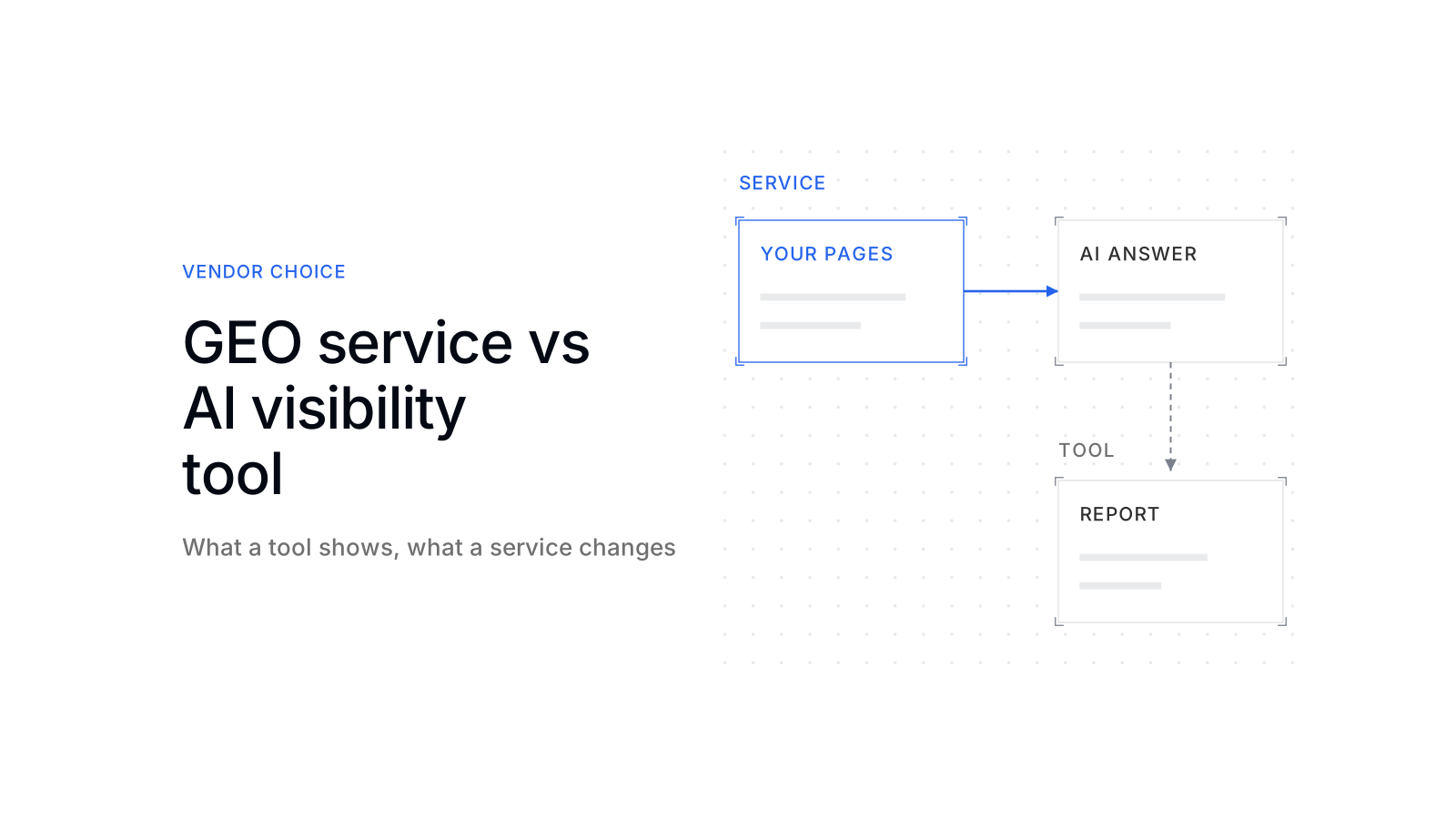
A tracking tool measures how AI answers name you; a GEO service changes what they are built from. scaile does both: it tracks your buyer questions across up to nine answer engines, shows the pages behind every gap and makes the change that closes it.

Dora is a founding engineer at scaile. She studied computer science, psychology and neuroscience at TUM, which is the perfect fit for GEO: she has a deep understanding of technology and of the human side, and knows how to write and produce content that leads humans to buy and AI to show you in its answers.
Key takeaways
A tracking tool tells you where AI assistants name you and where they name a competitor instead. It does not change either answer.
A GEO service does the work behind each gap: it finds out why the competitor is named, then improves your pages and the outside sources the answer relies on.
One check of a buyer question proves little, because AI assistants give a different list of brands almost every time. Judge progress over many checks.
You can keep the tool you already pay for. A service can work from its exports, or track for you so you pay only once.
scaile is tool and service in one: its own tracking across up to nine answer engines, the pages behind every gap, and the change on your website, which scaile makes itself. Your team only approves.
What does a GEO service do that your AI visibility tracking tool doesn’t?
Generative engine optimization (GEO) is the work that gets your company named and cited when buyers ask ChatGPT, Gemini, Perplexity or Google’s AI features for a provider.
Buyers ask it in sales calls in almost these words: “What does a GEO service do that our existing AI visibility tracking tool doesn’t, if the tool only shows where we stand?”
A tool tells you that a competitor is named for a buyer question. A service finds out why and changes it. The work: choose the questions worth winning, read the sources behind each answer, change and publish pages, work on outside sources, refresh what is live and read the numbers.

What a tracking tool shows, and where its report stops
A tracking tool shows, per buyer question, whether AI assistants name your brand, how and where. It also shows the competitors and sources they name instead. Good tools do this across several assistants, markets and languages. The report stops at the point where someone has to act:
The tool shows which brands an answer names in your place. It does not show why the assistant chose them.
The tool lists the pages the answer drew on. It does not say which page of yours should be the source, or which outside page you could appear on.
The tool shows that an answer describes your product wrongly. It does not correct the fact where the assistant read it.
The tool draws a line going up or down. It does not tell you which change caused the movement, or whether anything did.
Every row in the report ends in a task, and the tool does not own it. What a good tracker should measure is covered in how to choose an AI visibility platform. The tasks no tracker does are listed in what neither tool does.
From one gap in the report to a changed answer
A service turns one gap into a changed answer in five steps: confirm the question, read the sources, find the cause, change the inputs, measure again. Take an illustrative case: your tool shows a competitor named for “which provider fits a mid-sized company?” in your category, and your brand is missing.
- 1Confirm the question counts
Check that buyers ask it right before choosing a provider. Not every gap is worth closing.
Your partSay which products and markets matter most - 2Read the sources behind the answer
Open the pages the assistant cited: your own, a competitor’s, a list article, a review site.
- 3Find the cause
No page of yours answers the question, crawlers cannot read the page, your facts are scattered or out of date, or outside pages never mention you.
- 4Change the inputs
Write or rewrite the page, fix crawler access and indexing, correct the facts, and work on the outside pages the answer relies on.
Your partCheck the facts and approve before anything goes live - 5Measure again
Ask the same question over many runs and compare with the weeks before the change.
Most of the change happens on ordinary, crawlable pages. Google says there are no additional requirements for AI Overviews or AI Mode; to be shown as a supporting link, a page must be indexed and eligible for a snippet. [1] For ChatGPT, OpenAI’s OAI-SearchBot crawler surfaces websites in its search features. [2] That is technical SEO work the tool can flag but not do.
Content changes move answers. The research paper that introduced GEO, as a way for content creators to improve the visibility of their content, reports that it can boost visibility by up to 40% in generative engine responses. [3]
The work also reaches beyond your website. In an Ahrefs study of 75,000 brands, brand web mentions showed the strongest correlation with brand visibility in AI Overviews, at 0.664. [4] Ahrefs itself stresses that correlation is not causation; still, it is why a service includes digital PR and work on the list and review pages answers cite.

Why a moving number is not yet a result
A visibility number moves even when nothing changed, so a single rise or fall says little.
A SparkToro study found that an AI tool asked for brand recommendations a hundred times gives a different list, order and number of brands in nearly every response; the chance of getting the same list twice is under 1 in 100. [5]
Read the trend over weeks and many runs, next to the dates of your changes. A service reads the tool’s numbers in three ways:
- Share across runs: how often you are named across many runs of a question, not whether one answer named you.
- Change log: every page change dated, so a shift in the share can be set next to what was changed and when.
- Visits and leads: AI referrals and conversions from your analytics, because the share alone does not show sales.
Why scores from different tools are not comparable is explained in what a good AI visibility score is. Tying the work to sales is covered in how to measure GEO ROI.
Do you keep your tool when you hire a GEO service?
Keep the tool if your team reads it every week; let the service track if nobody does, so you do not pay twice. Three situations cover most teams:
Keep it. The service works from its exports, and your history stays where it is.
Extend the question set. Questions taken from your own pages measure what you already cover, not where buyers find a competitor.
Let the service track. One question set and one report replace two licences.
A tool alone is enough when someone on your team owns the gap list and changes pages every month. If that person does not exist, the number stays where it is. How the paths compare for different teams is in GEO agency vs tool vs in-house, and for software companies in which AI visibility solution fits a B2B SaaS company.
What scaile delivers
scaile is tracking tool and GEO service in one: its own platform tracks, researches and drafts, and your account manager runs the programme. Citation and source analysis gives every gap the pages the answer used, across up to nine answer engines. Data exports to CSV, JSON, Excel and Google Sheets, and history is kept from your project start.
Tracking only, in scaile’s own platform, with the buyer questions scaile finds with you. It can be extended to a full programme at any time.
You getA question set built from research, with the sources behind every answerA strategist builds the plan from your data, scaile makes the changes and your team approves every step, with weekly calls.
You getEach gap ranked, with the page change that closes itscaile takes over strategy, website changes, content, publishing, refreshes and monitoring. You provide expertise and approvals.
You getGaps closed month by month, with a report on what moved and what comes nextKeep the tool if your team lives in it, and give every gap an owner. If you want scaile to own both tracking and the changes, talk to scaile about Strategy with you.
FAQ
Does a GEO service guarantee that AI assistants will name us?
No. Rankings, citations, traffic and revenue cannot be guaranteed, because the assistants decide. A serious service commits to an agreed scope, a working process and honest reporting of what it measured.
Is a GEO service the same as an SEO agency?
Not quite. Both work on crawlable pages and content, but a GEO service measures whether AI answers name and cite you, and works on the sources those answers use. scaile does both, from keywords to AI answers.
What does a GEO service cost compared with a tracking tool?
A tool is a licence that grows with the questions, assistants and markets it tracks. A service is a monthly fee for an agreed scope of work.
Sources
- AI Features and Your Website | Google Search Central | Documentation | Google for Developers
- Overview of OpenAI Crawlers
- 2311.09735 GEO: Generative Engine Optimization
- An Analysis of AI Overview Brand Visibility Factors (75K Brands Studied)
- NEW Research: AIs are highly inconsistent when recommending brands or products; marketers should take care whe