AI visibility audit: the complete checklist and free tools
In short
An AI visibility audit checks what AI assistants answer your buyers and whether your site is built so that LLMs and people can read it easily and rate it as trustworthy. It does this in 12 checks, from the assistants' answers to crawler access, and free tools cover most of them. A really good audit, though, starts with your company, your audience and their real questions, and tracks the answers over time.

Dora is a founding engineer at scaile. She studied computer science, psychology and neuroscience at TUM, which is the perfect fit for GEO: she has a deep understanding of technology and of the human side, and knows how to write and produce content that leads humans to buy and AI to show you in its answers.
Key takeaways
An AI visibility audit checks three things: what AI assistants say about you, whether AI crawlers can technically reach your site, and whether LLMs and people can read your content easily and trust it.
A good audit starts with your company, your audience and their real questions. Random questions are only a spot check.
Check in order: first whether AI crawlers reach your pages, then whether they are in the search index, then what they say.
scaile's free tools give you a first trial audit. The full audit, at scale and systematic, is then what scaile takes on.
AI answers keep changing. So a good audit tracks over months and stores fan-outs, sources and competitors for several LLMs.
What is an AI visibility audit?
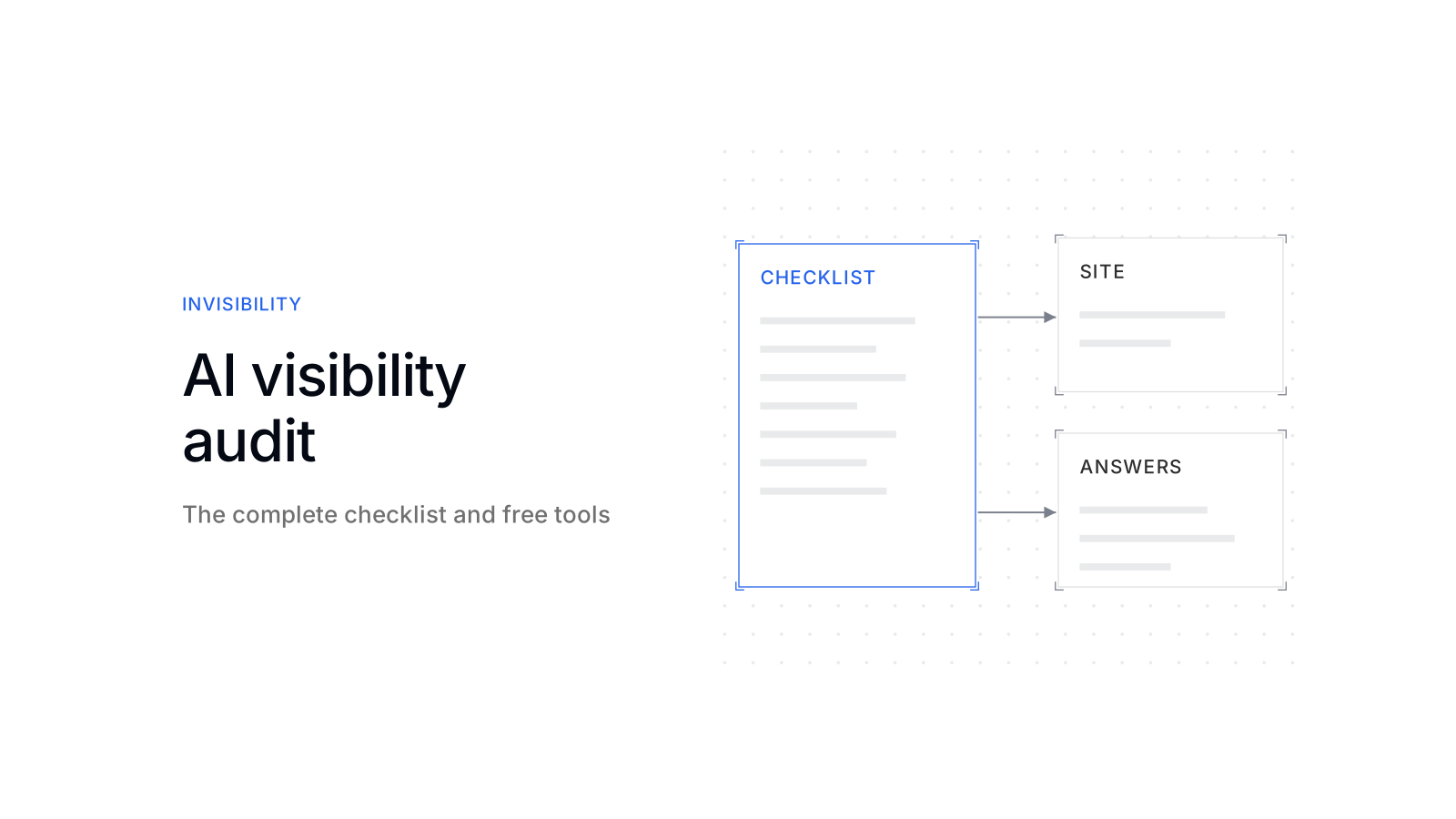
An AI visibility audit is a structured check of whether AI assistants name your company when buyers ask about your category, and why or why not. It has two halves. The answers half looks at what ChatGPT, Gemini, Perplexity and Google’s AI features say: who is named, how you are described, and which pages are cited. The site half looks at the chain those answers are built from: crawler access, search indexes and pages worth quoting.
An SEO audit asks whether your pages rank in a list of links. An AI visibility audit asks whether an assistant can read, trust and repeat them. For the technical part on its own, see what a technical GEO audit should deliver.
What does a complete AI visibility audit check?
A complete AI visibility audit checks 12 things, four on the answers and eight on the site, each with a clear condition under which it fails.
| # | Check | What to look at | It fails when |
|---|---|---|---|
| 1 | Named for buying questions | Answers to the questions buyers ask before they know you | A competitor is named in most runs and you in few or none |
| 2 | Described correctly | Answers to questions that name you | Products, prices, locations or facts are wrong or out of date |
| 3 | Who is named instead | Every brand in the answers, by how often and how early | You cannot say who holds your place |
| 4 | Which pages are cited | The URLs behind each answer | None of them is yours, and none of them names you |
| 5 | AI crawler access | robots.txt, CDN and firewall rules for the search crawlers | A search crawler is blocked, or allowed in robots.txt but refused by the server |
| 6 | In the search index | Google’s index, OpenAI’s search and other AI search indexes | Your key pages do not come back for the queries behind the answer |
| 7 | Reachable pages | Sitemap, internal links, click depth | Important pages are missing from the sitemap or sit deep with no route in |
| 8 | Entity clarity | Name, offer, location and people across your site and profiles | Your company is described differently in different places |
| 9 | Answer-first content with evidence | The page meant to answer each buying question | No page answers it in its first sentences, with numbers and sources |
| 10 | Structured data that matches the page | Schema markup on key pages | It is missing, invalid, or says something the visible text does not |
| 11 | Outside mentions | The third-party pages the answers cite | Those pages name your competitors and not you |
| 12 | Freshness | Visible publication dates and current facts | Dates are missing or the facts are stale |
The order matters more than the count, because an answer is built along a chain.

How do you check whether ChatGPT and other AI assistants mention your brand?
First understand your company and your audience, then ask the questions your buyers ask before they have a shortlist, in each assistant, several times, and write down who was named and which pages were cited. Checks 1 to 4 come out of the same runs.
- 1Understand the company and the audience
What you sell, how you differ from competitors, who buys and which problem those buyers start from.
ResultA clear picture of what you should be named for - 2Find the real questions
Find out which questions buyers ask about your topic at all, and analyse the real demand behind them. Then sort the questions by journey stage: is this a question where people often buy, or one that first builds visibility?
ResultA question set along the journey that nothing in it can steer - 3Ask three assistants
Put each question to ChatGPT, Gemini or Google’s AI Mode, and Perplexity, in a clean session, several times.
ResultSeveral answers per question and assistant - 4Log names and sources
For every run: which brands were named, in which order, and the URLs cited.
ResultA leaderboard and a source list - 5Ask about yourself last
Now ask about your company by name and compare the answer with your own facts.
ResultThe errors check 2 is looking for
Without step 1 the audit stays a spot check: a few questions your buyers may never ask that way. It is a place to start, but it says little about where you are really missing.
A question that names you answers itself, so it shows whether the facts are right, never whether you would be recommended. How many runs a question needs and why the session must be clean is in the guide to checking your AI visibility for free.
Read the cited sources before you read the names. When a user names a brand in the question, earned media accounts for 48% of the citations, and the brand’s own content for 23%. [1] The source list shows whether you are losing on your own pages or on other people’s.
How do you check whether AI systems can read and trust your site?
Work down the chain, and stop at the first link that fails. A page a crawler cannot fetch cannot be cited, however good it is.
Read robots.txt for the search crawlers, not only the training ones. OpenAI’s OAI-SearchBot surfaces websites in ChatGPT search, and sites that block it are not shown in ChatGPT search answers, though they can still appear as navigational links. [2] GPTBot is the crawler for training data. [2] Then check server logs, because a firewall can refuse a bot that robots.txt allows. The AI crawler guide lists every crawler.
A page must be indexed and eligible for a snippet to appear as a supporting link in Google’s AI Overviews or AI Mode. [3] Google ranking alone is not enough for ChatGPT: in 80 ChatGPT answers scaile measured, 3.5% of cited pages ranked on Google’s page 1. Check each index on its own.
Compare your sitemap with the pages you care about. A page missing from it, or five clicks deep, is read late or not at all.
Your name, offer, location and customers should read the same on your site, profiles and directories. A grounding page gives those facts one home.
For each buying question, the page meant to answer it gives the answer in its first sentences, with numbers and sources. In the benchmark of the paper that named generative engine optimization (GEO), such content changes raised visibility in AI answers by up to 40%, with results varying by domain. [4]
Open the third-party pages from your source list and check whether they name you where they answer the question.
Every guide shows a publication date, and its facts are current. In scaile’s DeepSeek study, the engine used the publication date, not the last update, in 173 of 191 pages where the two differed.
Index presence often has a cheap cause. In the same DeepSeek study of 1,000 websites, 2 in 10 sites without backlinks had at least one page in DeepSeek’s search, against 9 in 10 with 100 or more.
Which free scaile tools cover which part of the audit?
scaile’s four free tools cover seven of the 12 checks fully and three more in part. You can test each of them for free. Checks 2 and 8 have no free tool and need a person reading the answers and your profiles.

- AI Visibility Check writes 10 buying questions from your website, puts each to ChatGPT, Gemini and Perplexity, and records who gets named and what was cited. It never asks about you by name, so check 2 stays manual.
- Health Check runs 103 checks across technical foundation, content architecture, AI optimisation, meta and social, and experience and trust. On the page it reads your homepage, robots.txt and sitemap.
- Sitemap Visualiser applies your robots.txt rules path by path to GPTBot, OAI-SearchBot, ClaudeBot, PerplexityBot, Google-Extended and CCBot.
- GPT Search Check takes your domain and up to three queries and sends you the pages OpenAI’s search returns for them.
Where does a manual audit hit its limits?
A manual audit stops at sample size, consistency and change over time, because AI answers are not stable enough for a handful of runs.
SparkToro had 600 volunteers run 12 prompts through ChatGPT, Claude and Google’s AI a combined 2,961 times. [6] There was less than a 1 in 100 chance that ChatGPT or Google’s AI gave the same list of brands in any two responses. [6] The author’s advice is to ask at least 60 to 100 times and average the results. [6]
A second audit three months later, by someone else, from another location, with slightly different questions, measures the difference between two people as much as any change on your site. And a snapshot says where you stand, not whether you moved. Repeating the answers half on a schedule with the same questions is tracking, a different job; what a visibility score measures follows from it.
That is why a good AI visibility audit tracks over a longer period and records more than the answer: the searches an assistant runs in the background for a question (query fan-outs), the cited sources and the competitors named, separately for each LLM. scaile stores this data for several LLMs. That shows which search brings which source into the answer, and where you need to act.
What scaile delivers
scaile treats the audit as the start, not the result. The findings become changes on your site, pages that answer your buyers’ questions, and a tracked question set that shows whether the answers move.
scaile finds the questions your buyers ask, with you and from data, and tracks them in app.scaile.to across the AI assistants you choose.
You getChecks 1 to 4 on a schedule: who is named, how you are described, the cited sources and the query fan-outs, per LLMA dedicated GEO strategist turns the audit into a plan, and scaile makes the website changes and writes the pages with your team.
You getFixes for checks 5 to 12 on your own site, and a weekly meeting on resultsYour teamReviews and approvesscaile takes over the whole job, from the audit and strategy to content, refreshes and reporting.
You getThe audit, the fixes and the measurement, without extra hours from your teamYour teamProvides context and approvalsNo provider can guarantee rankings, citations, traffic or revenue, and scaile does not either.
An AI visibility audit is 12 checks along one chain: crawler access, search index, your pages, outside mentions and the answers themselves. Start from your audience and their real questions, fix the earliest failure first, read the cited sources before the brand names, and treat one round of answers as a snapshot. Free tools cover most of it, and the rest takes a careful afternoon. If you want the findings turned into changes on your site, talk to scaile about Strategy with you.
FAQ
How often should you run an AI visibility audit?
Run the full 12 checks once, then again after a relaunch, a CMS or CDN change, or a new product line. The answers half changes from run to run, so it belongs in tracking rather than in a repeated audit.
Is an AI visibility audit the same as an SEO audit?
No. They share the technical base, crawling and indexing. Then an SEO audit checks ranking factors, while an AI visibility audit checks whether assistants can read, quote and attribute your pages, and whether they name you.
Do you need llms.txt or special schema to pass the audit?
Not for Google. Google states that no new machine-readable files, AI text files or special schema are needed to appear in its AI features. Structured data still has to be valid and match the page.
Sources
- How LLMs Source Brand Information: An Analysis of 23,000+ AI Citations Research - Omniscient Digital
- Overview of OpenAI Crawlers
- AI Features and Your Website | Google Search Central | Documentation | Google for Developers
- 2311.09735 GEO: Generative Engine Optimization
- Intro to How Structured Data Markup Works | Google Search Central | Documentation | Google for Developers
- NEW Research: AIs are highly inconsistent when recommending brands or products; marketers should take care whe