GEO business case: how to get budget for AI search (template)
In short
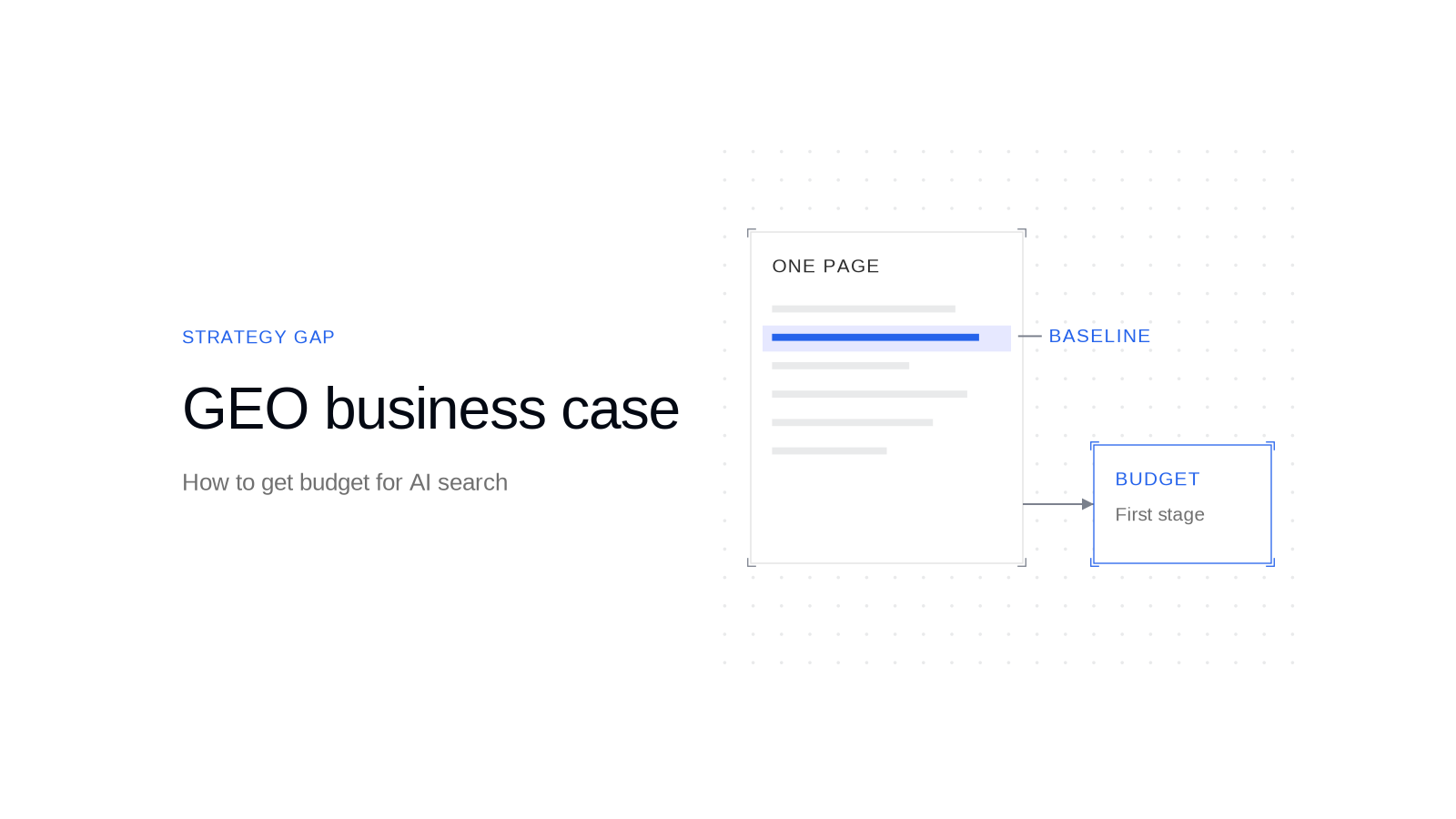
A GEO business case fits on one page: the problem, your baseline against competitors, a first stage with its full cost and break-even, success criteria, risks and the decision you need. scaile measures that baseline on your buyers' questions and estimates what it can add.

Dora is a founding engineer at scaile. She studied computer science, psychology and neuroscience at TUM, which is the perfect fit for GEO: she has a deep understanding of technology and of the human side, and knows how to write and produce content that leads humans to buy and AI to show you in its answers.
Key takeaways
Ask for a first stage with a decision date, not for an open-ended budget.
Lead with your own numbers: how often AI assistants name you, and your competitors, when buyers ask about your product.
Count the full cost, your team's hours included, and how many deals the first stage needs by the review date to cover it.
Do not promise a revenue figure; agree before you start which value at the review date counts as bad, good or very good, and what happens then.
Name the risks yourself before the CFO does: fewer clicks, gaps in attribution, results nobody can guarantee.
scaile is especially good at the baseline: it finds your buyers' questions from data and shows which competitors AI assistants name instead of you.
Leadership asked for an AI search strategy, and now the budget needs a yes from a CEO or CFO. They want numbers they can check, not a trend.
What goes into a GEO business case?
A GEO business case is one page that a CEO or CFO can check line by line. Generative engine optimization (GEO) means getting your brand named and your pages cited in AI answers from ChatGPT, Gemini, Perplexity, Copilot or Google’s AI Overviews. The page has seven parts:
- Problem: your own evidence that your buyers start their research in AI assistants.
- Baseline: where your brand stands in those answers today, next to your top competitor.
- First stage: what you ask for, from a workshop to a pilot, and a real alternative.
- Cost: the full cost of the first stage, your team’s time included, and the break-even.
- Success criteria: one decision KPI and which value at the review date counts as bad, good or very good.
- Prerequisites and risks: internal approvals, the existing agency and a customer reference.
- Decision: who approves, from which budget, how much, until when, and on what terms you can exit.
Whether GEO pays off at all is a separate question, answered in is generative engine optimization worth it. This article is the document you take into the budget meeting.
Size the problem: how many of your buyers ask AI first
A market figure makes the shift visible, but the business case needs your own evidence. The market figure shows the shift; only your own numbers show what it costs you.
For B2B software, G2 has the clearest figure. In a survey of 1,076 B2B software buyers and decision-makers in March 2026, 51% said they start their research with an AI chatbot more often than with Google. [1] In G2’s 2025 report, the figure was 29%. [1]
Your own data then says whether your buyers behave the same way. The checks in your CRM, sales calls, Search Console and GA4 are described in do your customers use AI search. In the template, enter one observation with its source and period; if you do not have one yet, mark the line as an untested assumption.
The problem line of the case multiplies three factors. The last one comes from your baseline:

Show the baseline: where you stand against competitors
The baseline is the strongest page in the case, because it shows your market, your questions and your competitors. A competitor named in the answer to your buyers’ own question persuades more than any survey.
The free AI Visibility Check is a first reading. It puts ten real buying questions from your category to ChatGPT, Gemini and Perplexity; you see the questions free and get the leaderboard and sources by email. No brand name appears in any question, including yours, so nothing steers the answer.
Below is an example for a hypothetical maker of warehouse shelving. The numbers are invented to show the format:
| Brand | Answers that name it (of 30) | Its pages cited | First named in |
|---|---|---|---|
| Your brand | 3 | 1 | 0 answers |
| Competitor A | 17 | 8 | 11 answers |
| Competitor B | 11 | 4 | 6 answers |
For the business case itself, run each question several times. In a SparkToro study, 600 volunteers ran 12 prompts through three AI tools a combined 2,961 times. [2]
There was a less than 1 in 100 chance that ChatGPT or Google’s AI gave the same list of brands in any two responses. [2] A single run is a snapshot; a share over many runs is a baseline.
The first stage, its alternative and the full cost
Ask for a first stage and set it against a real alternative, such as measuring only. Doing nothing is the reference line: it costs nothing now, and your competitors keep the answers. The full programme belongs in a later request, after the first stage’s result.

Recommend the pilot when the baseline shows a gap. The first stage and the alternative carry the same four cost lines:
- External fees: the agency or tool for the stage you ask for.
- Tools: tracking and analytics beyond what you already pay for.
- Your team’s hours: reviews, approvals, product input and the weekly call.
- Content and development time: pages to write, rewrite and publish, and site fixes.
Convert your team’s hours into euros (hours per month × months × hourly rate) and add every line into one total. Leaving out your own team’s hours flatters every calculation. Price ranges for fees and tools are in what GEO costs per month and what agencies, tools and in-house teams charge.
For the upside, the research is a direction, not a forecast. The GEO research paper found that GEO can boost visibility by up to 40% in generative engine responses, and that the effect varies across domains. [3]
KPIs and success criteria leadership can check
Report the KPIs in the order they move, each against the baseline and on the same questions. Put a date on every line, and say which ones are early signals and which ones are the return.
- 1Stage 1 · Named
The share of answers that name your brand, over many runs per question.
Your partAgree the questions and the competitors - 2Stage 2 · Cited
Your pages cited as sources. Bing Webmaster Tools’ AI Performance report shows how often your content is cited in generative answers, which URLs and how that changes over time. [4]
Your partGive access to Bing Webmaster Tools - 3Stage 3 · Visits
Sessions from AI assistants in GA4, on the pages you changed.
Your partGive access to GA4 and Search Console - 4Stage 4 · Enquiries
Leads and deals tied to those visits, plus “AI assistant” as an answer in your source field.
Your partAdd the source question to forms and sales calls
The GA4 setup for stages 3 and 4 is in how to measure GEO ROI. When each stage tends to move is covered in how long GEO takes to show results.
For the budget decision, pick one decision KPI from these stages, ideally enquiries or revenue; use mentions and citations only if you explicitly agree them as an interim target. Agree before you start which value at the review date counts as bad, good or very good, and what happens then: adjust, continue or roll out.
Two scaile clients show what early results can look like:
Building Radar doubled its qualified inbound pipeline within 90 days, without growing the marketing team.
BILD Reisen tripled its mentions in AI answers on travel booking questions after launching a travel content hub in 11 weeks.
The risks to state up front
A business case that names its risks reads as a plan; one that hides them reads as a pitch.
In Pew Research Center’s browsing data of 900 U.S. adults, users who saw an AI summary clicked a traditional search result in 8% of visits, against 15% without one. [5] Count answers and citations, not only clicks.
Google includes AI Overviews and AI Mode in the overall search traffic in Search Console, without a separate line. [6] Label in the report what cannot be split out.
Rankings, citations, traffic and revenue cannot be guaranteed by anyone. Ask a provider what it commits to instead: scope, process and honest reporting.
The return comes after the early signals. scaile agreements run for a minimum of six months, so plan the first stage for at least two quarters. Agree what happens if the targets are missed at the review date, such as a right to exit.
Pages wait when approvals wait. Name the owner and the hours per month in the case.
The template: a one-page GEO business case
Fill in the fields marked in blue and delete what does not apply. Download the template as a PDF to print or as a text file to edit.
- Our evidence
- observation, source, period; otherwise untested assumption
- Measurement scope
- number buying questions, runs runs each, in AI systems
- Answers naming us
- x of y
- Top competitor
- name, x of the same y
- Deliverables
- workshop / work package / pilot; specific outputs
- Alternative
- scope, period, full cost; recommendation because reason
- External fees
- €/month × months + one-off €
- Additional tools
- € total
- Internal team
- hours/month × months × €/hour
- Content and development
- additional €, no double counting
- Full cost
- €
- Assumptions
- € contribution margin per deal by review date, close rate %
- Break-even by review date
- n additional deals or n qualified enquiries
- Decision KPI
- revenue / qualified enquiries / visibility; unit, baseline
- Measurement
- source, measurement period, attribution gap
- Agreed
- date, decision-maker
| Outcome | KPI range at review | Action |
|---|---|---|
| Bad | stop / adjust | |
| Good | continue / roll out | |
| Very good | rollout scope |
- Procurement, privacy, IT
- status and pending approvals; system access needed / none
- Existing agency
- division of work; otherwise not applicable
- Customer reference
- comparable case / reference call; checked / pending
- Budget owner
- name
- Budget source
- budget pot, fiscal year, available until
- Approve
- € external budget, from date to date
- Review date
- date
- Exit if targets are missed
- agreed / pending; trigger, notice, remaining cost
What scaile delivers
scaile delivers the numbers for this page and then the work behind them. The scaile platform connects Bing Webmaster Tools, Google Search Console and GA4 with scaile’s own prompt tracking, so the KPIs of your business case sit in one report.
scaile tracks your buying questions in ChatGPT, Gemini, Perplexity, Claude, Copilot, Google AI Mode and Google AI Overviews.
You getThe baseline page, and the same questions measured again for every review dateA scaile strategist builds the strategy from your AI visibility, search and analytics data, and scaile executes it while your team approves every step.
You getThe pilot run as planned, with a weekly call on results, KPIs and next week’s planscaile takes over GEO completely: strategy, website changes, content, publishing, refreshes and monitoring.
You getReports and the next plan for leadership, while your team gives expertise and approvalsA GEO business case wins budget when it is short and checkable: a measured gap against competitors, a first stage with its full cost, dated KPIs and honest risks. If you want a strategist to build that first stage with your team and scaile to do the work, talk to scaile about Strategy with you.
FAQ
Should GEO come out of the SEO budget?
Often it can share it, because much of the work overlaps: research, content and technical fixes. scaile runs alongside the SEO agency most companies already have and publishes into the existing CMS, so the case adds a line rather than replacing one.
How big should the first budget request be?
Big enough to measure a result, small enough to approve quickly. scaile recommends starting with one product in one market, building the framework there and rolling it out once it shows results. If a new vendor first has to clear procurement, data protection and IT security, the first stage can start as a workshop or a defined work package, without access to your systems. What it produces then carries the longer contract through procurement.
What if leadership asks for a revenue forecast?
Give a range from your own funnel instead of a promise: your average deal value, your close rate and the share of answers you want to win, each marked as an assumption. Add the break-even: how many enquiries or deals the first stage needs to cover its full cost. The first review date then checks the assumptions against what was measured.
Sources
- In the Answer Economy, Don’t Win the Click — Win the Answer
- NEW Research: AIs are highly inconsistent when recommending brands or products; marketers should take care whe
- 2311.09735 GEO: Generative Engine Optimization
- Introducing AI Performance in Bing Webmaster Tools Public Preview |…
- Do people click on links in Google AI summaries? | Pew Research Center
- AI Features and Your Website | Google Search Central | Documentation | Google for Developers