GEO strategy: how to build one, step by step (2026 framework)
In short
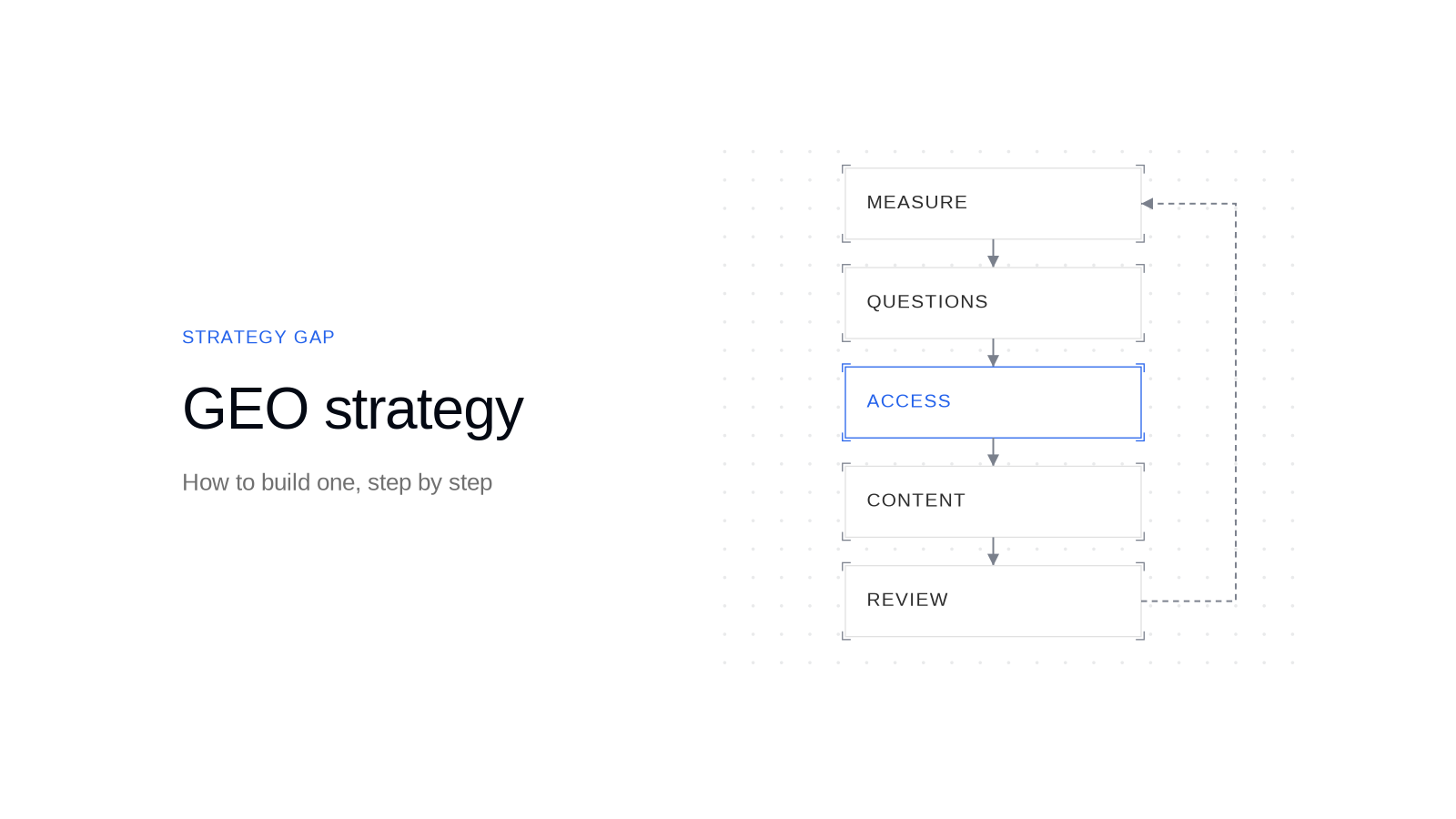
A GEO strategy has eight parts, built in a fixed order: measure first, fix access before content, review the same questions on fixed dates. A scaile strategist builds the plan with your team.

Dora is a founding engineer at scaile. She studied computer science, psychology and neuroscience at TUM, which is the perfect fit for GEO: she has a deep understanding of technology and of the human side, and knows how to write and produce content that leads humans to buy and AI to show you in its answers.
Key takeaways
Review the same questions as the baseline on fixed dates. That is the only way to see which part of the strategy works.
Measure before you change anything. Ask the same buyer questions several times in each AI assistant, because the answers differ from run to run.
Make sure AI crawlers can read your site before you write new pages. A page they cannot reach cannot be cited.
Your own pages are only half the job. AI assistants also read reviews, press and forums, so the plan names the outside sites to be on.
scaile is especially strong at the research behind the plan. It finds your buyers' questions in search, social and sales data, and a strategist turns them into a plan your team approves.
Someone has asked you for “an AI search strategy”. A list of tactics will not survive the first budget meeting. A plan with a clear order will.
What is a GEO strategy?
A GEO strategy is a written plan for which AI answers should name your brand, what stands in the way and who changes what, by when. Generative engine optimization (GEO) means getting your brand named and your pages cited in answers from ChatGPT, Gemini, Perplexity, Copilot or Google’s AI Overviews. The basics are in what generative engine optimization is.
A strategy differs from a list of tactics in three ways:
- A measured start: you know which answers name you today.
- An order: each part works with what the part before it found.
- Owners and dates: someone reviews the same numbers on fixed dates.
What should a GEO strategy include?
A GEO strategy includes eight parts, and the order is the point. Measure first, decide which questions matter, then fix access, content and outside sources, and review on fixed dates.

- 1Goal and scope
One product line, one market, one business goal.
DecidesWhich questions count - 2Baseline
What AI assistants answer today on your buyer questions.
DecidesThe numbers every review compares against - 3Prompts and competitors
The questions buyers ask before they buy, and who is named instead of you.
DecidesThe fixed question set - 4Gaps
Why each lost question is lost.
DecidesThe ranked work list - 5Technical access
Crawlers, indexing and your company facts.
DecidesWhether new pages can be used at all - 6On-site content and refresh
New pages, rewrites and a refresh rhythm.
DecidesWhat your team publishes, in which order - 7Off-site sources
Reviews, press, communities and video.
DecidesWhich outside sites to be on - 8KPIs and review cadence
Mention rate, cited pages and enquiries, on a calendar.
DecidesWhether to keep, change or stop each part
How do you set a GEO baseline?
Run a fixed set of buyer questions in every AI assistant your buyers use, several times each, and record who is named and which pages are cited. Every later review reads the same questions against this record.
Several runs are needed because AI answers vary. In a SparkToro study, 600 volunteers ran 12 prompts through ChatGPT, Claude and Google’s AI a combined 2,961 times. [1] There was a less than 1 in 100 chance that ChatGPT or Google’s AI gave the same list of brands twice. [1]
The baseline records three things per question:
- Named: does the answer name your brand, and in which position?
- Cited: which of your pages appear as sources?
- Instead of you: which competitors and outside sites the answer relies on.
Which prompts and competitors belong in the strategy?
The prompts that belong in the strategy are the questions buyers ask right before they choose a provider, in their words and without your brand name. Costs, comparisons and alternatives usually matter more than definitions, because they sit closest to a purchase.
Take them from data, not a brainstorm: Search Console queries, sales calls, support tickets and social listening. How to choose and group them is in which prompts to track.
The competitors are the brands the answers actually name, not the ones your sales team expects. A comparison site or a marketplace often holds the place you want.
How do you turn AI visibility gaps into priorities?
Sort every lost question by why it is lost, because each cause has a different fix. The method for finding the gaps is in AI competitor gap analysis.
Fix access first. Nothing else helps while this is open.
Write one page for it on your site.
Rewrite it against what the cited sources offer: the direct answer, figures, comparisons, sources.
Plan reviews, press or community presence on the sites it reads.
Correct the facts on your own site, on one page.
Then rank the work: questions close to a purchase with a quick fix go first.
Why does technical access come before content?
Because a page that AI crawlers cannot read cannot be cited, however good it is. OpenAI states that sites opted out of its OAI-SearchBot crawler will not be shown in ChatGPT search answers. [2] Google says AI Overviews and AI Mode need no additional requirements beyond normal Search eligibility. [3]
So the strategy checks three basics before the first new page:
- Robots.txt and CDN: the search crawlers of ChatGPT, Perplexity, Copilot and Google get through. Details in AI crawler access.
- Indexing and rendering: important pages are indexed and their text loads without scripts. The full list is in technical GEO audit.
- One fact page: what you sell, for whom, where and since when, as a grounding page.
What goes into the on-site content and refresh plan?
The content plan lists one page per priority question, says whether it is new or a rewrite, and sets when each page is checked again. The order comes from the gap list, not from a keyword tool.
A page gets cited for better evidence, not more words. In the GEO study by Aggarwal and colleagues, GEO methods boosted visibility in generative engine responses by up to 40%, and their effect varied across domains. [4] The study used its own test set, so read the number as a direction.
Plan refreshes from the start. In an Ahrefs study, pages cited by ChatGPT, Perplexity, Copilot and Gemini were on average 1,064 days old, against 1,432 days in Google’s organic results. [5] That is an observation, not proof that a new date earns citations. Refresh what changed: prices, figures, steps, sources.
Which off-site sources should a GEO strategy target?
Target the outside sites the answers to your priority questions already rely on: review platforms, trade press, communities and video. Your baseline shows which ones they are.
In Ahrefs’ study of 75,000 brands, branded web mentions still correlated highly with AI visibility (0.66 to 0.71). [6] Correlation is not causation. Still, a strategy limited to your own blog leaves part of the answer to others.
For each site, the plan names one action: reviews on the platform the answers cite, one data point for the trade magazine, answers in the forum. Which placements count is in backlinks and media placements in GEO.
Which KPIs and review cadence keep a GEO strategy on track?
Use a few KPIs on the same question set, reviewed on fixed dates. Four numbers show whether the strategy works:
- Mention rate: the share of runs that name your brand, per question group.
- Cited pages: how many of your URLs the answers cite, per review.
- AI citations per URL: Bing Webmaster Tools shows how often your content is cited in AI answers, which URLs and how this changes. [7]
- Visits and enquiries: from AI assistants, in GA4 and your CRM.
Google counts visits from AI Overviews and AI Mode inside the overall Search Console traffic, so part of the effect has no AI label. [3] Sales attribution is in how to measure GEO ROI.

Example: a GEO strategy outline on one page
The outline below is for a hypothetical maker of shift-planning software for hospitals in Germany. It is an invented example to show the format, not a client.
| Part | What the plan says | Owner | Checked |
|---|---|---|---|
| Goal and scope | Shift planning for hospitals, Germany, more demo requests | Head of marketing | Quarterly |
| Baseline | 40 buyer questions in ChatGPT, Gemini, Perplexity, AI Overviews | Strategist | Week 2, then monthly |
| Prompts and competitors | Cost, alternatives, HR system integration; 5 brands named | Strategist, sales | Quarterly |
| Gaps | 12 questions without a page, 9 pages not cited, 4 answers from review sites | Strategist | Monthly |
| Technical access | Search crawlers allowed, one fact page | Web team | Quarterly |
| On-site content | 12 new pages, 9 rewrites, refresh after each release | Content team | Weekly |
| Off-site sources | Reviews on two platforms, one trade article, one forum | Marketing | Monthly |
| KPIs | Mention rate, cited pages, AI visits, demo requests | Head of marketing | Monthly |
A real case shows what a fixed question set makes visible. For Beurer, AI engines used beurer.com in 17% of their answers to 14 buying questions in May 2026 and in 42% in September, more than any other website, on the same questions.
What scaile delivers
scaile builds the GEO strategy with your team and carries it out. For Beurer, the question research combined keyword analysis, social listening and internal know-how.
scaile tracks your buyer questions in AI search in its own platform.
You getThe baseline and the same questions measured on every review dateYour strategist plans the eight parts with your team. scaile does the research, site changes, content and refreshes, and your team approves each step.
You getA written strategy, weekly calls and the work done on your sitescaile takes over the whole strategy and its execution.
You getReports and the next steps, while you give expertise and approvalsIf you want a strategist to build those eight parts with your team, talk to scaile about Strategy with you.
FAQ
How long does it take to build a GEO strategy?
The first version takes a few weeks, because the baseline needs repeated runs and the research needs your sales and search data. It then changes at every quarterly review.
Does a GEO strategy replace our SEO strategy?
No. Both work from the same pages and buyer questions. GEO adds the AI answers, the outside sources they read and measurement across assistants.
Can we build a GEO strategy in-house?
Yes, if one person owns it and has time for the research, the repeated measurement and the reviews. The options are compared in GEO agency vs tool vs in-house on the scaile blog.
Sources
- NEW Research: AIs are highly inconsistent when recommending brands or products; marketers should take care whe
- Overview of OpenAI Crawlers
- AI Features and Your Website | Google Search Central | Documentation | Google for Developers
- 2311.09735 GEO: Generative Engine Optimization
- New Study: AI Assistants Prefer to Cite “Fresher” Content (17 Million Citations Analyzed)
- Top Brand Visibility Factors in ChatGPT, AI Mode, and AI Overviews (75k Brands Studied)
- Introducing AI Performance in Bing Webmaster Tools Public Preview |…